

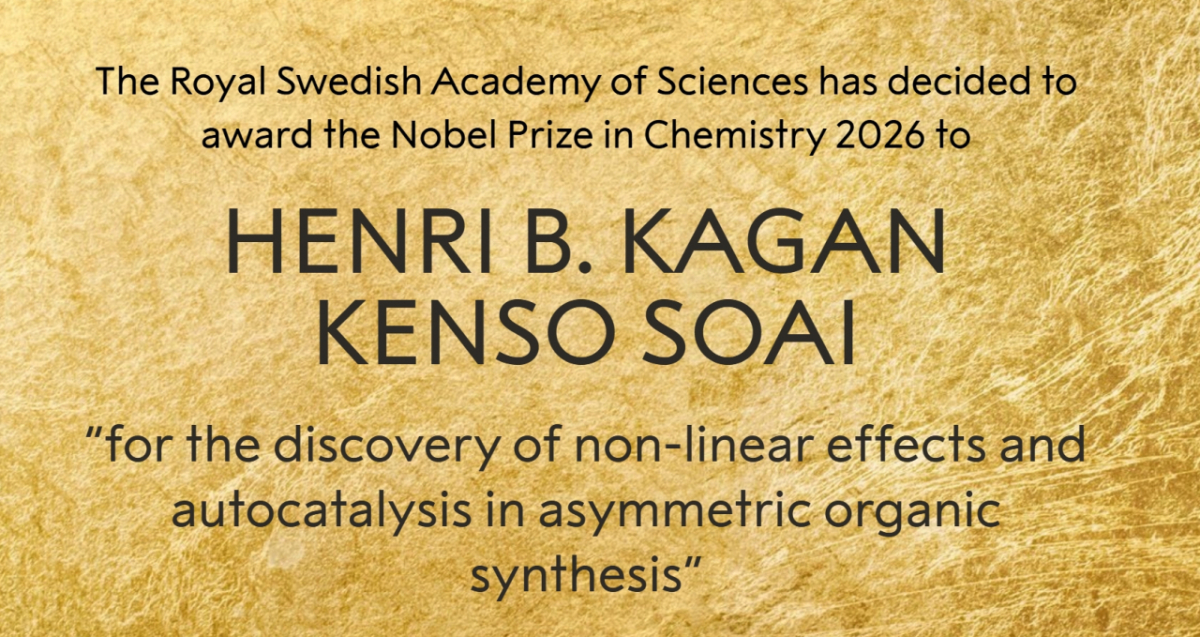
The 2026 Nobel Prize in Chemistry was awarded to Henri Kagan, an emeritus professor at Paris-Sud University in France, and Kenso Soai, an emeritus professor at Tokyo University of Science, for elucidating the phenomenon of 'mirror-image isomers' (chirality).
Mirror-image isomers refer to pairs of molecules that face each other like reflections in a mirror but do not overlap. In living organisms on Earth, even if these two variants have identical chemical structures, they bind differently to enzymes and receptors. It is reported that while one variant may be effective as a drug, the other may be ineffective or cause side effects. Professor Kagan and So A-i (Prof.) were recognized for their contribution to elucidating this reason.
On the 7th (local time), the Nobel Committee of the Royal Swedish Academy of Sciences selected Professor Kagan and So A-i (Prof.) as the recipients of this year's Nobel Prize in Chemistry. The Nobel Committee stated that they were selected "for their discovery of nonlinear effects and autocatalysis in asymmetric organic synthesis."
Professor Kagan is recognized for proposing the concept of the nonlinear effect in such catalytic reactions, establishing a theoretical framework explaining "under what conditions a small left-right imbalance can be amplified."
So A-i (Prof.) was the first to prove the 'Soai reaction,' in which adding a trace amount of an asymmetric substance exponentially amplifies only one of the mirror-image isomers. This research provided clues for elucidating the properties of biomolecules, such as amino acids found in early life on Earth and in space.

 in TECH
