

DeepNoid will expand its medical AI research scope from chest imaging to brain MRI and pathology.
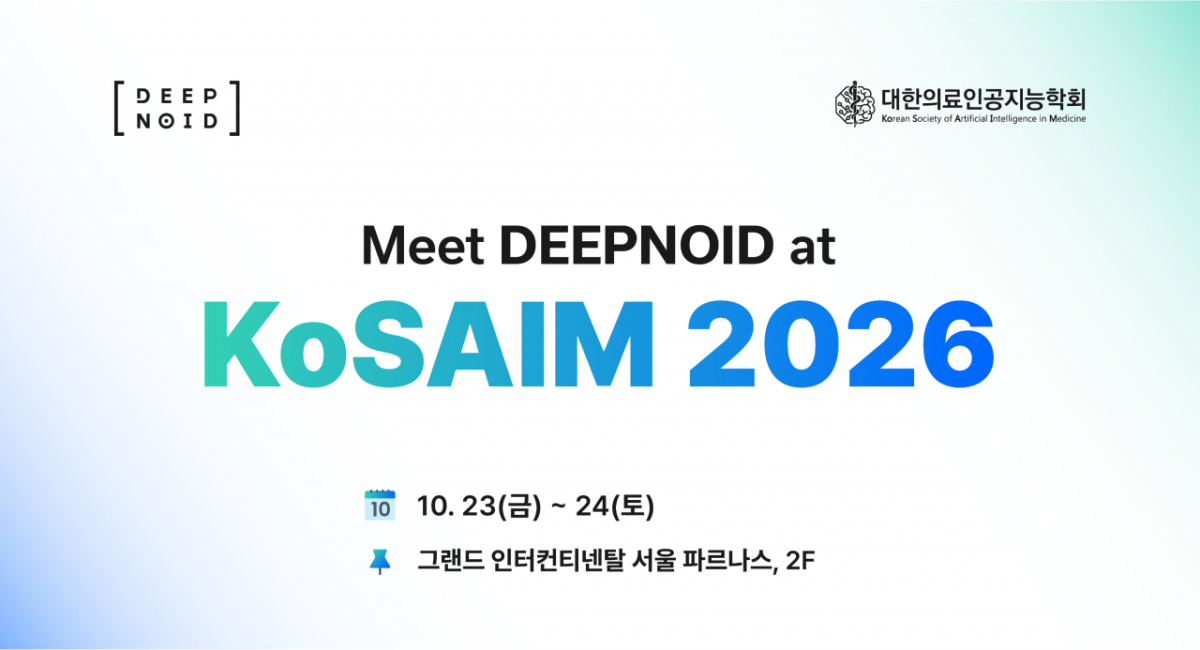
On the 20th, DeepNoid announced that seven research abstracts by its in-house research team were accepted for presentation at the regular academic conference of the Korean Society for Artificial Intelligence in Medicine (KoSAIM), 'KoSAIM 2026.' The conference will be held on the 23rd and 24th at the Grand InterContinental Seoul Parnas.
The accepted studies consist of one oral presentation and six poster presentations. They center on technologies that integrate AI into medical professionals' diagnostic reading and examination processes to improve accuracy and consistency while reducing workload.
The oral presentation will unveil 'GLINT,' a vision-language AI technology. It is a technique that learns by linking sentences in diagnostic reports with the corresponding areas in chest X-ray and CT images. Without separate location annotation data, it can identify abnormal findings and simultaneously display their locations on the images.
DeepNoid plans to utilize GLINT as a foundational technology to enhance the diagnostic performance and explainability of its generative AI-based chest X-ray reading solution, 'M4CXR,' and CT-related technologies.
In the field of brain MRI, the company will present research that improves the segmentation performance of white matter hyperintensity (WMH) lesions using a foundation model. This serves as a foundational technology that can be expanded into products related to degenerative brain diseases in the future.
In the pathology field, DeepNoid will showcase a technology that predicts microsatellite instability (MSI), an indicator for immunotherapy in colorectal and gastric cancers, using only standard stained slides. The company will also present 'SheafStain,' a virtual staining technology that converts standard stained images into immunohistochemistry (IHC) stained images, and 'STREAM,' research focused on generating high-quality images for pathology training.
In the field of cytopathology, studies predicting BRAF gene mutations using thyroid cytology images and determining the malignancy of bladder cancer in urine cytology tests were accepted.
At the academic conference venue, DeepNoid will also demonstrate 'M4CXR,' its brain aneurysm diagnostic assistance solution 'DEEP:NEURO,' and its brain MRI quantitative analysis solution 'DeepNeuro BrainSeg.'
Choi Woo-sik, CEO of DeepNoid, stated, "We will connect our research outcomes not only to product advancement but also to services that support the entire diagnostic workflow, moving forward as an agent AI-based medical service company."

 in TECH
