

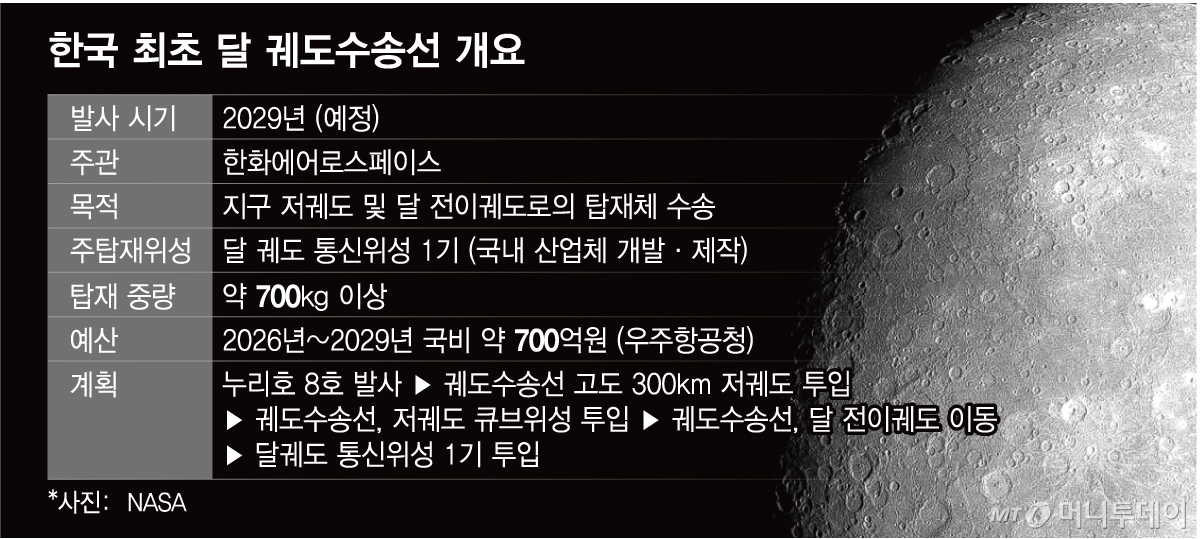
As Korea aims to launch its first lunar orbital transporter in 2029, the eighth Nuri rocket mission will be led by industry players from the launch vehicle itself to the primary payload satellite. It is expected to mark a turning point where domestic aerospace R&D (research and development) shifts significantly from state-led to private-sector-led.
Hanwha Aerospace, which will lead the design and development of Korea's first orbital transporter, is responsible for the manufacturing and development of the 'Korean-made launch vehicle' Nuri. After being selected as the system integrator for Nuri in 2022, it has been transferring core launch vehicle technologies and equipment from the Korea Aerospace Research Institute (hereafter KARI). In the fifth Nuri launch conducted on the 7th, the company supplied major components, including a 75-tonne liquid engine, and also participated directly in launch control and operations. It is also the system integrator for the 'Next-Generation Launch Vehicle Development Project,' which aims to develop reusable launch vehicles in the 2030s.
Hanwha Aerospace's participation rate in Nuri missions is expected to increase with each successive launch after 2027. Oh Tae-seok Woo Ju-hang-gong (Commissioner) stated immediately after the success of the fifth Nuri launch, "We plan to conduct at least one Nuri launch per year until 2032, and through this, transition to a private-sector-led commercial launch system."
In particular, assessments suggest that 2029 will be a turning point where the space industry shifts from state-led to private-sector-led. This is because it will be the first year in which a private company develops and launches everything from the launch vehicle to the core payload, the orbital transporter.
Additionally, the Space Agency plans to entrust one lunar orbit communication satellite to be carried by the orbital transporter to a private operator. A lunar orbit communication satellite is a 500-kilogram-class communication satellite that demonstrates communication and navigation technology between the Moon and Earth while in lunar orbit.
Korea previously launched the lunar orbiter 'Danuri' in 2022, at which time development was led by KARI, a national research institution. Private entities such as Korea Aerospace Industries (KAI), AP Satellite, and Satrec Initiative participated in forms involving the main body structure, payload computers, and software development. In contrast, the lunar orbit communication satellite to be sent in 2029 is expected to be led by the private sector from the development of the main body system.
A source at the Space Agency's Aerospace Mission Headquarters said, "There are many domestic companies possessing excellent space optical communication technology and lunar exploration infrastructure construction technology, and there is an urgent need for demonstration opportunities in space," adding, "We expect the lunar orbit communication satellite development project to be a good opportunity."
The lunar orbit communication satellite development project was included in the Space Agency's 2027 budget proposal alongside the orbital transporter development project. The Space Agency plans to launch a business operator bidding process immediately upon budget confirmation.
However, experts believe that for it to be 'New Space' in the true sense, the private sector must be able to build independent revenue models in the space market. They argue that the current structure, which relies mostly on national R&D investment and government demand, has clear limitations.
According to the "Strategy for Building a National Space Innovation System for Entering the Top Five Space Powers" published last year by the Science and Technology Policy Institute (STEPI), Korea remains at 'Stage 2 of the National Space Innovation System,' where the government's investment ratio is high and the private sector cooperates in part. Stage 2 involves the government sharing funds, technology, and infrastructure needed for space development with the private sector to promote private technological innovation.
A system where public-private joint investment occurs substantially is considered Stage 3, which applies to Japan, Germany, and France. The highest level, Stage 4, is characterized by prior private self-investment, with the government purchasing aerospace services produced by the private sector. The United States, where commercial activities in the space field are active among companies such as SpaceX and Blue Origin, is a representative example.
A senior official at the Space Agency responded to this by saying, "For companies to actively invest, sufficient volume must be supported; when it becomes possible to mass-launch hundreds of small satellites, like a low-orbit communication satellite network, an investment flow among private companies will naturally form." Nevertheless, they added, "At the current point in time, demand across the entire space market is insufficient, so I believe it is a period when the government must take active action."

 in TECH
