

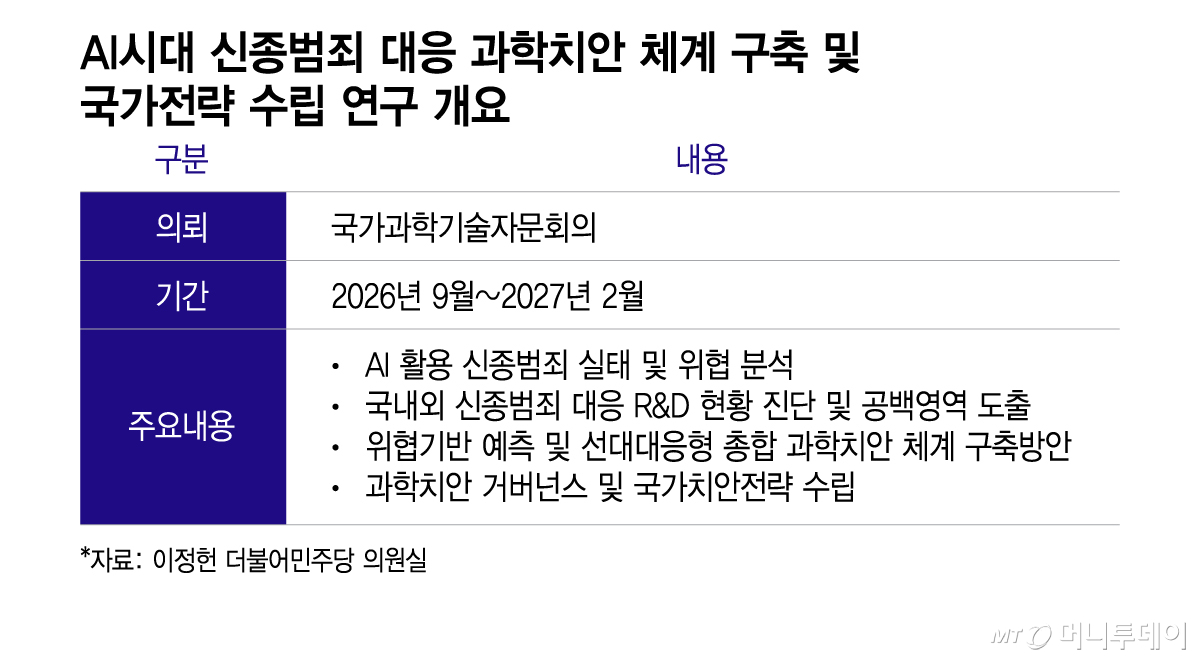
The government has begun developing a national-level strategy to respond to the increase in new types of crime that exploit artificial intelligence (AI). This measure follows the rapid rise in various crimes, including the evolution of existing fraud and financial crimes through AI, personal information infringements (hacking), deepfakes, social media-based scams, and new types of spam.
According to Democratic Party of Korea lawmaker Lee Jung-hun’s office and the National Police Agency on the 26th, the Presidential Council for Science, Technology and Innovation began a commission last month through the Ministry of Science and ICT titled “Research on Building a Scientific Public Safety System and Formulating National Strategies to Address New Types of Crime in the AI Era.”
Through its task directive, the Presidential Council for Science, Technology and Innovation stated that “crime methods such as AI-generated content and SNS-based new scams are evolving and surging,” and explained the research background by noting that “victims are concentrated among children, adolescents, and the elderly, and it is difficult to ensure safety that citizens can feel using existing public safety methods.”
The goal of this research is to analyze the current status of new types of crime by category and the state of victimization among vulnerable groups following the emergence of generative AI, including deepfakes, voice phishing, and drug trafficking on the dark web, and to identify policy gaps through this analysis. It also plans to compare and analyze cases from major foreign countries to develop measures for building a domestic scientific public safety system. Recent successive personal information infringement incidents via AI are also expected to fall within the scope of the research. The police and the Presidential Council for Science, Technology and Innovation plan to complete the research commission by February 2027 and formulate a national-level strategy for responding to AI crimes. They intend to clarify the ambiguous criteria among crime response agencies and create cross-ministerial response measures.
Lawmaker Lee Jung-hun stated, “As new types of crime exploiting AI technology, such as deepfakes, voice phishing, and drug trafficking, are diversifying, a proactive response system commensurate with technological development must be established.” He added, “By meticulously analyzing response cases from major foreign countries, a national-level scientific public safety strategy encompassing everything from crime prevention to investigation and victim protection should be formulated.”

 in TECH
