

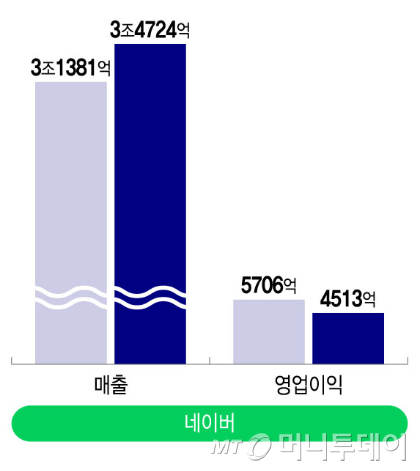
Naver said Thursday that it recorded revenue of 3.4724 trillion won and an operating profit of 451.3 billion won in the third quarter this year. While revenue increased by 10.7% year-on-year, driven by growth in commerce, financial services, and global C2C businesses, operating profit decreased by 20.9% due to expanded AI investments in infrastructure, content, and offline data.
Revenue by segment was 1.9484 trillion won for the Naver Platform, 487.7 billion won for the Financial Platform, and 1.036 trillion won for Global Challenges, representing increases of 7.3%, 14.1%, and 15.9%, respectively.
Naver Platform service revenue increased by 13.1% as users of Naver Plus Store and membership services grew and N Delivery was strengthened. Q3 Npay payment volume reached 26.2 trillion won, a 15.6% increase, while external payment volume rose by 21.8%.
Naver Financial aims to become the domestic leader in active terminals by the first half of next year based on terminal standards, by expanding its offline integrated terminal 'Npay Connect.' The Global Challenges segment was driven by the inclusion of Wallapop, growth in C2C businesses such as Poshmark and Soda, and Saudi Arabia's digital twin project.
The AI business is expected to contribute significantly to revenue starting next year. Naver CEO Choi Soo-yeon said during the earnings announcement conference call on Thursday, "We have signed a 2 trillion won computing service supply contract with a U.S. AI inference company, including next-generation GPUs (Graphics Processing Units), completing customer acquisition for initial volumes next year."
These customers are the initial clients for the AI Factory project being pursued with Brookfield and NVIDIA.
Choi said, "Revenue is expected to be generated sequentially alongside the launch of commercial services in the first half of next year," adding that the company will pursue long-term contracts with major customers and expand its customer base to global AI companies in parallel to reduce dependence on specific clients.
Following AI Briefing and AI Tab, Naver will also launch a personal AI agent app by the end of this year. The plan is to connect not only information search and recommendations but also actual purchases, visits, and task execution.
Choi said, "The flow connecting shopping and local services from AI Tab has nearly doubled compared to the early launch period, and actual transaction volume is growing accordingly," adding, "We are preparing a new personal AI agent app that performs actual tasks on behalf of users."
To strengthen commerce competitiveness, Naver will establish a logistics-specialized subsidiary. The strategy involves expanding delivery infrastructure centered around leased logistics centers.
Choi stated, "Investments of nearly 1 trillion won are expected to be required by 2030," while noting that the design will limit the impact on cash flow and profitability through appropriate financing methods and revenue structures. Center operations and delivery will be conducted in cooperation with existing partners. Naver will handle system, data, and infrastructure design.
Naver launched 'Ballady Plus,' a map-based lifestyle service, as a beta version across Saudi Arabia last October. Choi described it as "the first super app introduced overseas." In the capital Riyadh, preparations are underway for an outdoor delivery robot service, targeting launch in the first half of next year.
The timing for results to materialize is mostly next year. AI Factory revenue will be reflected sequentially starting from the first half of next year. The Riyadh delivery robot also targets the first half of next year. Although operating profit decreased this quarter, the structure involves investments leading and revenue following.

 in TECH
