

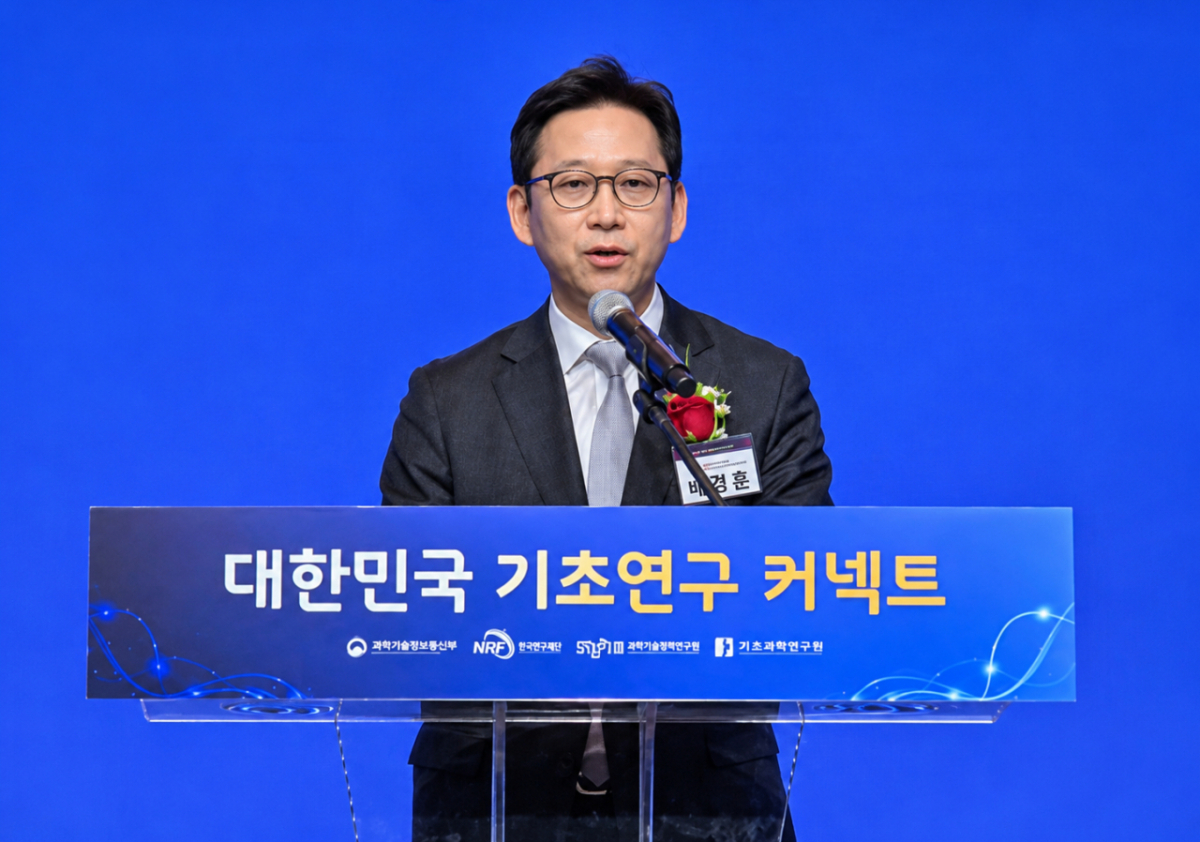
Deputy Prime Minister and Minister of Science and ICT Bae Kyung-hoon revealed his concerns about future education, prompted by recent controversies over cheating with AI (artificial intelligence) glasses surrounding the CSAT and professional qualification exams. He also emphasized the need to expand support for basic research to foster creative and logical thinking skills.
At a welcome address for the "Korea Basic Research Connect" eventat Conrad Seoul in Yeongdeungpo-gu, Seoul, on Friday, Bae said, "The CSAT was held yesterday. The Ministry of Education had been preparing in various ways, but there were shortcomings, so it seems I did not sleep well for about two days while the Ministry of Science and ICT provided various forms of support."
He continued, "Seeing recent cheating incidents related to the CSAT and AI glasses has made me think even more about how we should raise our children in the future," adding, "I have come to believe that we must create many opportunities for our children to engage in more creative and logical thinking."
He stated, "The role of basic science researchers present here is even more important," emphasizing, "It has been a week during which I came to strongly believe that it is crucial to invest more budget in basic research so as to encourage our children to actively participate in logical and creative research and work, and to create such platforms."
Minister Bae also presented three policy directions for the qualitative growth of the basic research ecosystem: expanding support for challenging research, innovating research management to suit the AI era, and globalizing the research support system.
He said, "To cultivate potential innovative capabilities to respond to unpredictable future changes, we will strengthen support for diverse and challenging research," adding, "We will expand research opportunities for young emerging researchers, establish research hubs by regional university and field, and actively support regional researchers."
In particular, he foreshadowed a major overhaul of the research performance evaluation system. Deputy Prime Minister Bae stated, "In an era where AI solves academic challenges, we will completely abolish quantitative evaluations centered on papers and patents and accelerate the transition to quality-based performance evaluation," emphasizing, "To verify whether government budgets are properly supporting excellent researchers in producing uninterrupted research outcomes, we will also strengthen verification of research support methods based on data analysis."
He also pledged to expand international research cooperation. Deputy Prime Minister Bae said, "We will globalize the research support system so that our outstanding researchers can actively engage on the world stage," adding, "We will improve the system by expanding the pool of overseas expert evaluators and increasing English-language evaluations, enabling free collaboration with overseas researchers and the production of internationally recognized outcomes."

 in TECH
