

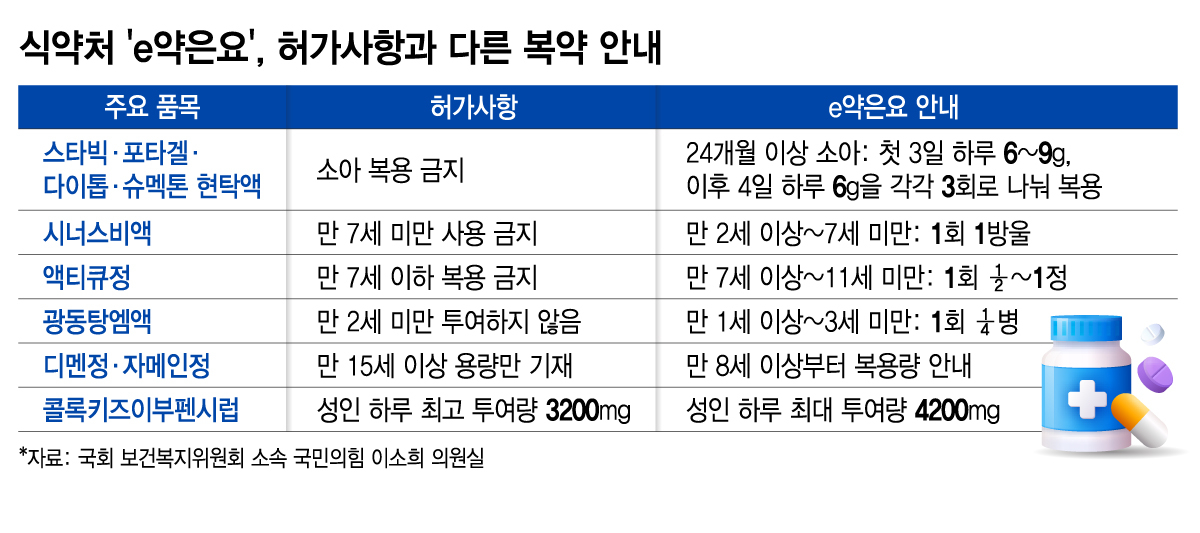
It was revealed that the Ministry of Food and Drug Safety’s public medication information service, ‘e-Drug Info,’ continues to provide pediatric dosage instructions for antidiarrheal drugs whose use in children has been prohibited. The guidance has not been updated more than three months after the approved terms were modified. Cases were also confirmed where the service provided usage ages and dosages for children that differed from the approved terms for nasal sprays, cold medicines, and other products.
According to documents prepared by the office of People Power Party lawmaker Lee So-hui (Rep.), a member of the National Assembly’s Health and Welfare Committee, on the 12th, which compared ‘e-Drug Info’ data from the Drug Safety Korea portal with approved terms, pediatric dosages remained listed for four products containing smectite: Daewoong Pharmaceutical’s ‘Stavix Suspension,’ Daewon Pharmaceutical’s ‘Potagel Suspension,’ Samah Pharmaceutical’s ‘Daitop Suspension,’ and Ilyang Pharmaceutical’s ‘Smectone Suspension.’
The Ministry of Food and Drug Safety modified the approved terms for these products on July 6, prohibiting their use in children. The precautions currently posted on Drug Safety Korea state that “the following persons must not take this medicine,” with “children” listed as the first category.
However, the ‘e-Drug Info’ section at the top of the same product pages still contains the description: “Used for acute diarrhea in children aged 24 months and older.” The administration instructions state: “Children aged 24 months and older should take 6 to 9 g per day divided into three doses for three days, followed by 6 g per day divided into three doses for four days.” The precautions limited the contraindication to “children under 24 months of age.” The expanded contraindication covering all children had not been reflected.
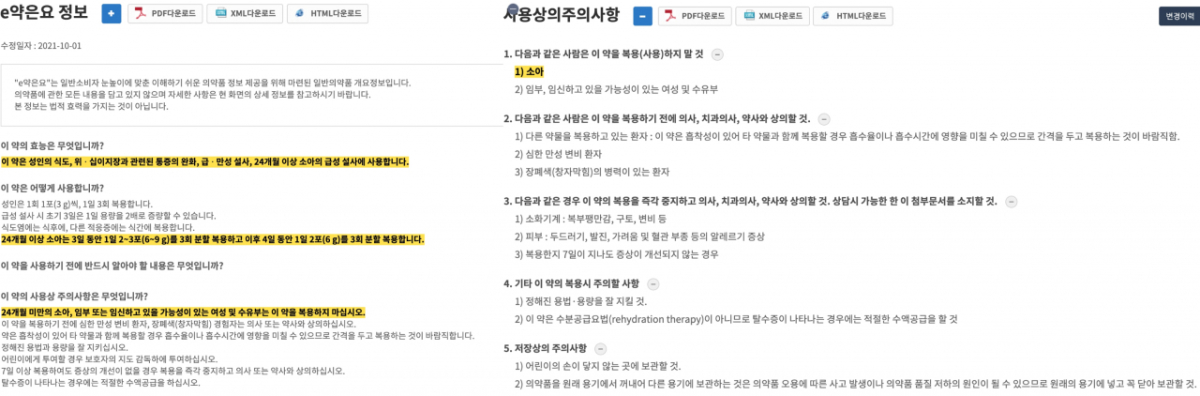
Conflicting guidance has remained posted side by side for more than three months since the modification of the approved terms. The last update dates shown on ‘e-Drug Info’ are October 1, 2021, for Stavix, and January 29, 2021, for Daitop and Smectone. Potagel was updated on June 9 this year, but the subsequent change prohibiting pediatric use was not reflected.
‘e-Drug Info’ is general over-the-counter drug summary information designed to help ordinary consumers easily understand medication details. It explains efficacy, administration methods, and precautions in a question-and-answer format, addressing queries such as “What are the effects of this medicine?” and “How do I use this medicine?” Critics point out that because this guidance provides easy-to-access information for consumers who find professional approval documents difficult to read, discrepancies with the latest approved terms can cause confusion.
Cases where usage ages for children were incorrectly guided were also found in other over-the-counter drugs. Hanlim Pharmaceutical’s nasal spray ‘Sinusbi Liquid’ is prohibited from use by those under 7 years of age according to its approved terms, but ‘e-Drug Info’ lists dosages for those aged 2 to under 7 years. KwanDong Pharmaceutical’s ‘KwanDong Tang M Liquid’ states in its approved terms that it should not be administered to those under 2 years of age, yet ‘e-Drug Info’ instructs taking one-quarter bottle per dose for those aged 1 to under 3 years. The last update date for this product on ‘e-Drug Info’ was the 16th of last month.
Some products still listed pediatric dosages on ‘e-Drug Info’ even though they were omitted from the approved dosage and administration instructions. Cold medicines such as ‘Shinhanbang Hwa Col Capsules’ and ‘Outcol Mok Gold Capsules,’ and motion sickness medications such as ‘Dimen Tablets’ and ‘Zamein Tablets,’ list dosages only for those aged 15 years and older in their approved terms, but ‘e-Drug Info’ provides dosages for younger age groups.
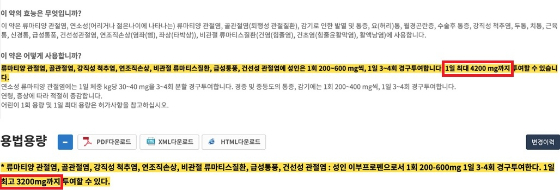
Cases of incorrect guidance regarding dosages or formulations were also confirmed. The ‘e-Drug Info’ entry for Green Cross’s ‘Coloc Kids Ibuprofen Syrup’ lists the maximum daily dose for adults as 4,200 mg, which is 1,000 mg higher than the approved maximum daily dose of 3,200 mg. Daewon Pharmaceutical’s ‘Cold Daewon Kids Cold S Syrup’ is a liquid product, yet the first sentence of its administration instructions on ‘e-Drug Info’ reads: “Adults take 2 tablets per dose, children take 1 tablet per dose.” A tablet unit was included in the administration guidance for a syrup.
The office’s documents also included cases where contraindications related to pregnancy were not adequately communicated. Antidiarrheal drugs containing nifuroxazide, such as ‘Shagen Capsules,’ ‘Rephiz Capsules,’ and ‘Enterpol Capsules,’ are prohibited for use by pregnant women and women of childbearing age according to their approved terms, but ‘e-Drug Info’ presented this only as a recommendation to consult a professional. The warning prohibiting use by pregnant women and children under 2 years of age was missing from the entry for ‘Tressorix Forte Capsules.’
The ‘e-Drug Info’ screen displays a statement that it does not contain all drug information, advising users to refer to detailed information, along with the note: “This information has no legal effect.” However, since the service provides specific guidance on target users and dosages, providing information that differs from approved terms could lead consumers to make incorrect medication decisions.
In 2020, the Ministry of Food and Drug Safety promoted its intention to widely utilize this service through private applications. The number of API utilization applications submitted by the office is 5,506. Since information provided by Drug Safety Korea can be used in external services, there are calls for ensuring the accuracy of source data and managing updates.
Lawmaker Lee So-hui (Rep.) stated, “The Ministry of Food and Drug Safety changed four antidiarrheal drugs to prohibit pediatric use three months ago, yet ‘e-Drug Info,’ which is viewed by the public, still provides dosages for children.” The lawmaker added, “People may not even realize that these medicines should not be given to their children. This is not ‘e-Drug Info’; it is ‘e-Don’t Know.’”
The lawmaker continued, “The service created by the Ministry of Food and Drug Safety to reduce information asymmetry is actually providing incorrect medication information, such as listing the maximum daily dose for adults for antipyretic analgesics as 1,000 mg higher than approved.” The lawmaker emphasized, “I will question this issue during this National Assembly audit and demand institutional improvements to correct the problem by cross-checking all of ‘e-Drug Info’ against the latest approved terms.”

 in THEBIO


