

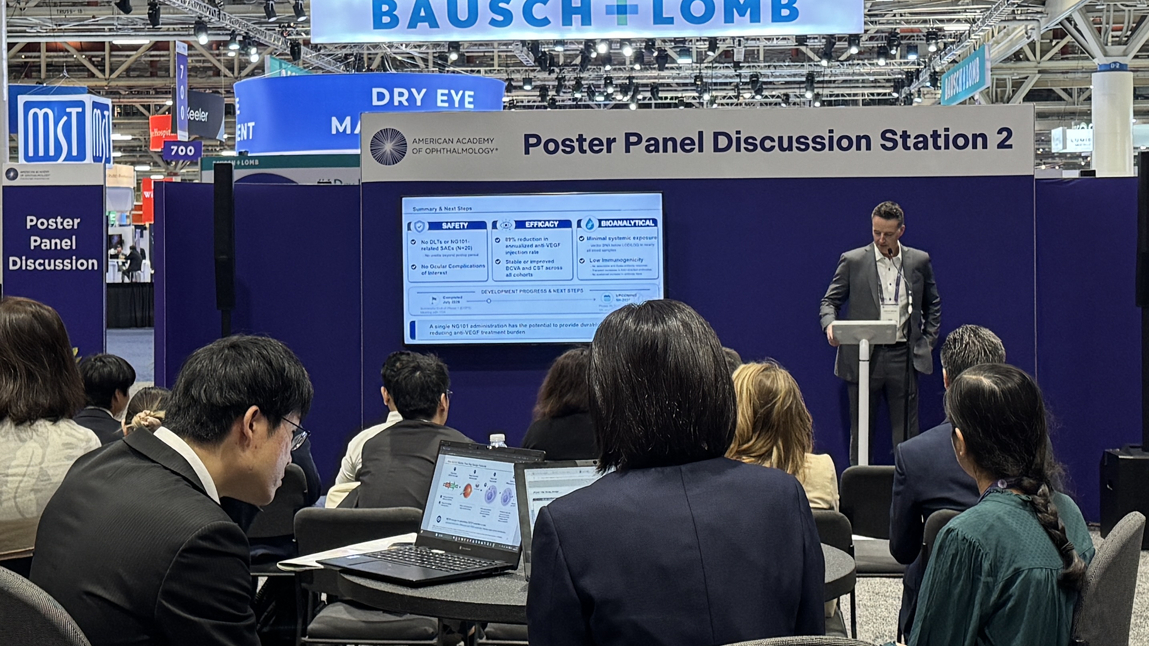
Lee Yeon Pharmaceutical announced on the 13th that its partner, Eligen, presented the 24th-week results for the high-dose group (Cohort 3) in the Phase 1/2a trial of 'NG101', a gene therapy for wet age-related macular degeneration, at the American Academy of Ophthalmology (AAO), the world's largest ophthalmology academic conference.
Lee Yeon Pharmaceutical is Eligen's largest shareholder and is responsible for the joint research and development, as well as global production and supply, of NG101. Once NG101 enters the commercialization stage, it is planned to be produced through the state-of-the-art GMP (Good Manufacturing Practice) facilities at Lee Yeon Pharmaceutical's Chungju plant and supplied exclusively to markets worldwide.
The AAO is a forum where ophthalmologists, pharmaceutical and biotech companies, and investors participate to discuss recent new drug development status, clinical trial results, and the latest treatment trends. This year's event was held in New Orleans, Louisiana, USA, from the 9th to the 12th (local time).
At this conference, the NG101 clinical results were presented by Robert A. Sisk, a retinal specialist at the Cincinnati Eye Institute and a An Gwa-hak (Prof.) at the University of Cincinnati. Dr. Sisk has clinical and research experience in the fields of retinal diseases and gene therapy. He has participated in various clinical trials for hereditary retinal diseases and gene therapy. He served as the principal investigator (PI) and surgeon in Eligen's Phase 1/2a trial of NG101.
The Phase 1/2a trial of NG101 was conducted on a total of 20 patients with actual wet age-related macular degeneration. Patients were divided into a low-dose group (6 patients), a medium-dose group (6 patients), and a high-dose group (8 patients) based on the administered dosage. Following the presentation of 52-week results for the low-dose group at the Association for Research in Vision and Ophthalmology (ARVO 2026) in May, Eligen presented 52-week results for the low-dose group and 44-week results for the medium-dose group at the American Society of Retina Specialists (ASRS) in July. At this AAO, they presented 52-week long-term observation results for the low- and medium-dose groups, as well as 24-week data for the high-dose group.
According to Eligen's presentation, NG101 demonstrated consistent therapeutic efficacy by reducing the number of anti-VEGF injections by approximately 90% after administration across all dose groups. The medium-dose group showed an 89% reduction in the number of injections compared to pre-treatment based on 52-week observation results. The high-dose group also confirmed relatively superior efficacy, requiring an average of only 0.5 injections per patient over the 24th weeks following administration.
In particular, wet age-related macular degeneration is a degenerative disease, and maintaining vision without loss alone is considered a successful treatment outcome. NG101 has already achieved its primary goal of vision maintenance in the low- and medium-dose groups. Furthermore, it demonstrated an excellent therapeutic effect of improving vision by 8 letters (8 letters) in the high-dose group.
An improvement of 8 letters means that, based on the standard visual acuity chart (ETDRS chart), patients can read 8 more letters than before. This signifies an improvement of 20 to 30% compared to previous vision. In the field of ophthalmic clinical trials, a significant improvement in visual acuity is typically judged when it reaches 5 letters or more.
A Lee Yeon Pharmaceutical official explained, "Unlike existing standard treatments that require patients to receive continuous and cumbersome eye injections up to 10 times per year for life, NG101 aims for therapeutic effects lasting at least one year or several years with a single administration." The official added, "Furthermore, it has demonstrated excellent vision improvement results, earning high clinical value recognition from relevant academic societies and business partners."
NG101 also confirmed safety in the Phase 1/2a trial. In the clinical trial, it demonstrated excellent tolerability across all patient groups regardless of dose escalation. No serious adverse reactions (SAE) related to the drug or dose-limiting toxicity (DLT) were reported.
Having secured consistent efficacy and safety data across all dose groups in the Phase 1/2a trial, Eligen recently completed a Type-B meeting with the U.S. Food and Drug Administration (FDA) to enter Phase 2b. Based on this, it plans to obtain approval for Phase 2b in the first half of next year. NG101 was previously designated as a Fast Track development product by the FDA.
NG101 is an AAV (adeno-associated virus) vector-based gene therapy. It carries the 'aflibercept' gene, which is the active ingredient in 'Eylea', a blockbuster treatment with annual global sales of approximately 13 trillion won. It is designed to enable retinal cells to self-express anti-VEGF protein for a long period with a single retinal administration.
Kim Jong-mok, CEO of Eligen, stated, "NG101, developed by Eligen, has demonstrated the clinical potential to drastically reduce the burden of anti-VEGF injections with a single administration, consistently from the low-dose group to the high-dose group." He added, "We are preparing for approval of Phase 2b in the U.S. in early next year."

 in THEBIO
