

[Exclusive] "Already earned hundreds of billions" — Is it still profitable even with a criminal record? ... Unfair advertising rampant in 'short-form' videos
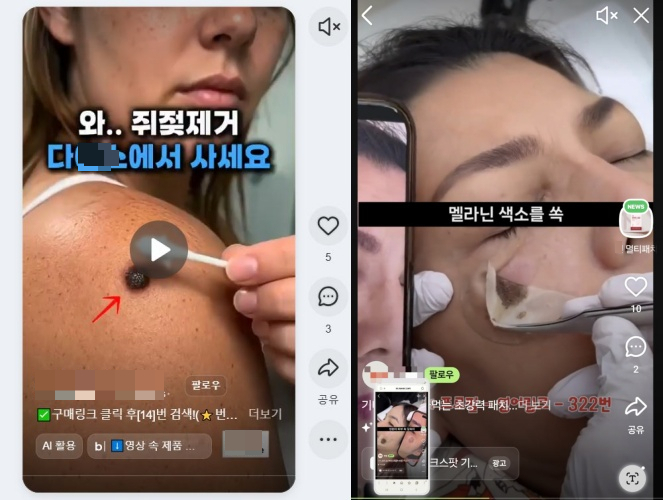
"Oral Wegovy," "cosmetics that remove melasma," "cream that removes gynaecomastia when applied."
These phrases, frequently seen on the internet, all constitute false advertising. Recently, such false advertising has proliferated through "short-form" (short videos) and other means on online platforms, prompting a sharp increase in government crackdowns on unfair advertising. The number of detected cases of unfair advertising for general foods, health functional foods, cosmetics, and medical devices last year increased by nearly 40% compared to three years ago. In contrast, the recovery of unjust gains is almost nonexistent. Among approximately 60,000 cases of unfair food advertising, there were only two instances of penalty surcharges imposed for the purpose of recovering unjust gains.
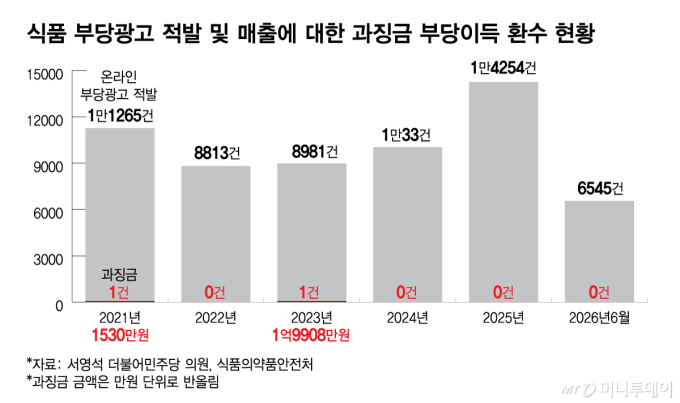
◆ Unfair advertising up ~40% in 3 years... Almost no penalty surcharges for recovering unjust gains
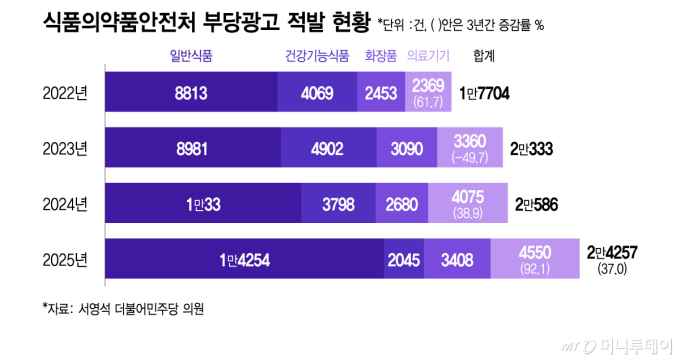
According to data obtained by Democratic Party of Korea lawmaker Seo Young-seok from the Ministry of Food and Drug Safety on the 15th, the number of detected cases of unfair advertising for general foods, health functional foods, cosmetics, and medical devices last year was 24,254, a 37.0% increase compared to 17,704 cases three years ago.
General foods accounted for the largest share of unfair advertising. The number of detected cases last year was 14,254, a 61.7% increase from three years prior. For medical devices, 4,550 cases of unfair advertising were detected, a figure that increased by as much as 92.1% compared to three years ago. Excluding health functional foods, the number of detected unfair advertising cases increased significantly in most fields, including cosmetics and medical devices.
However, even when detected, the recovery of profits from unfair advertising is not properly carried out. In the case of general foods, the number of online unfair advertising cases detected from 2021 to June this year reached 59,891, but among these, penalty surcharges were imposed for the recovery of unjust gains in only two cases, totaling just 213.48 million won.
Sales through false and exaggerated advertising can reach tens or hundreds of billions of won. In July last year, when the Ministry of Food and Drug Safety inspected food advertisements that sold products as if they were weight-loss drugs under the guise of "Oral Wegovy," 26 companies were found to have violated the Act on Labeling and Advertising. The products sold by these companies numbered approximately 600,000 units, with sales reaching 11.5 billion won. However, the current situation is that recovery of such unjust gains is extremely minimal.
◆ Need to strengthen post-hoc penalties such as tracking operators and recovering unjust gains
Seo (Rep.) pointed out, "Unfair advertising increases every year, yet only two cases out of nearly 60,000 detections have resulted in the recovery of unfairly earned sales revenue," adding, "This inevitably leads to the perception that it is fine as long as you can sell, even if detected." He further emphasized, "We must improve the system so that penalty surcharges for recovery work properly, along with measures to track actual operators and manage histories of repeated violations."
There are indications that rapid regulatory improvement and strengthened penalties are urgent. Chung Ji-young, Secretary-General of the Korea Consumers' League, stated, "Regulations have failed to keep pace with new types of media, making the problem of exaggerated advertising more severe," and added, "It is necessary to completely transform the regulatory framework according to the characteristics and content of the media." He continued, "Among countries of a certain scale, ours is the only one without a 'class action system,'" stating, "From a post-hoc perspective, penalties must be strengthened so that there is a clear signal that one will 'go bankrupt' if they engage in illegal acts. Otherwise, we can only keep chasing them."
Kim Tae-min, representative attorney of the Food Advertising and Hygiene Law Research Institute, pointed out, "Over 90% of advertisements appearing on Reels or short-form videos can be considered exaggerated advertising," adding, "It is difficult to detect exaggerated advertising, and even if detected, one can drag out a trial for two years by paying a fine of a few million won." He continued, "Since sellers can obtain unjust gains of hundreds of millions or billions of won over time, they are not afraid of becoming repeat offenders," stating, "A system for recovering unjust gains is needed. Just as it is publicly declared that those who mess around with stocks will be 'ruined,' the Ministry of Food and Drug Safety, police, and all ministries must respond with full force to exaggerated advertising."
[Exclusive] Earned 19.2 billion won through unfair advertising claiming "cures tinnitus"... Only requests for 'post blocking'
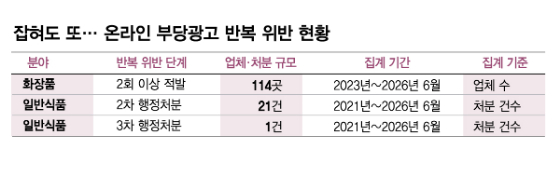
Companies that have been detected for unfair advertising or received administrative penalties online but continue to engage in exaggerated advertising are not uncommon. Over the past three and a half years, 114 companies have been detected at least twice for unfair cosmetic advertising, and cases of third-time administrative penalties have emerged in the general food sector, raising questions about whether current sanctions are sufficient to prevent repeated violations.
114 companies detected at least twice for cosmetics... Third administrative penalty also for general foods
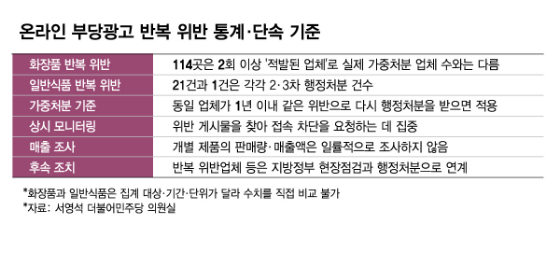
According to data received by Democratic Party of Korea lawmaker Seo Young-seok, a member of the National Assembly's Health and Welfare Committee, from the Ministry of Food and Drug Safety on the 15th, 114 companies were detected at least twice for unfair cosmetic advertising from 2023 to June this year. The main content of these companies' violations was advertising that could cause cosmetics to be mistaken for pharmaceuticals.
Administrative penalties for repeated violations have also continued in the general food sector. From 2021 to June this year, there were 21 cases of second-time administrative penalties and one case of a third-time penalty due to unfair advertising. Second-time penalties totaled three cases in 2021, 10 in 2022, two in 2023, and three each in 2024 and last year. The third-time penalty case occurred in 2021.
However, the 114th cosmetic companies represent the number of "companies detected" at least twice, while the 21st and one cases for general foods represent the number of "administrative penalties" for second and third times, respectively, so direct comparison of the figures is not possible. Not all detections of unfair advertising lead to administrative penalties. Aggravated penalties in the cosmetics sector apply when the same company receives an administrative penalty again within one year for the same violating act. The data submitted by the Ministry of Food and Drug Safety did not include the number of companies among the 114th repeatedly detected cosmetic companies that actually received aggravated penalties.
◆ Repeated violations continue while only requesting 'access blocking'... Verification and punishment of sales through unfair advertising are not properly carried out
It is pointed out that the background for continued repeated violations lies in a crackdown structure where online unfair advertising detection and subsequent penalties are separated. The Ministry of Food and Drug Safety's regular monitoring focuses on finding violating posts among the vast amount of advertisements posted on online markets (open markets), social networking services (SNS), and online shopping malls, and requesting access blocking. It does not involve conducting on-site inspections and administrative penalty procedures for all detected companies.
In general online monitoring, sales volume and revenue for individual products are not uniformly investigated. Consequently, it is structurally difficult to comprehensively grasp how many products were sold through unfair advertising and how much revenue the company generated.
A Ministry of Food and Drug Safety official explained, "The purpose of regular monitoring is to quickly block violating advertisements to reduce consumer exposure," adding, "For repeatedly violating companies or items that have become social issues, we link them with local government on-site inspections or planned inspections to verify sales amounts and carry out administrative and criminal measures in parallel."
In fact, significant sales scales related to unfair advertising were confirmed during planned inspections. When the Food Unfair Acts Emergency Response Team inspected unfair advertising claiming effects for improving vertigo and tinnitus in June last year, the related revenue of 11 companies was approximately 19.2 billion won.
The Ministry of Food and Drug Safety requested administrative penalties from the competent local governments for seven food business registration companies among these, and has penalized four so far. Among the cases where investigation requests or indictments were filed against the 11th companies, three have been referred to the Prosecution Service, while related procedures are ongoing for the remaining companies and cases.
Measures to verify and recover economic benefits arising from unfair advertising are also limited. From 2021 to June this year, 59,891 cases of online unfair advertising for general foods were detected, but there were only two penalty surcharges linked to sales for recovering unjust gains. However, these penalty surcharges can only be imposed by local governments for serious violations equivalent to business suspension of two months or more, and do not include general penalty surcharges that substitute for business suspension.
Experts point out that merely blocking posts and increasing the number of detections is difficult to prevent repeated violations. They argue that procedures are needed to verify and recover economic benefits returning to companies, as well as personnel to monitor whether sales continue after detection.
Lee Eun-hee, a professor in the Department of Consumer Studies at Inha University, stated, "It is reported that some cases continue selling under their existing names without caring even after being detected," adding, "We must establish regulations allowing revenue generated after detection to be treated as unjust gains and recovered, and increase monitoring personnel to ensure it leads to actual enforcement."
The fact that post-detection procedures are divided among multiple institutional investors is also cited as a factor reducing the effectiveness of sanctions. Kim Tae-min, representative attorney of the Food Advertising and Hygiene Law Research Institute, stated, "Even if the Ministry of Food and Drug Safety detects violations, local governments handle administrative penalties, police conduct investigations, and related review institutions must block posts," adding, "It is difficult to respond if the relevant ministries do not move together."
The Ministry of Food and Drug Safety maintains that it links local government on-site inspections and administrative penalties for repeatedly violating companies. In the cosmetics sector, it is also considering measures to strengthen the responsibility of responsible sellers who have repeatedly engaged in unfair advertising.
[MT Report] Light punishment fuels "hit-and-run" exaggerated advertising (Part 2)
"Melasma removal" actresses are in on it too... Changing the signboard is enough even after being penalized for unfair advertising

 in THEBIO


