

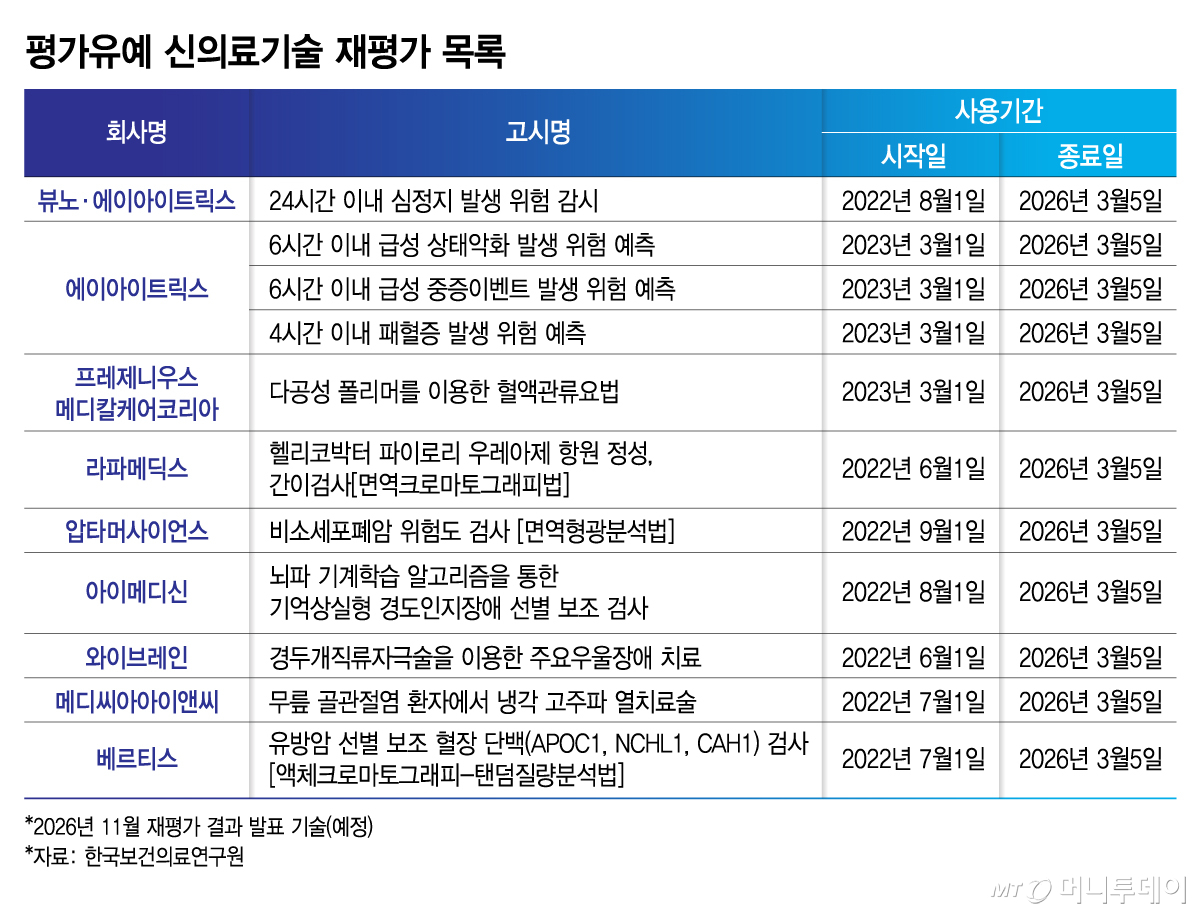
The results of the new medical technology evaluation for medical AI (artificial intelligence), which is currently being used in clinical settings as a temporary non-covered service, are scheduled to be released next month. As clinical efficacy is expected to be the primary basis for judgment, it is projected that both subsequent research and development (R&D) of medical AI and government policies aimed at resolving gaps in regional, essential, and public healthcare through AI will be significantly impacted.
According to the medical device industry on the 16th, a total of 11 new medical technologies under evaluation deferral (based on public notice standards), including VUNO’s “VUNOMED DeepCAS” which predicts the risk status of inpatients and e-AI Atrix’s “VitalCare,” as well as Vertis’ “MastCheck” which assists in breast cancer diagnosis via blood, are undergoing safety and efficacy reviews by the National Evidence-based Healthcare Collaborating Agency (hereinafter NECA).
The evaluation deferral system for new medical technologies allows medical technologies approved by the Ministry of Food and Drug Safety to be used first as non-covered services in the market if they meet certain criteria. Companies developing new medical technologies, such as medical AI or genetic testing, can generate revenue through non-covered services during a deferral period of up to four years while accumulating evidence, such as papers, to sustain their business. Although conditional, this system, along with similar integrated review and evaluation mechanisms for innovative medical devices known as “early-entry medical technologies,” is highly regarded as a regulatory innovation case that helps companies cross the “valley of death” by preventing revenue loss between approval and entry into the covered insurance system.
This is the first time that new medical technologies under evaluation deferral have been put on the government’s review bench. Depending on the outcome, their “fate” will be determined, whether they proceed with the health insurance coverage process as a new medical technology or even face the termination of non-covered use. The initial review by the subcommittee of the New Medical Technology Evaluation Committee for technologies whose temporary non-covered use ended on March 5 was collectively concluded on September 18, and a “final judgment” is expected to be made at the main committee meeting scheduled for the 23rd. A source in the medical AI industry stated, “The results were originally scheduled to be announced in October, but we received notice from NECA in early this month that they would be communicated by mid-November.”
New medical technology evaluations are largely based on two criteria: safety and efficacy. The issue with the latter is that whether it “actually helps patients” is crucial, yet this standard remains ambiguous. NECA has stated its policy of using the quantity and quality (systematic literature review) of papers written and published using data accumulated during non-covered use as evidence, but specific criteria have not been disclosed. A source well-versed in the medical AI evaluation process said, “It is not uncommon for opinions to be divided between ‘sufficient’ and ‘insufficient’ even among expert committee members reviewing the same papers and materials.”
Companies each claim that their efficacy evidence is sufficient. In particular, VUNO, a leading medical AI company, expects a “positive result,” stating that it published six papers proving the clinical efficacy of VUNOMED DeepCAS during its 43-month evaluation deferral period. However, even VUNO, which has expanded to 180 medical institutional investors nationwide and 65,000 hospital beds, only “expects” to pass the evaluation without being able to “confirm” it.
The results of this evaluation are expected to have a significant impact on the development of subsequent new medical technologies, including medical AI. In particular, if highly recognized and widely used medical AI solutions fail to meet the criteria, the Ministry of Health and Welfare’s “AI Basic Healthcare Strategy,” which aims to resolve gaps in regional, essential, and public healthcare through AI, could face confusion in actual use and budget execution due to questions regarding clinical efficacy. This is because the “evaluation standards” themselves may be raised.
Companies may challenge the review results, leading to legal disputes. Precedents already exist. Although not medical AI, Genkyrix filed an application for a stay of execution along with a lawsuit to cancel the disposition, arguing that “there was no issue with the performance or quality of the test itself,” after its breast cancer prognosis diagnostic test, “Genowell BCT,” failed the NECA evaluation last month and was excluded from innovative medical technologies. In early this month, the Seoul Administrative Court granted Genkyrix’s application for a stay of execution, stating that there is no concern it would have a significant impact on public welfare.
Lim Jae-jun, Vice Chairman of the Insurance Committee at the Korea Medical Device Industry Association, pointed out, “While extending the period for evaluation-deferred technologies considers clinical utilization (usage volume) and the potential for evidence creation in addition to safety, entry into the formal system is evaluated solely based on papers,” adding, “If companies are expelled from the market for unclear reasons despite having clinical efficacy, it will inevitably lead to corporate backlash and a contraction of the AI service industry.”

 in THEBIO
