

OliX is focusing on securing global clinical momentum by supplementing and resubmitting the Phase 2a trial plan (IND) for its macular degeneration treatment, which had been rejected in New Zealand. Amid continuing expectations for new drug development in areas such as hair loss, obesity, and MASH (metabolic dysfunction-associated steatohepatitis), the securities industry is paying attention to clinical progress in OliX's major pipelines and expanded opportunities for technology transfer.
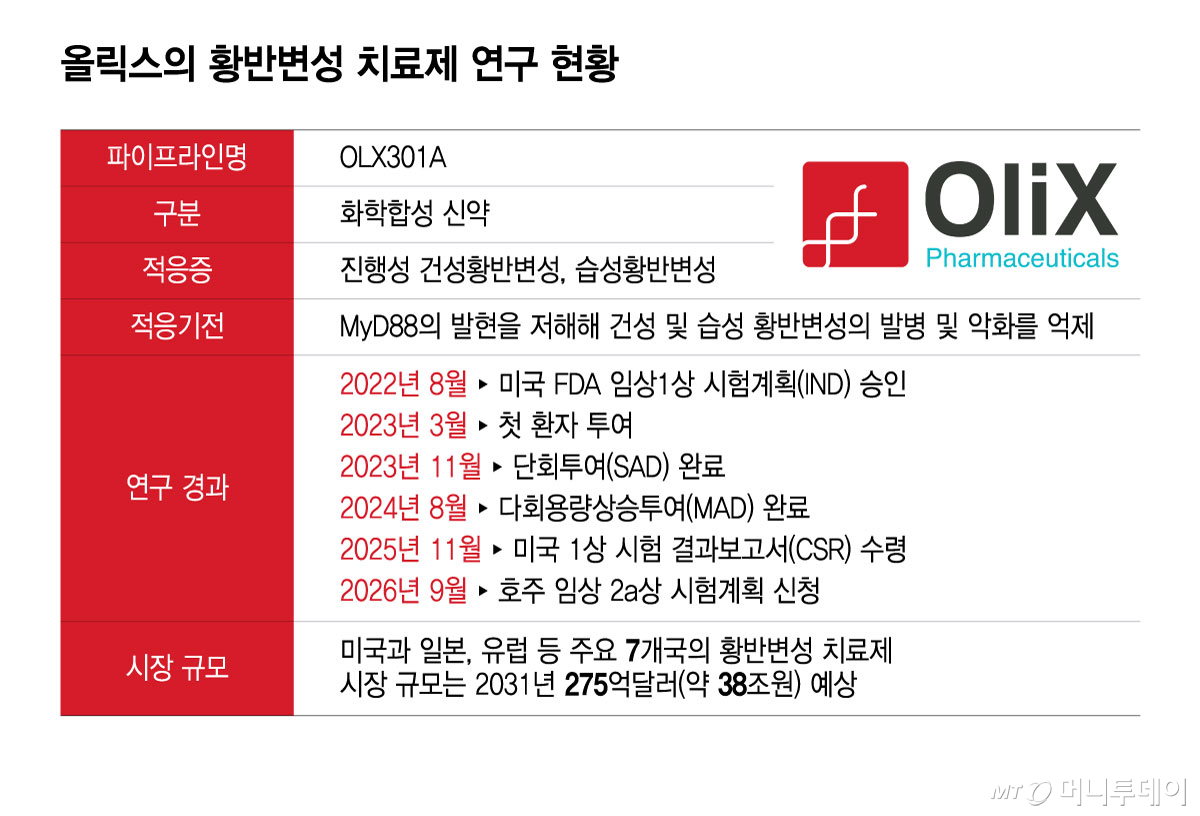
OliX announced on the 30th that it recently completed the submission of supplementary documents to New Zealand authorities after holding a briefing on the 19th to outline its plan for prompt resubmission regarding the Phase 2a trial of 'OLX301A (compound name OLX10212)'.
OliX's OLX301A is a short interfering RNA (siRNA) therapy being developed for age-related macular degeneration accompanied by bilateral geographic atrophy (GA). It works by suppressing 'MyD88,' an inflammatory signaling protein involved in the onset and progression of the disease, using siRNA technology. Based on the excellent safety and tolerability confirmed in Phase 1 trials, it is attracting attention as a 'first-in-class' siRNA drug that suggests the possibility of vision improvement beyond merely suppressing disease progression.
While pushing forward with global clinical trials, OliX applied for an IND in New Zealand following Australia, but was rejected by the local Human Ethics Committee (HDEC) on grounds of failing to meet ethical standards and relevant regulations, causing a shock to its stock price at one point. The company briefing held in mid-month was also conducted to explain the purpose and procedures of the clinical trial to individual shareholders.

Regarding the matter, OliX stated, "This rejection is an issue related to the review by the HDEC, not the regulatory authority, the Medicines and Medical Devices Safety Authority (MedSafe)," adding, "It is not due to a fundamental problem with the clinical trial design itself." The company further noted, "We previously received regulatory approval for the Phase 2a IND of our male pattern hair loss treatment 'OLX104C' in New Zealand," and added, "Based on this experience in advancing local clinical trials, we will respond swiftly to subsequent procedures."
Regarding the Phase 2a IND in Australia, the company said, "We submitted the relevant application to the Human Ethics Committee (Bellberry HREC) on the 16th of last month and are currently awaiting the result." While this may vary depending on local approval procedures, OliX expects approval within approximately two months. It was also reported that plans are in place to apply for additional INDs in the United States and South Korea to enhance the reliability of clinical data.
OliX's new drug momentum extends beyond hair loss and macular degeneration to various areas including brain diseases, obesity/MASH, among others. In particular, 'OLX501A,' an obesity new drug for which the company is pushing for entry into clinical trials next year, targets a receptor called 'ALK7' expressed in fat cells, acting by directly promoting lipolysis, thus differentiating it from existing treatments. It has the potential to become a 'pillar' of a new treatment strategy that combines with GLP-1 class therapies to enhance weight loss effects while reducing muscle loss.

Arrowhead's 'ARO-ALK7,' which targets ALK using siRNA technology similar to OliX, yielded positive data in Phase 1/2 interim results, showing a maximum reduction of visceral fat by 13.6% at week 8. Observations suggest that follow-up clinical data to be released in the fourth quarter could serve as an opportunity for OliX's OLX501A to be re-evaluated. Global pharmaceutical companies are also showing keen interest, with GSK (GlaxoSmithKline) and Roche acquiring ALK7-targeted siRNA new drug candidates from Chinese biotech firms for up to $1 billion (approximately 1 trillion 334.7 billion won) and $1.16 billion (approximately 1 trillion 548.6 billion won), respectively.
Amid fierce competition among global big pharma companies to secure treatments, securities industry analysts believe that opportunities for siRNA technology transfer could expand due to the technological power struggle between the United States and China. Researcher Um Min-yong at Shinhan Investment Corp stated, "With siRNA included in the bio section of the draft revision of the Ministry of Commerce and Ministry of Science and Technology's export ban/restriction technology list in China in mid-month, spillover benefits for OliX are expected," adding, "Since its technological capabilities have already been verified through platform-based repeat contracts with companies like Lilly and L'Oréal, (in the case of technology transfer) the benefits will be even greater."

 in THEBIO


