

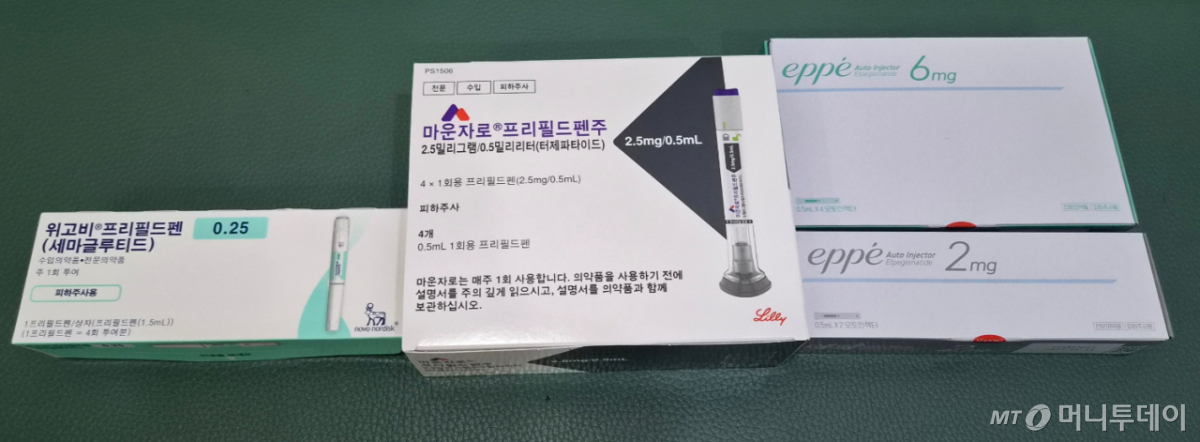
Pressure to reduce the prices of GLP-1 (glucagon-like peptide-1) class obesity drugs is mounting. This follows the emergence of the domestically produced obesity drug 'Epe' (active ingredient: epeglenatide), which offers price competitiveness, and the government's decision to allow the importation of medications for self-treatment from overseas countries such as Japan.
According to the pharmaceutical industry on the 16th, Eli Lilly's oral GLP-1 obesity treatment 'MuYuda' (active ingredient: orforglipron; US product name: Foundayo) received approval as a Class 1 new drug from China's National Medical Products Administration (NMPA) on the 12th (local time).
Orforglipron is a low-molecular-weight drug in the GLP-1 class, available as a pill that needs to be taken only once a day. It can be taken at any time, regardless of whether food has been consumed or if one is fasting. Typically, its price is set lower than that of injectable drugs like 'Mounjaro' (active ingredient: tirzepatide).
In Korea, it has become possible to import medications sold at low prices overseas for self-treatment purposes starting this month. This is because the Ministry of Food and Drug Safety and the Korea Customs Service have implemented measures allowing individuals to carry in up to 'a total of 6 bottles (if exceeding 6 bottles, a 3-month dosage based on the medication's usage instructions)' of medications that were prescribed and purchased with formal approval from the regulatory authority of the respective country, in accordance with its standard medical system, starting from the 12th.
Consequently, there is a growing trend of obese patients seeking prescriptions for obesity drugs in Japan and China, where prices are relatively lower. Even when factoring in airfare and accommodation costs, they determine that obtaining prescriptions overseas is more cost-effective than doing so domestically. In fact, the price for a 4-week (1-month) supply of Mounjaro's high-dose 10mg product is known to be in the mid-500,000 won range in Korea, while it can be purchased for around 300,000 won in Japan when covered by insurance, and in the 200,000 won range in China.
According to obesity drug supply price data obtained by Democratic Party of Korea lawmaker Nam In-soon, a member of the National Assembly's Health and Welfare Committee, from the National Health Insurance Service and the Health Insurance Review & Assessment Service, the factory ex-works price (wholesale supply price) for Mounjaro Prefilled Pen Injection 2.5mg in Korea from January to June this year is 68,397 won. This amounts to 5.1 times Japan's supply price of 13,340 won.
As cheaper overseas obesity drugs also become purchasable through self-prescription, there are views that pharmaceutical companies' domestic pricing policies for obesity drugs may change. Hanmi Pharmaceutical's new obesity drug Epe has also ignited the price competition for obesity medications. The supply price for a 4-week supply of Epe at its initial monthly dosage of 2-4mg is 129,800 won, which is about half the level of Mounjaro's low-dose 4-injection supply price of approximately 270,000 won.
It is expected that prices could drop further once Eli Lilly and Novo Nordisk launch their oral GLP-1 obesity drugs in the future. Lilly and Novo have respectively applied to the Ministry of Food and Drug Safety for domestic product approval of Foundayo and 'Wegovy Pill' (active ingredient: semaglutide). Both products have already been launched in the United States.
However, no signs of price adjustments by pharmaceutical companies for obesity drugs have been detected yet. A Lilly official stated, "The difference in drug prices between Korea and Japan reflects the fundamentally different health insurance systems of each country and cannot be simply compared," adding, "We are exploring various ways to ensure that domestic patients who need Mounjaro can access treatment," offering a general stance.

 in THEBIO
