


AriBio has initiated the U.S. product approval process for its oral Alzheimer's disease treatment candidate 'AR1001' (generic name: mirodenafil), which demonstrated efficacy in a global Phase 3 clinical trial.
Targeting mild cognitive impairment and mild dementia, the company plans to complete related procedures by the first half of next year, leveraging the convenience of an oral medication and effects comparable to injectables, before filing for new drug approval with the U.S. Food and Drug Administration (FDA) in the second half of the year.
AriBio Group held a press conference on the 23rd at the Grand Ballroom of the Fairmont Hotel in Seoul Yeouido to report the top-line (key endpoint) success of AR1001's Phase 3 clinical trial, explaining detailed results and future plans.
AR1001's Phase 3 clinical trial was conducted on 1,535 early-stage dementia patients across approximately 230 clinical sites in 13 countries. The change at the 52nd-week time point of the 'Clinical Dementia Rating Sum of Boxes' (CDR-SB), which comprehensively measures memory and activities of daily living, was used as the primary efficacy endpoint.
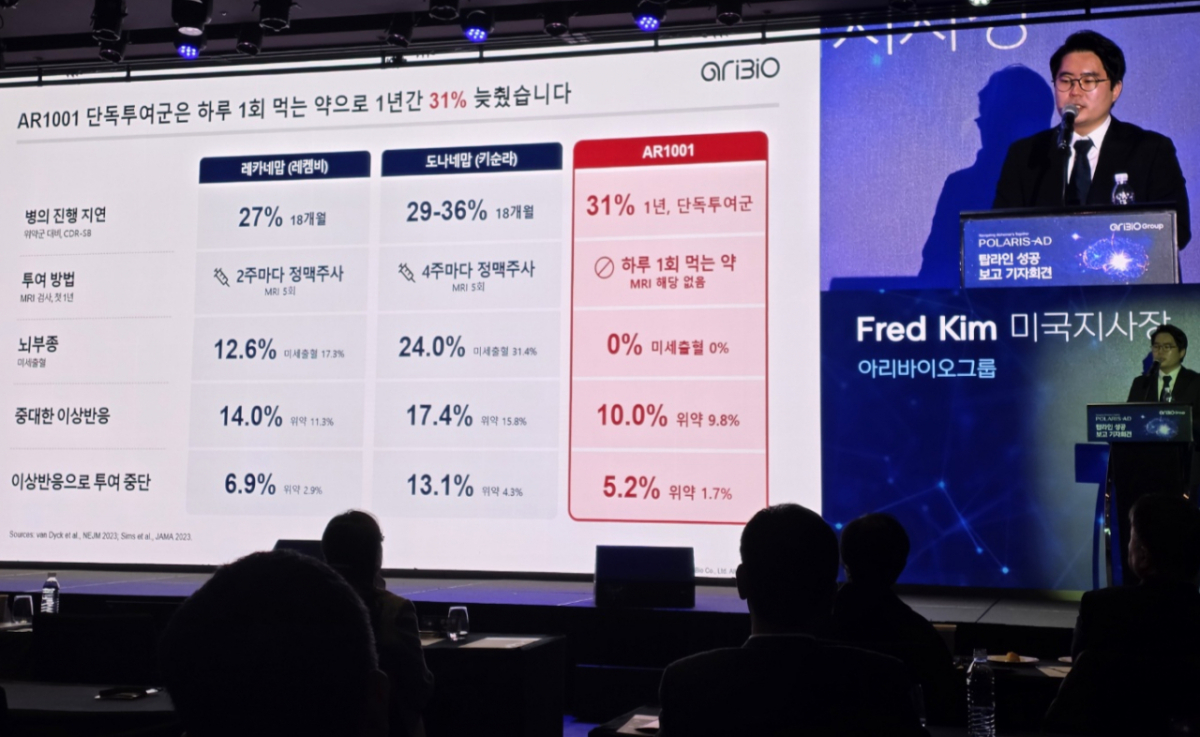
As a result, in the monotherapy group, the CDR-SB score for the AR1001 treatment group was 0.44 points lower than the placebo (dummy drug) group, indicating that it slowed the clinical progression of disease deterioration by 31%. In contrast, in the overall population group, which included patients using symptomatic treatments concurrently, the CDR-SB score difference was 0.11 points, numerically favoring the AR1001 treatment group, but statistical significance was not demonstrated.
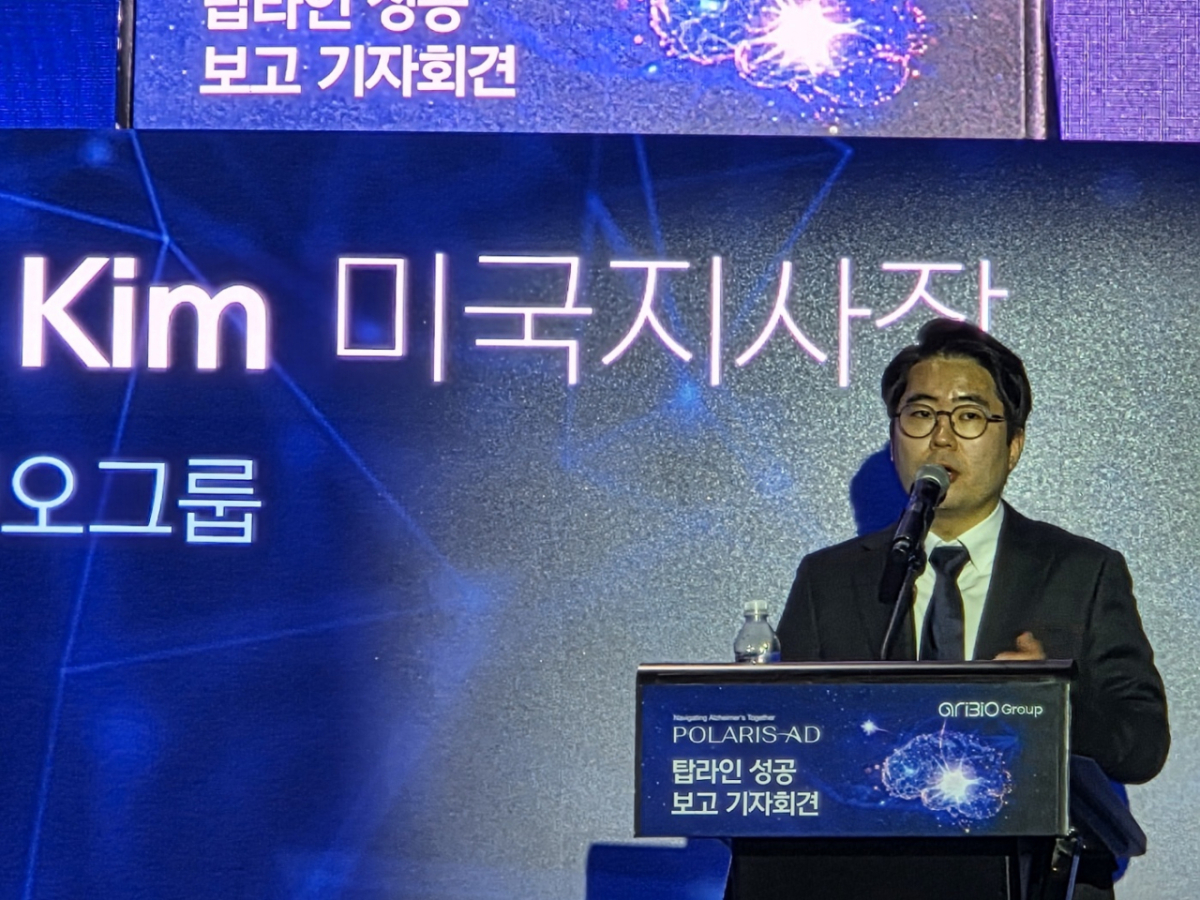
Regarding this, Fred Kim, AriBio's U.S. branch manager, said, "The Phase 3 trial was designed such that success is declared if efficacy is confirmed in either monotherapy or the overall population."
Kim added, "If it were effective only in combination therapy, it would become a drug dependent on other medications, but since monotherapy does not require other drugs, it can be developed as a first-line treatment or for other indications."
He continued, "Of the 69th million patients with mild cognitive impairment and 16 million with mild dementia worldwide, only about 0.1% receive antibody injection therapy, yet these drugs generate annual global sales of 210 billion won," noting that "AR1001's goal is to become a safe and effective disease-modifying treatment used first after diagnosis."
On this day, AriBio disclosed for the first time the results of a 78-week extension trial following the 52nd-week Phase 3 clinical trial results. Existing antibody injections 'Leqembi' (generic name: lecanemab) and 'Kisunla' (generic name: donanemab) slowed dementia symptoms by 27% and 36%, respectively, in CDR-SB scores during the same period in clinical trials, while its AR1001 also delayed disease progression by 33% when administered as monotherapy, yielding results that did not lag behind long-term.
Branch manager Kim said, "The existing placebo group showed a gentler slope than the expected deterioration trend after starting to take the real drug, and the difference in disease progression speed compared to the patient group previously taking the real drug was maintained."
He added, "This is a result that supports AR1001's potential as a disease-modifying treatment, and we plan to utilize it in discussions with the FDA regarding approval."
Overseas experts who participated online in the press conference evaluated AriBio's Phase 3 clinical trial as "encouraging." Dr. Susan Hendricks, a statistics expert who has participated in more than 80 global clinical trials, said, "The FDA has a recent trend of granting approval based on a single Phase 3 trial, so (AR1001 is worth challenging with monotherapy alone)."
She added, "In addition to achieving the primary endpoint, consistent decreases in secondary endpoints such as 'phosphorylated tau217 (p-tau217)' are interesting, and reinforcing these points will help with approval."
Dr. Sharon Xie, a professor at Stanford University in the U.S. and the overall principal investigator of the Phase 3 trial, expressed expectations regarding the possibility of combination therapy with existing Leqembi or Kisunla.
"AR1001 has a completely different mechanism of action, so it is worth developing," and adding, "It would be quite significant if the effects of each simply add up," Xie said.

AriBio plans to complete overall discussions for FDA approval by June next year and submit a New Drug Application (NDA). Management from domestic and international partners, including strikeout Pharmaceuticals and China's Fusheng Pharmaceutical, attended the press conference on this day to convey messages of support.
In response to a question about whether the clinical scale (604 patients in the monotherapy group) was not small compared to existing dementia injections, Jung Jae-jun, chairman of AriBio Group, answered, "Existing injections targeted 1,800 to 2,000 people to achieve statistical significance (P-value), while we predicted that it would be possible with more than 550 people." and stated,
He said that the important point is that statistical significance was secured; clinical scale is irrelevant to whether approval is granted.
"We will further solidify the evidence through additional analyses and extension trials, and work closely with global regulatory agencies to create treatment opportunities for suffering patients and their families," he sadi.

 in THEBIO


