

Curacl is accelerating the clinical development of its oral retinal disease drug candidate 'CU06' (generic name: rivastat) to target a gap in the existing injection-centric market. Analysts suggest that because the oral formulation places less burden on patients than conventional eye injections, it could address unmet needs.
On the 24th, Curacl announced that it recently submitted an Investigational New Drug (IND) application to the U.S. Food and Drug Administration (FDA) for a Phase 2b clinical trial in the United States. The trial will evaluate the vision-improving effects of CU06 over 24 weeks in 156 patients with diabetic macular edema (DME).
DME is a condition in which fluid leaks from retinal blood vessels damaged by diabetes and accumulates in the macula, which is responsible for central vision. It can impair the ability to read text or see objects clearly, requiring treatment tailored to the patient's condition and ongoing management.
CU06 is the first-in-class drug candidate developed independently by Curacl as an oral vascular endothelial dysfunction blocker. Research and development are underway with the goal of improving vascular barrier function to protect retinal neurons and preserve or improve visual function.
According to Phase 2a results disclosed in 2024, among patients who completed the trial as per the protocol, the subgroup with a best-corrected visual acuity (BCVA) of 69 letters or fewer before dosing showed an average vision improvement of approximately 6 letters at 12 weeks in the CU06 300 mg dosing group.
A Curacl official stated, "If there are no objections from the FDA, the IND will be automatically approved one month after submission," adding, "We plan to rigorously verify the vision-improving effects and safety observed in Phase 2a and select the appropriate dose for use in Phase 3."
The reason CU06 is drawing attention is that it differs from existing treatments in mechanism, modality, and administration method. Currently, the mainstream approach involves directly injecting vascular endothelial growth factor (VEGF) inhibitors (anti-VEGF agents), which suppress the excessive formation of retinal blood vessels, into the eye. While this can preserve or improve vision, repeated intraocular injections and hospital visits have been a burden for patients requiring long-term treatment.
For this reason, it is analyzed that a significant proportion of DME patients do not receive anti-VEGF therapy. According to an analysis of U.S. insurance data (Medicare) published in the Journal of the American Medical Association Ophthalmology (JAMA Ophthalmology) in 2022, among DME patients aged 65 and older, only 35.2% received anti-VEGF treatment in 2018, with no record of administration for the remainder that year.
An industry official projected, "Oral drugs have a lower barrier to entry than injections and are highly likely to be chosen as maintenance therapy, such as reducing injection frequency, for patients requiring continuous management," adding, "In cases where existing injections do not yield sufficient vision-improving effects, drugs with different mechanisms could serve as therapeutic alternatives."
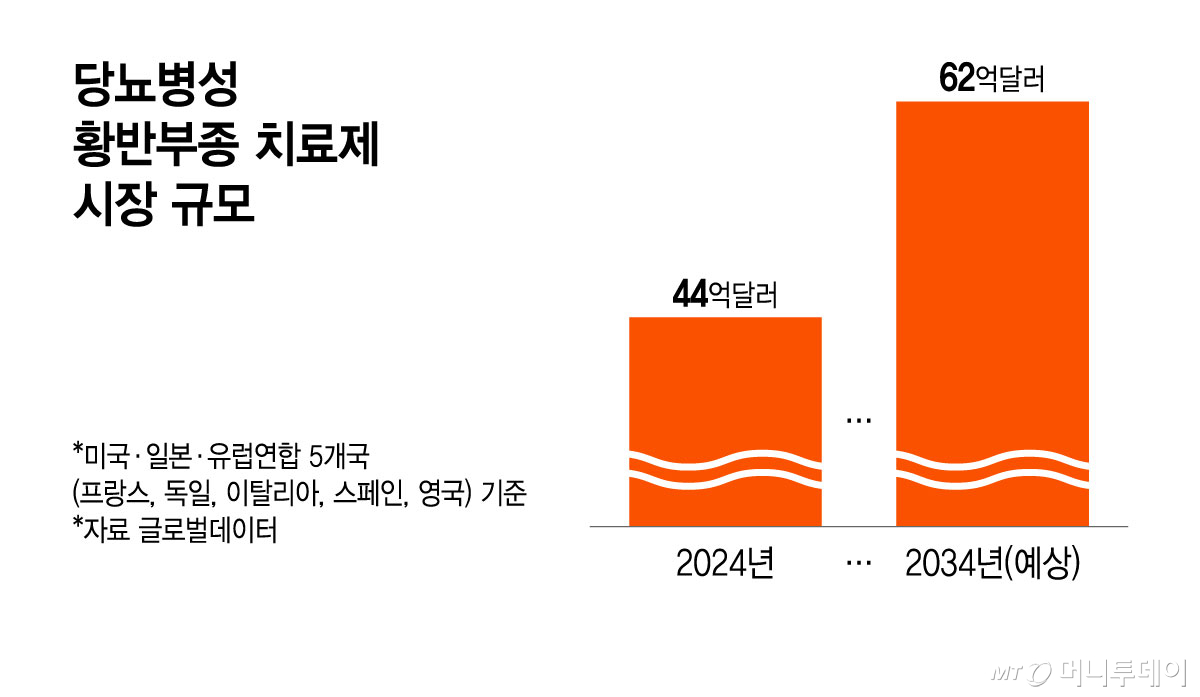
The DME market is expanding due to aging and an increase in chronic disease patients. According to analysis by the global market research firm GlobalData, the size of the DME treatment market in the United States, Japan, and five European Union countries (France, Germany, Italy, Spain, and the United Kingdom) is projected to grow from 4.4 billion dollars (approximately 5.9057 trillion won) in 2024 at an annual average rate of 3.4% to reach 6.2 billion dollars (8.3216 trillion won) by 2034.
The industry believes the relevant market could be much larger when considering patients who avoid or hesitate about injection therapy. Analysts suggest that this background may have influenced Curacl's decision to launch its own clinical trials after receiving a return of the technology transfer rights for CU06 from French ophthalmology specialty pharmaceutical company Thea in 2024 and holding a meeting with the FDA last year.
Curacl has secured more than 10 drug pipelines, including CU06, CU01, MT-101, and MT-103, based on its small-molecule drug discovery platform 'SOLVADYS' and antibody discovery platform 'EAGLES'. The company is also actively promoting open innovation by combining internal and external research capabilities, such as recently embarking on the development of next-generation anticancer drugs based on antibody-drug conjugates (ADCs) with Mapthis and Pinobiotech.
A Curacl official stated, "CU06 is an oral treatment with a differentiated mechanism that normalizes blood vessels," adding, "We will make every effort in its development to broaden treatment options for patients and medical professionals."

 in THEBIO

