

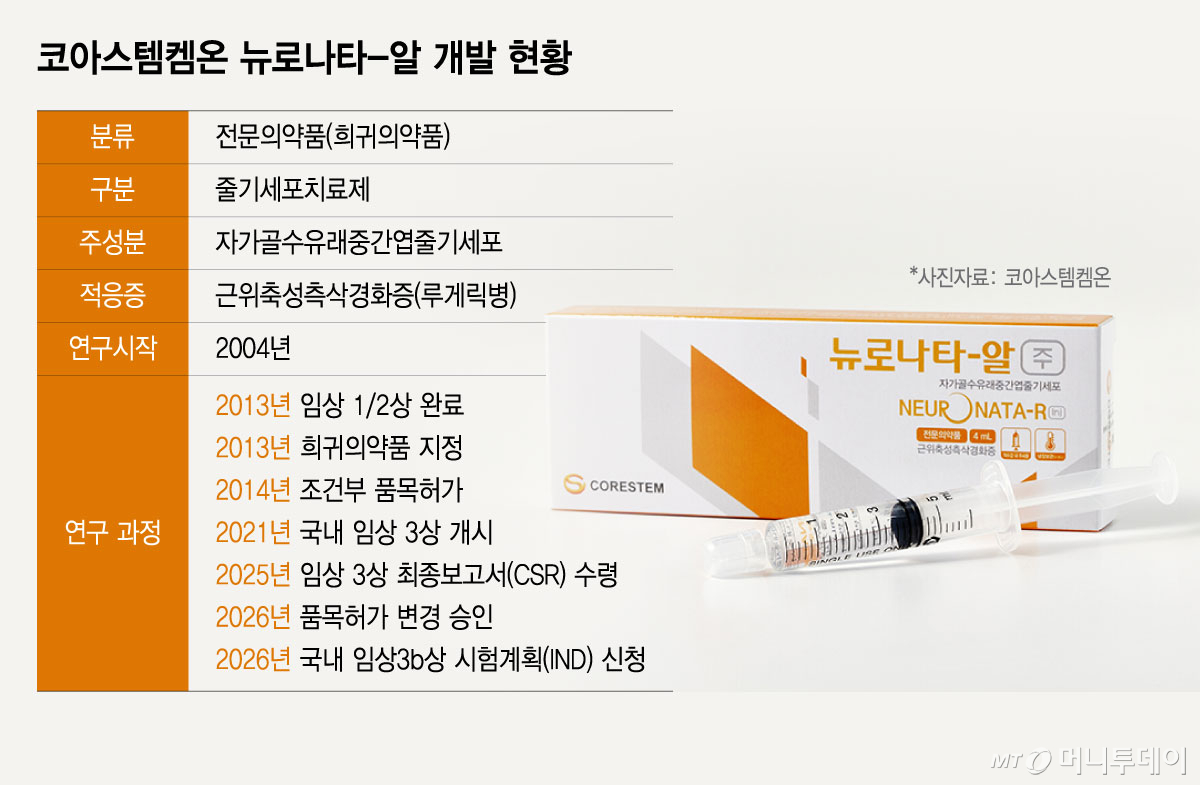
Corestem Chemon has laid the groundwork for entering the U.S. market with its stem cell therapy 'Neuronata-AL Injection' (active ingredient: renzumestrocell, hereinafter referred to as Neuronata-AL) for amyotrophic lateral sclerosis (ALS, or Lou Gehrig's disease). The company aims to enter the local market through the U.S. Accelerated Approval process and generate annual revenue of over 500 billion won.
Corestem Chemon announced on the 26th that it has submitted an Investigational New Drug (IND) application for the Phase 3b trial plan of Neuronata-AL to the Ministry of Food and Drug Safety.
The Phase 3b trial of Neuronata-AL will be conducted at three domestic medical institutions, targeting 146 adult patients with Lou Gehrig's disease. Participating patients will be randomly assigned to either the Neuronata-AL group or the placebo group and administered two doses. The primary objective is to determine whether two doses of Neuronata-AL delay functional decline in patients compared to the placebo. The primary endpoint of this confirmatory trial is the change in 'ALSFRS-R' (a physical function score for Lou Gehrig's disease patients).
Corestem Chemon's Neuronata-AL is an autologous stem cell therapy manufactured using mesenchymal stem cells obtained from a patient's bone marrow. After completing Phase 2 trials, it received conditional marketing approval from the Ministry of Food and Drug Safety in 2014. It was launched in 2015 as the first stem cell therapy for neurological disorders and has been administered to numerous patients.
Corestem Chemon initiated the Phase 3 trial of Neuronata-AL in 2021 and received the final Clinical Study Report (CSR) last year. In the Phase 3 trial, statistical significance was not achieved for the primary efficacy endpoint 'CAFS' (a composite measure of function and survival) or the secondary endpoint 'ALSFRS-R' across all patients.
However, in a subset of patients with relatively slow disease progression (Slow Progressor, NfL below 52pg/mL), efficacy was confirmed not only for the primary and secondary efficacy endpoints but also in pulmonary function tests (SVC). Based on this, the company obtained an amendment to its marketing approval in the first half of this year. In the Phase 3b trial, referencing the Phase 3 data, it will evaluate changes in respiratory function, time to disease progression, and biomarkers for neuronal damage and neuroinflammation together.
Corestem Chemon's strategy is to use the Phase 3b trial of Neuronata-AL as a stepping stone for U.S. market entry. Currently, the company is at the stage of refining its approval strategy through consultations with the U.S. Food and Drug Administration (FDA).
If Corestem Chemon receives approval for the domestic Phase 3b plan for Neuronata-AL, it intends to submit the trial protocol to the U.S. FDA and further apply for Accelerated Approval. The FDA's Accelerated Approval system grants early approval in exchange for verifying clinical efficacy through a confirmatory trial after approval. Since the condition is the initiation of the confirmatory trial rather than its results, the company can apply for Accelerated Approval without waiting for the Phase 3b results.
The global market size for Lou Gehrig's disease treatments is projected to grow to $1.097 billion (approximately 1.47 trillion won) by 2027. Corestem Chemon estimates that if Neuronata-AL receives FDA approval, it could generate annual revenue of over 500 billion won, considering the sales performance of competing drugs. Since there is no fundamental treatment to halt the progression of Lou Gehrig's disease, the market size could expand further if Neuronata-AL becomes the first stem cell therapy to receive FDA approval.
A company official stated, "Lou Gehrig's disease is a rare disorder with no fundamental cure, and the FDA tends to encourage and favor new drug research for it." The official added, "Neuronata-AL is highly competitive because we have already secured Phase 3 data, and it is a drug that is marketed domestically and has confirmed safety."
The official further stated, "We are continuing meetings with the FDA, providing materials such as the number of clinical trial participants, data, and sales history for Neuronata-AL, and the FDA is well aware of this." The official concluded, "The Phase 3b trial serves as a starting point that connects the domestic clinical trials and the U.S. approval strategy into a single flow. We will prepare the Phase 3b approval and Accelerated Approval processes without any issues through close consultations with the FDA."

 in THEBIO
