

The government plans to announce a reform plan for the electricity rate system that will lower industrial electricity rates differently by region later this month. The initiative aims to strengthen industrial competitiveness and promote balanced regional development by reducing electricity costs for companies outside Seoul.
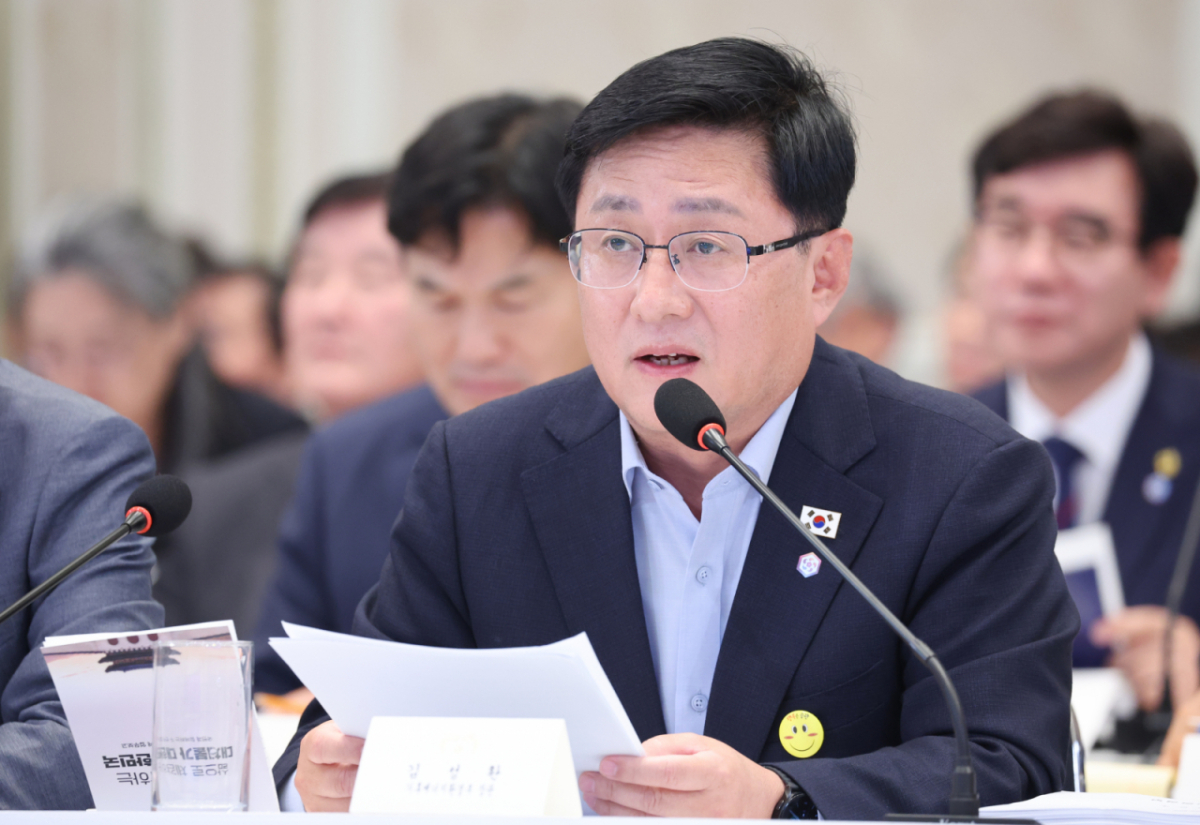
Kim Sung-hwan, Minister of Climate, Energy and Environment, pointed out at a press conference marking his first anniversary in office on the 3rd that "South Korea competes with China in almost every industrial sector, and as electrification rates rise, the stability and price of electricity have become key to industrial competitiveness." He added, "China uses electricity priced at around 120 won per kWh, while ours is in the 180th-won range, making it difficult for Korean industries to compete with China."
He further stated, "Ideally, we would lower rates to match China's levels, but doing so could lead to significant losses for KEPCO. Therefore, Korea Electric Power Corporation intends to set the reduction level within a manageable range."
The regional electricity rate system is a new framework that reflects transmission network costs and other factors in electricity prices, ultimately allowing regions closer to power plants to receive greater rate reductions.
The government is pushing for the introduction of regional electricity rates because rising industrial electricity rates over recent years have increased cost burdens in certain industries such as steel and petrochemicals. In particular, given that these industries must compete with Chinese companies relying on low electricity costs, there is a growing need to alleviate their electricity rate burdens.
Previously, the Ministry of Climate implemented a seasonal and time-of-use electricity rate reform starting in April this year, lowering daytime rates and raising nighttime rates for industrial users. This was done to improve grid stability by reducing rates during daylight hours when renewable energy generation is high, while also easing cost burdens on companies that primarily operate factories during the day. If regional electricity rates are also implemented, it is expected that additional relief will be provided to companies located outside Seoul.
A public deliberation process to decide whether to proceed with new nuclear power plant projects is also scheduled to begin later this month. Given that future electricity demand is expected to surge rapidly due to the Honam Semiconductor Industrial Complex and AI data centers, the plan is to determine whether to move forward with new nuclear plants through various public deliberation processes, including gathering public opinions, expert forums, and opinion polls.
On the 4th, the Ministry of Climate also reported its major work plan for the second half of 2026, which focuses on transitioning South Korea into an "Electro-state." While efforts in the first half of this year were concentrated on developing roadmaps such as the "National Sovereignty Government Energy Daejeon Promotion Plan" and the "First Renewable Energy Basic Plan," the ministry plans to fully implement policies in the second half.
The Ministry of Climate will prioritize achieving an Electro-state by focusing on providing electricity and water supply for the AI Daejeon. Stable electricity and water supply are essential for operating the Honam Semiconductor Industrial Complex and large-scale AI data centers, so the ministry plans to accelerate infrastructure expansion in these areas.
To achieve 100 GW (gigawatts) of renewable energy capacity ahead of schedule by 2030, the ministry will launch large-scale solar projects on reclaimed land and border regions. It will mandate solar panels on factory rooftops and improve systems so that households with residential solar installations under 10 kW (kilowatts) can receive cash settlements for excess electricity generated after use. For offshore wind power, project-specific close management and government-led planning will be used to shorten project timelines.
Efforts to expand the power grid will accelerate to ensure AI data centers and advanced industrial complexes can begin operations immediately. By expanding existing transmission lines, new construction will be minimized, and new power lines near villages will be buried underground to improve community acceptance. Flexibility resources such as Battery Energy Storage Systems (BESS) and pumped hydro storage will also be significantly expanded.
In addition to electricity, the ministry will establish a stable water supply foundation, another key element for the success of mega projects. The review cycle for the National Water Master Plan will be shortened from five years to two years to flexibly reflect demand fluctuations, and integrated operations across various water resources will be strengthened. Plans include converting agricultural dam water to industrial use or changing discharge methods for power dams to respond flexibly to floods and droughts.
Industries undergoing decarbonization transitions will be nurtured as new growth engines. To develop the renewable energy sector as a "second semiconductor," the ministry will promote: commercialization of tandem cell solar technology using new materials; establishment of a domestic ecosystem for 15 MW (megawatt) class wind turbines; commercialization of wind turbines exceeding 20 MW; and revitalization of the direct current (DC) industry.
To encourage private investment, the ministry plans to introduce tax incentives for production promotion of key materials and components, domestic production subsidies, and support for energy transition project financing (PF) guarantees within the power fund.
In addition, the Ministry of Climate plans to implement other measures in the second half of this year, including: building a next-generation flood defense system capable of responding to extreme rainfall caused by climate change; strengthening chemical safety management at 1,700 business sites; banning the distribution and sale of unapproved biocidal products; and conducting detailed surveys of multi-emission facilities for air quality management.

 in ECONOMY
