

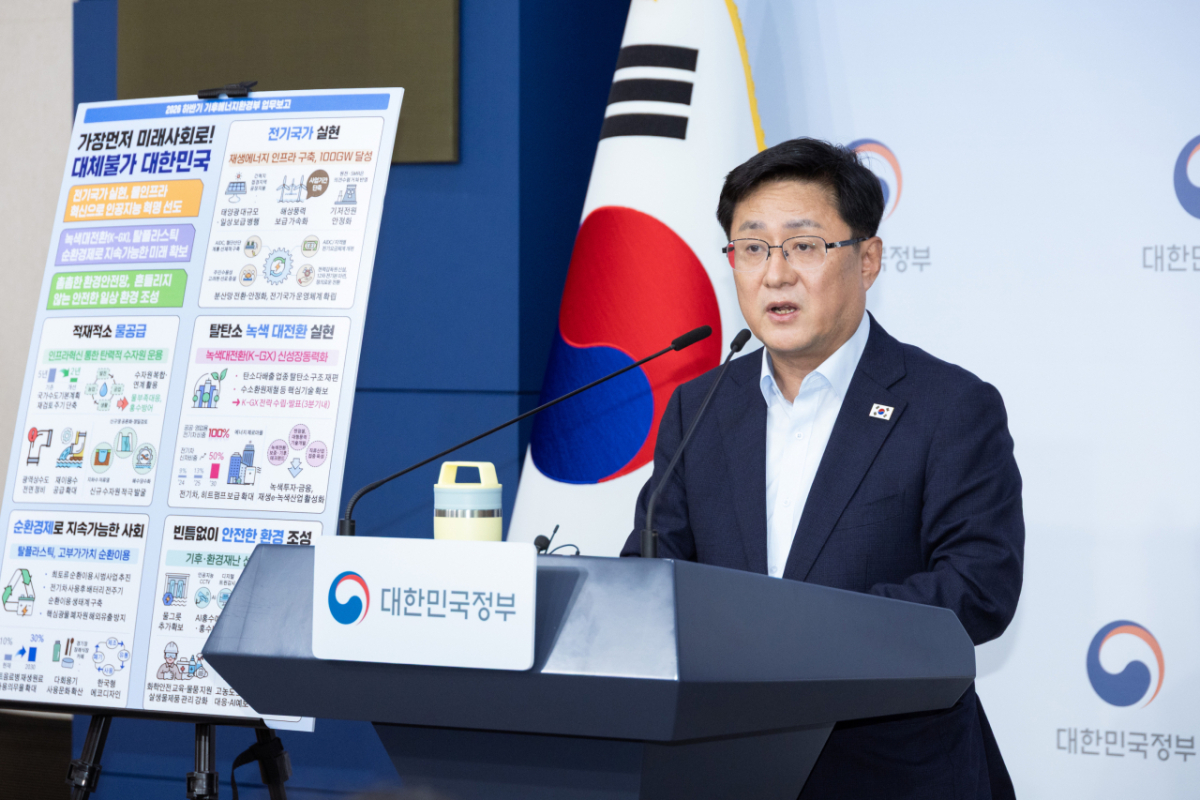
Minister Kim Sung-hwan announced that electricity rates will be reduced differentially to help industries competing with China, such as steel and petrochemicals, regain their competitiveness. The public discussion process to decide whether to proceed with new nuclear power plants is scheduled to begin this month.
Kim (Minister) stated at the one-year anniversary press conference held at the government Seoul office on the 3rd that "a public hearing on a regional differential electricity rate system will be held in August, and the final decision will be made shortly thereafter."
The regional electricity rate system is a new pricing structure that lowers electricity rates for areas closer to power generation facilities. Previously, electricity rates were applied differently based on usage categories such as industrial, residential, general, and educational purposes regardless of location. However, concerns have been raised that transmission costs are not properly reflected in the rates, prompting efforts to introduce the regional rate system. The regional rate system will apply only to industrial use, not residential use.
Kim (Minister) explained that the goal of introducing a regional electricity rate system is to reduce the electricity cost burden on companies in local areas and strengthen industrial competitiveness. He said, "Industries competing with China, such as steel and petrochemicals, are currently reporting that electricity rates have reached an unsustainable level." He added, "We aim to lower electricity rates differentially so that these industries can regain even a small degree of competitiveness."
However, there are concerns that reducing electricity rates could worsen the financial burden on Korea Electric Power Corporation (KEPCO), and plans are being made to address this issue. Kim (Minister) stated, "To alleviate KEPCO's financial burden, we would need to lower regional rates while increasing rates in the Seoul metropolitan area. However, this could create competitiveness issues for companies in the Seoul metropolitan area." He also noted, "We are considering separate measures to ensure that the regional rate system does not become a new source of deficit for KEPCO."
The public discussion process to decide whether to proceed with new nuclear power plants will also begin in earnest. Kim (Minister) explained, "The 15 gigawatts (GW) for the Yongin semiconductor industrial complex and the 6.3 GW for the Gwangju semiconductor industrial complex are fixed figures. However, there is a possibility that an additional 6 to 7 GW of power demand will arise for AI data centers." He added, "Considering all these factors, we need to discuss how much nuclear power will be necessary."
He stated, "The draft of the 12th Basic Plan for Electricity Supply and Demand, which includes whether to proceed with new nuclear power plants, will be prepared between September and October. To this end, discussions including how to handle nuclear power will begin this month."

 in ECONOMY
