

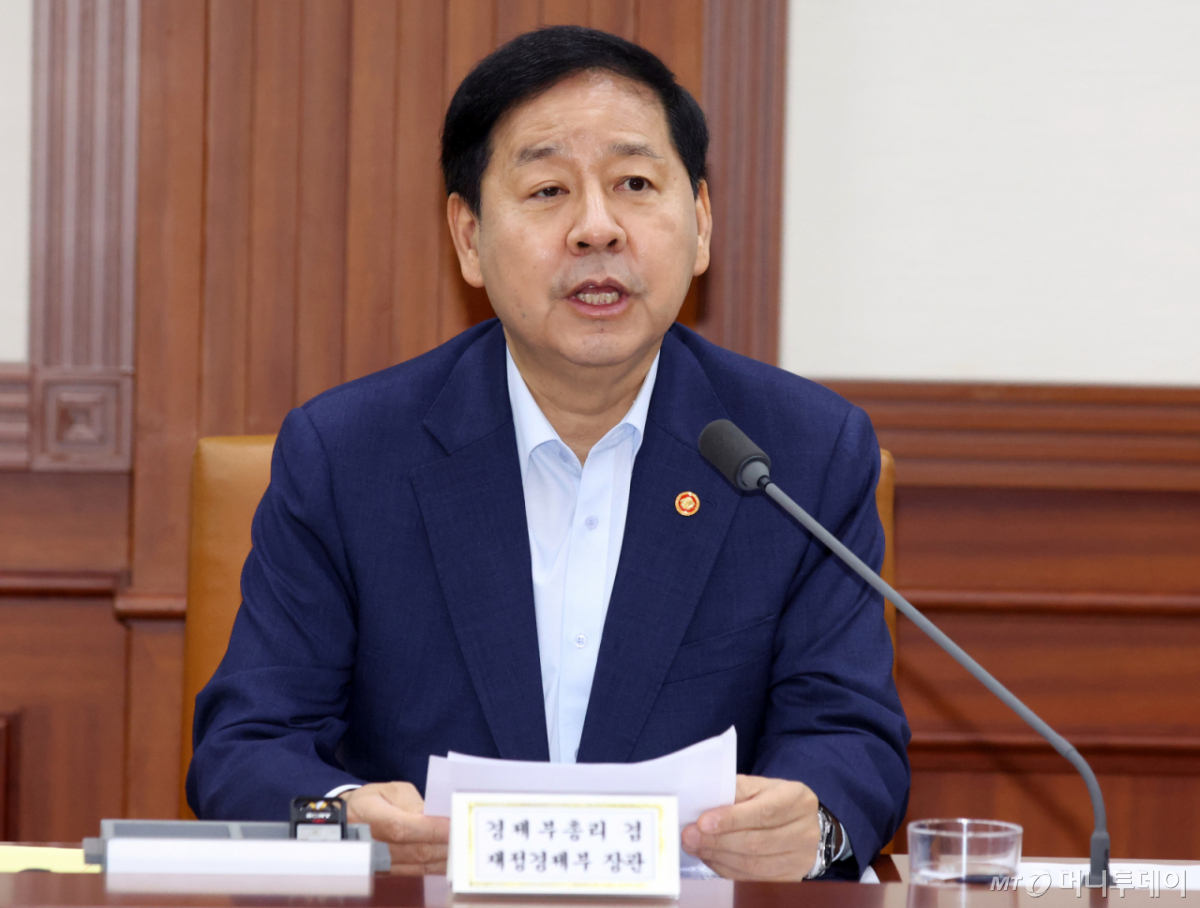
Deputy Prime Minister Koo Yun-cheol stated, "Thanks to the strong performance of the semiconductor sector, exports have recorded their highest-ever figures, while consumption and investment continue to improve, making it highly likely that the economy will return to a 3% growth trajectory for the first time in five years."
At the 'Emergency Economic Headquarters Meeting and Meeting of Ministers Responsible for Economic and Structural Innovation' held at the Government Complex in Seoul on the morning of the 6th, Deputy Prime Minister Koo noted, "The June current account balance surplus announced earlier reached $49.73 billion, marking the first time in history that it has approached the $50 billion level."
During today's meeting, discussions covered: △response measures related to the Middle East conflict, △directions for advancing economic structural innovation, △a paradigm shift in the national asset management system, and △plans to restore youth employment.
Deputy Prime Minister Koo said, "We will operate the Gyeong Je-gwan-gye (Minister) meeting as the 'Koo Jo-hyeok-sin (Minister) meeting' as well, preparing economic structural innovation measures monthly to ensure swift discussion and response."
He emphasized, "We will fundamentally strengthen the competitiveness of our industries to enable the emergence of second- or third-generation innovative sectors like semiconductors. We will sequentially develop, announce, and implement plans for industrial upgrading, including AI-based manufacturing process innovation and high-value-added transitions, across key industries such as steel and petrochemicals."
He pledged, "To support this, we will focus on cultivating the robotics industry, which is central to physical AI, and lay the groundwork for introducing physical AI across all sectors."
He also mentioned tailored innovation measures to address sectoral disparities. Deputy Prime Minister Koo stated, "To alleviate livelihood and financial insecurities among vulnerable groups, we will prepare a 'Strengthening Safety Net Plan' in the second half of this year and soon announce government plans for reforming basic and retirement pension systems. Regarding youth, we plan to concretize the customized policy directions by stage of social entry previously announced at the National Fiscal Strategy Meeting."
The national asset management system will also be transformed. Deputy Prime Minister Koo said, "In line with the rapidly growing scale of national assets (approximately 1,400 trillion won), we will shift the asset management paradigm from ownership and preservation to active utilization and value creation."
He added, "Beyond the existing real estate-centric management system, we will establish customized regulatory frameworks tailored to the characteristics of key assets such as securities, intellectual property, and virtual assets. We will also strengthen the control tower function of a central agency responsible for integrated utilization of national assets."
Deputy Prime Minister Koo stated, "We will gradually build a system tentatively named 'K-Asset Cloud' to link and integrate asset data across the public sector. This year, we will first connect asset information from national governments, local governments, and public institutional investors within the Digital Budget and Accounting System (dBrain)."
Regarding plans to restore youth employment, he emphasized, "We will expand support systems covering all stages from job seeking, recruitment, entry, and growth, and build a platform to match young people with actual job opportunities."
Deputy Prime Minister Koo promised, "The government will continue efforts to improve the structural health of capital markets and foster new industries, transforming them into more reliable investment destinations in the future."

 in ECONOMY
