

The Democratic Party of Korea's Seoul City Party will establish a new special headquarters to address issues related to real estate taxation and housing supply. While the central government moves to strengthen holding taxes on non-residents with one property, the city party is discussing supplementary measures to relax the criteria for deeming properties as owner-occupied. Democratic Party Seoul Ji Yeok (Rep.)s emphasized their criticism of Seoul City's private-led redevelopment and reconstruction housing supply policies and pledged to develop supply countermeasures led by the ruling party.
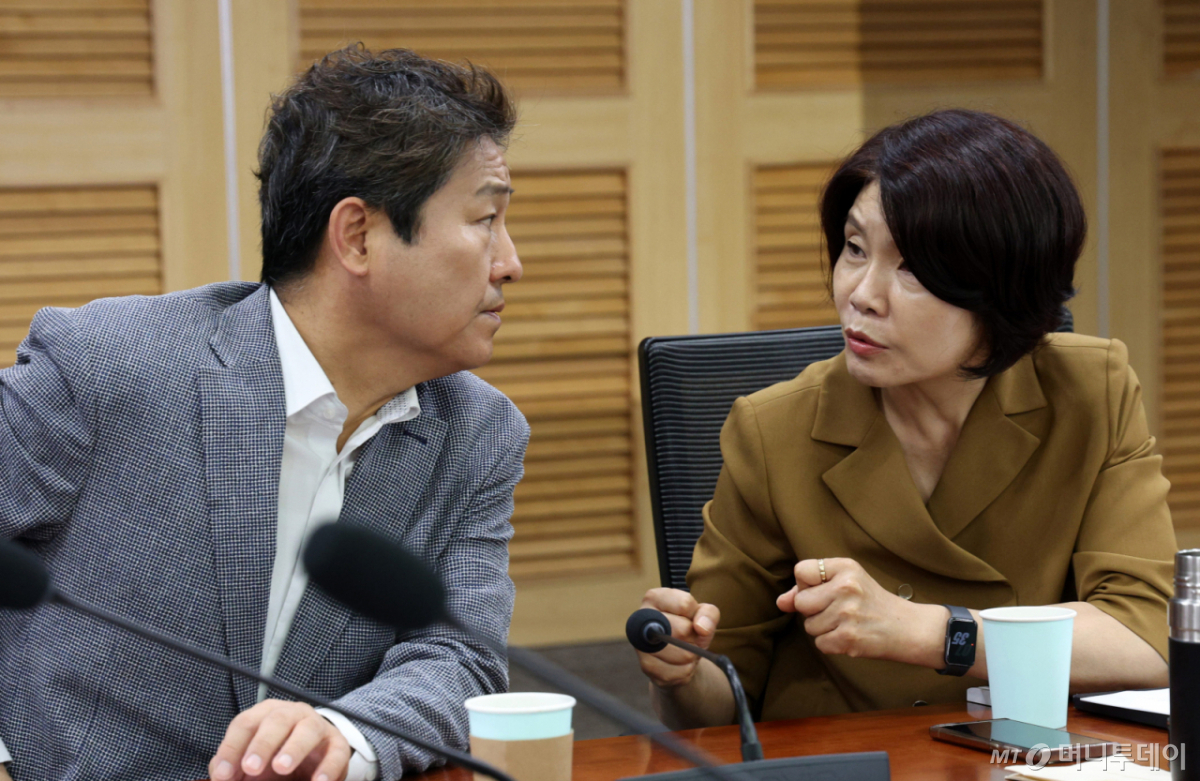
Kim Yeong-bae (Rep.), a candidate for Seoul City Party Chair, announced in a post-briefing after the seminar titled "Understanding Changes in Real Estate Tax Policy and Its Impact on Public Sentiment in the Seoul Region" held at the National Assembly Members' Hall in Yeouido, Seoul, on the morning of the 6th: "Through today's discussions, we have made the decision to establish a special headquarters-type response mechanism to address major issues in real estate problems and Mayor Oh Se-hoon's administration."
Regarding real estate taxation, it was decided to closely monitor market impacts through cooperation with the Seoul City Council, aiming for passage by the National Assembly in December. Kim (Rep.) stated, "The core of today's discussion is to closely monitor how real estate tax policies affect the market, rental and lease markets, citizens' daily lives, and what countermeasures are needed."
Particularly, plans focus on discussions regarding the government's recent tax reform proposal concerning non-residents with one property. The core of the recently announced real estate tax reform is to prevent concentration in 'one strong property.' Eliminating excessive tax reduction benefits for high-value properties owned by non-residents is also part of this initiative.
Specifically, while basic deductions for owner-occupied single homes were increased from 1.2 billion won (appraised value) to 1.4 billion won (market value approximately 2 billion won), thereby easing the burden of comprehensive real estate tax, non-residents with one property face a reduction in basic deductions from 1.2 billion won to 0.9 billion won, increasing their tax burden.
Democratic Party lawmaker Oh Ki-hyung explained regarding discussions on comprehensive real estate tax reform: "This involves a process of gathering diverse opinions, such as flexibly applying or gradually relaxing the criteria for deeming non-residents' single homes as owner-occupied."
This is interpreted as an effort to seek alternatives reflecting concerns over the real estate tax reform proposal. Observations suggest that since real estate policies significantly impact public sentiment in Seoul and with the 2028 general election approaching next year, the city party has taken preemptive steps for public opinion management.
Kim Yeong-bae (Rep.) also strongly criticized Mayor Oh's real estate supply policy, stating it fails to lead to genuine housing stability for ordinary citizens. Kim (Rep.) pointed out: "Mayor Oh claims he will supply 90,000 units through redevelopment and reconstruction, but over 220,000 households are being demolished in the process. Ultimately, a supply gap of 130,000 units emerges—where will these people go?" He further emphasized: "We will closely monitor the resulting rental market crisis and the loss of housing ladders for the 2030 youth generation."
Additionally, referencing recent Seoul City announcements on rental housing recruitment, __NAME_0__ criticized: "Six out of eight priority points for vulnerable housing groups have been abolished, leaving only housing subscription account deposit periods and residence duration. This is evidence that Mayor Oh pays no attention to substantive measures for youth and vulnerable housing groups."
The Democratic Party of Korea's Seoul City Party stated its position to strengthen cooperation with the central party's response mechanism and the government to derive substantive housing supply countermeasures. A second meeting on housing supply will be held at the Seoul City Council on the 13th, continuing discussions. Immediately after the conclusion of the Seoul City Party Chair election on the 16th, detailed operational plans and schedules for the response mechanism will be finalized.

 in ECONOMY
