

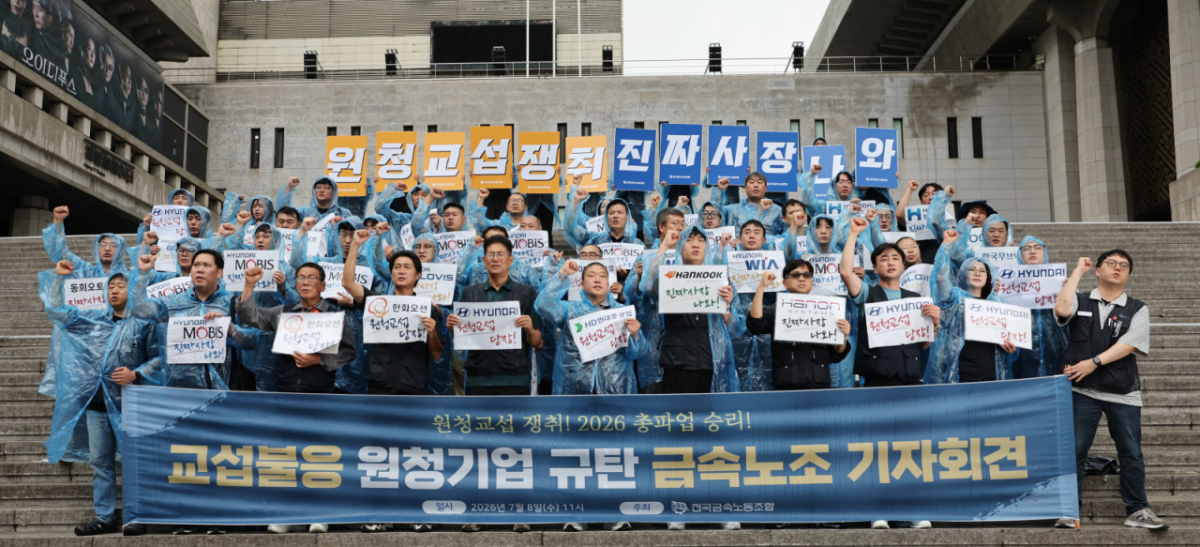
Following the enforcement of the amended Labor Union Act (Yellow Envelope Law), demands from both labor and management sides to determine whether prime contractors' employer status should be separated from bargaining units have surged, leading to concerns that the Central Labor Relations Commission (CLRC) is facing an overwhelming workload. With limited personnel and a growing number of cases, even the Ministry of Employment and Labor, which must adhere to the 52nd-hour workweek limit, is frequently seeing overtime hours exceed this cap.
According to the Ministry of Employment and Labor on the 17th, there are currently 82 retrial cases related to multiple union disputes under the amended Labor Union Act filed with the CLRC (as of the 7th). While there were about 19 cases in May and 14 in June, the number jumped to 40 in July. In the first week of August alone, nine cases were filed, surpassing the number of cases received during the same period last month.
The Labor Commission determines issues such as whether prime contractors qualify as employers under the amended Labor Union Act or whether multiple unions should be separated into distinct bargaining units. If either labor or management sides file an objection to a first-instance ruling by a local labor commission, the CLRC conducts a retrial.
Since the amended Labor Union Act was enforced in March this year, subcontract unions have increasingly demanded negotiations with prime contractors, leading to a rise in requests for rulings from the Labor Commission. During the first month of enforcement (March 10 to April 9), 1,011 subcontract unions requested negotiations targeting 372 prime contractor sites, and over 50 correction applications were filed with local labor commissions.
Local labor commissions began making formal decisions on requests for bargaining unit separation starting in April. Most of these decisions faced objections to the first-instance rulings, which is believed to have caused a surge in CLRC retrials beginning in May.
The problem is that the current staff and time are grossly insufficient for the CLRC to handle all retrial cases coming from across the country. Cases under the amended Labor Union Act are handled by the CLRC's Bargaining Representative Decision Division, which currently has only nine staff members. Even this number was increased from five to the current level starting this month in preparation for the surge in retrials caused by the amended law.
The statutory processing period for cases under the amended Labor Union Act is up to 20 days for orders to correct failures to notify negotiation requests, and 30 days for decisions on bargaining unit separation. Given the current rate of retrial increases and the limited staff, it is realistically impossible to process these cases within the statutory timeframe.
As a result, all CLRC staff are currently enduring monthly overtime work of up to 100–120 hours. In response, the Ministry of Employment and Labor plans to increase additional pay by expanding the cap on overtime allowances for its staff from the current limit of 4 hours per day and 57 hours per month to 8 hours per day and 100 hours per month.
However, critics argue this is merely a temporary fix. With the structural increase in cases related to the amended Labor Union Act, offering additional pay as an incentive cannot be considered a fundamental solution.
Especially, once unfair labor practice cases related to the amended Labor Union Act begin to be formally filed, work intensity is expected to more than double beyond current levels. Even if the CLRC decides to separate bargaining units, if prime contractors refuse to negotiate, unions can request further rulings on the prime contractors' unfair labor practices.
It is also difficult to avoid criticism that the Ministry of Employment and Labor, which is responsible for protecting workers' health rights, is actually encouraging long working hours among its own institutional investors staff. While civil servants are not subject to the Labor Standards Act, which sets a 52-hour workweek limit, it is ironic that employees within the Ministry of Employment and Labor, which enforces the Labor Standards Act and promotes reduced working hours, are instead exposed to excessive long working hours.
A Ministry of Employment and Labor official explained, "We plan to manage against excessive long working hours by providing substitute leave when overtime exceeds 8 hours per day," adding that "staff recruitment is also currently underway."

 in ECONOMY
