

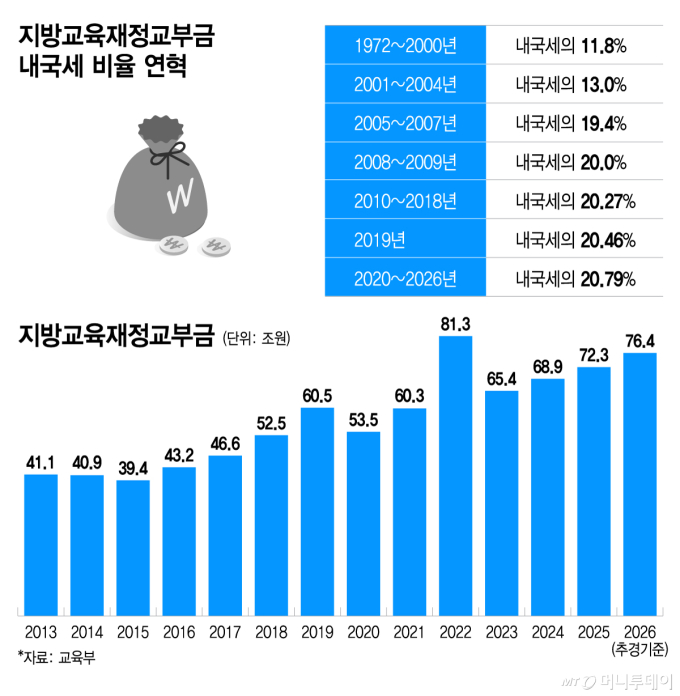
The government has decided to abolish the domestic tax-linked structure of the Local Education Fiscal Subsidy (hereinafter "Education Subsidy"), which has been maintained for 54 years. It is also pursuing a plan to break down the 'partition' in the Education Subsidy by utilizing surplus tax revenues for a Future Response Fund. However, final negotiations are underway as the Ministry of Planning and Budget and the Ministry of Education hold differing positions on the details, causing last-minute difficulties. Consequently, the release of the reform plan has been delayed beyond initial plans.
◇Principle agreement to abolish domestic tax-linked structure, but last-minute difficulties over details=According to relevant ministries on the 17th, the Ministry of Planning and Budget and the Ministry of Education are in final coordination regarding the Education Subsidy reform plan. It is expected that the core issue, the domestic tax-linked structure, will be abolished, and a new calculation formula for the Education Subsidy reflecting economic growth rates and school-age populations will be introduced. The Education Subsidy is a budget for local education offices funded by 20.79% of domestic taxes and part of the education tax. When the domestic tax-linked structure for the Education Subsidy began in 1972, the subsidy rate was 11.8%, but it has steadily risen since then to reach the current 20.79%.
The Ministry of Planning and Budget maintains that the domestic tax-linked structure must be abolished amid a declining school-age population. The Ministry of Education, which has consistently argued for maintaining the domestic tax-linked structure whenever discussions on reforming the Education Subsidy arise, has now decided to agree in principle to the abolition plan. Both ministries are currently discussing a new calculation formula for the Education Subsidy that reflects growth rates and school-age populations. Minister of Education Choi Gyo-jin stated at the National Assembly's Education Committee on the 14th, "There has been much agreement regarding the formula on which one can reduce volatility more and provide substantial support."
However, they remain at an impasse over the details. It is reported that the Ministry of Education requested that while abolishing the domestic tax-linked structure, a legal provision be included to ensure the total amount of the Education Subsidy under the current '20.79% rule' is secured steadily each year through relevant safety mechanisms.
Positions also diverge on how to utilize the Future Response Fund, which is planned to be newly established using surplus tax revenues. The Ministry of Planning and Budget plans to create a 'Talent and Education Account' within the Future Response Fund and allocate it to areas such as higher (university) education and lifelong learning that could not previously be funded through the Education Subsidy. Contrary to the Ministry of Planning and Budget's plan, the Ministry of Education insists that the Future Response Fund must also be usable for elementary and secondary education.
As the two ministries have failed to reach final agreement, all situations remain uncertain, including whether the Education Subsidy reform plan will be finalized and the possibility of its confirmation before the government budget proposal is submitted to the National Assembly in early September.
◇Background for reform: declining school-age population, increasing subsidy amounts=The Ministry of Planning and Budget's strong push for reforming the Education Subsidy stems from concerns that with a massive surplus tax revenue expected due to the semiconductor boom, the Education Subsidy, which grows without limits, could be mismanaged. This is because while the school-age population shrinks, the Education Subsidy increases year after year. The domestic tax-linked structure, which causes volatility based on tax revenues and creates a 'partition' that prevents use for infants, higher education, and lifelong learning, also influenced this decision.
The school-age population (ages 6–17), which was 10.73 million at the time of its introduction in 1972, has decreased to 4.922 million as of this year (based on mid-range population projections by the National Data Agency). In contrast, the Education Subsidy increased from 43.2 trillion won in 2016 to 76.4 trillion won as of this year's supplementary budget proposal, a rise of approximately 76.8%. The reason the Education Subsidy has been maintained despite population decline is due to the domestic tax-linked structure. The Education Subsidy, which was 11.8% of domestic taxes in 1972, has steadily increased to 20.79% by 2020 for various reasons, including the implementation of compulsory free education for middle schools. The 'partition' structure of the Education Subsidy is also a background factor for its abolition. The Education Subsidy, funded at 20.79% of domestic taxes, is an so-called 'partitioned' budget used only for kindergarten, elementary, and secondary education.
Yang Jun-seok of Catholic University of Korea Gyeong Je-hak-gwa (Prof.) said, "The timing for reforming the Education Subsidy seems to have already passed," adding, "If left unaddressed, government spending could increase indefinitely, so reform must be carried out quickly; however, it is also important to specifically determine how these funds will be used."

 in ECONOMY
