

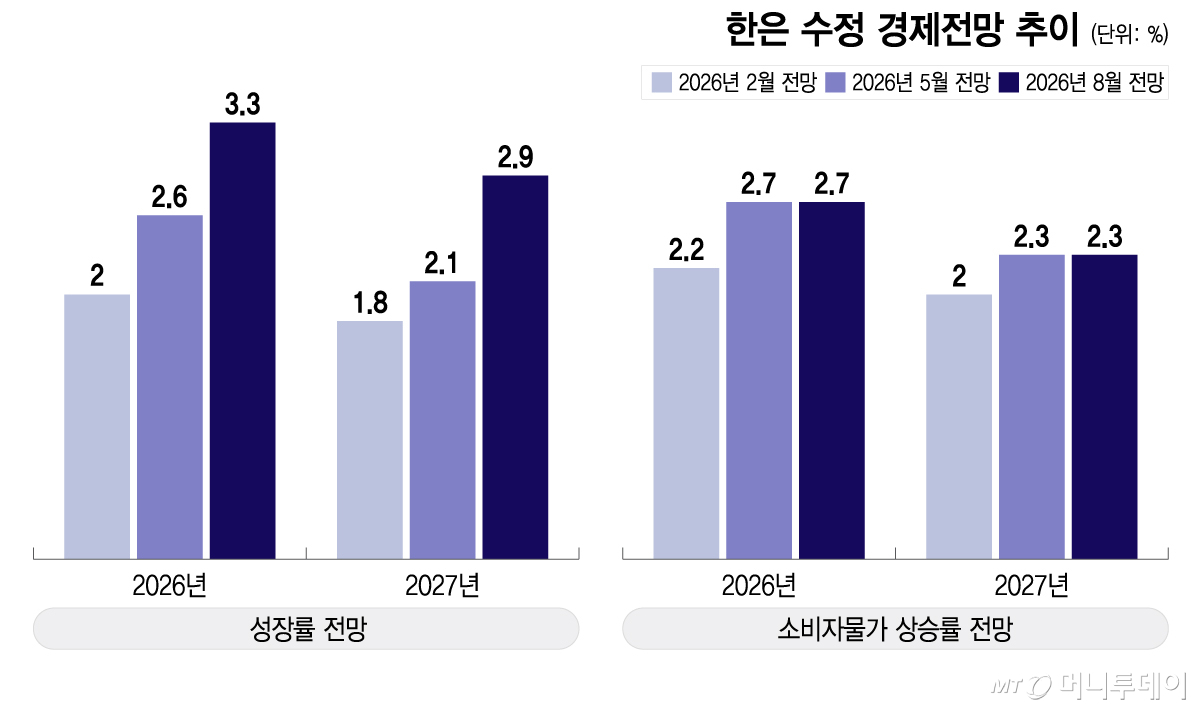
The Bank of Korea presented its economic growth forecast for this year at 3.3%, an increase of 0.7 percentage points (pp) compared to the projection made three months ago.
This forecast reflects a boom in the semiconductor industry, and it is judged that if export growth centered on the semiconductor sector continues to expand, this year's economic growth could reach as high as 3.5%. The possibility of upwardly revising the potential growth rate, which reflects the actual growth rate, has also been kept open.
On the 27th, when announcing its revised economic outlook, the Bank of Korea projected growth rates of 3.3% for this year and 2.9% for next year. This represents an increase of 0.7 pp and 0.8 pp, respectively, compared to the May forecast. The semiconductor industry boom has lifted the growth rate forecasts.
Bank of Korea Governor Shin Hyun-song said at a press conference held after the Monetary Policy Board meeting that day: "The semiconductor market is performing better than initially expected, and exports and investment are continuing to grow at high rates. With improvements in income conditions, consumption recovery is also expected to gradually expand."
Compared to the forecast made three months ago, the Bank of Korea explained that there were upward factors including a semiconductor industry boom (0.35 pp), revision of actual figures (0.2 pp), acceleration of investment such as three major mega-projects (0.1 pp), and a smaller-than-expected impact from the Middle East conflict (0.1 pp).
The revision of actual figures means that this year's second-quarter growth was recorded at 0.6% quarter-on-quarter, which is better than expected. With first-quarter growth reaching a high level of 1.8%, the second quarter also recorded "positive" growth, resulting in a first-half growth rate of 3.8% compared to the same period last year.
As exports continued their soaring performance, the Bank of Korea raised its forecast for this year's current account balance surplus from the previous 250 billion dollars to 450 billion dollars. On the other hand, it forecast that the increase in the number of employed persons this year would slow down to 140,000, compared to the May forecast of 180,000.
The Bank of Korea stated: "This year's employment figures are expected to fall below the May forecast due to the impact of the Middle East conflict and sluggishness in vulnerable sectors such as construction." However, it added: "In the second half of the year, the impact of the Middle East conflict is expected to gradually ease, and with continued economic improvement, private employment is projected to show a recovery trend."
According to the Bank of Korea's economic outlook scenario, optimistic factors include further expansion of semiconductor export growth and an early calming of the Middle East situation. If export growth continues to expand, this year's and next year's growth rates are expected to rise by 0.2 pp and 0.6 pp, respectively. This means that growth rates for this year and next could reach as high as 3.5%.
If the Middle East situation calms down early, growth rates are forecast to be revised upward by 0.1 pp this year and 0.2 pp next year. This is a forecast based on the assumption that international oil prices will fall from $76 per barrel in the second half of this year to around $63 per barrel next year.
Conversely, if export growth slows down, this year's and next year's growth rates are expected to decline by 0.1 pp and 0.4 pp, respectively. Additionally, if the Middle East situation remains in a deadlock for an extended period, it is forecast that growth rates for this year and next will be pulled down by 0.1 pp and 0.3 pp, respectively.
The Bank of Korea's growth rate forecast is higher than those of the OECD (2.6%), International Monetary Fund (IMF·2.6%), government (3.0%), and Korea Development Institute (KDI·3.2%), but lower than Moody's (3.5%). The more recently institutional investors have released their forecasts, the higher their growth rate projections tend to be.
Contrary to forecasts suggesting a prolonged period of low growth, this year's and next year's growth rates are expected to remain at relatively high levels, leading to discussions about the possibility of upwardly revising the potential growth rate.
Potential growth rate is the maximum growth rate that can be achieved without triggering inflation when all production factors are utilized. Potential growth rates vary depending on the model used; currently, Korea's potential growth rate is estimated to be around the mid-1% range.
A Bank of Korea official explained: "If the long-term trend of actual growth rates rises as forecasted, the potential growth rate could also increase."

 in ECONOMY
