

Distribution indicators by income group improved significantly in the second quarter due to the disbursement of support funds for high-price impacts. While both high-income and low-income households saw their incomes rise, the increase was larger for low-income households.
According to the '2026 Second Quarter Household Income and Expenditure Survey Results' released by the Data Bureau on the 27th, the equivalized disposable income ratio of the 5th quintile stood at 4.97 times in the second quarter. This is an indicator showing the degree of inequality in household income and represents the lowest figure since statistics began being compiled in 2006. It is also the first time the ratio has fallen below 5, after previously fluctuating between 5 and 7 times.
The average monthly income for households in the 1st quintile was 1.283 million won, a 7.5% increase from the same period last year. Disposable income available for actual consumption also rose by 7.5% to 1.094 million won. The average propensity to consume, which is the proportion of disposable income spent on consumption, fell by 2.7 percentage points. An average propensity to consume exceeding 100% means that household expenditure exceeds income.
For households in the 5th quintile, the average monthly income increased to 11.15 million won, with a growth rate (3.8%) relatively lower. Disposable income rose by 4.3% to 8.621 million won.
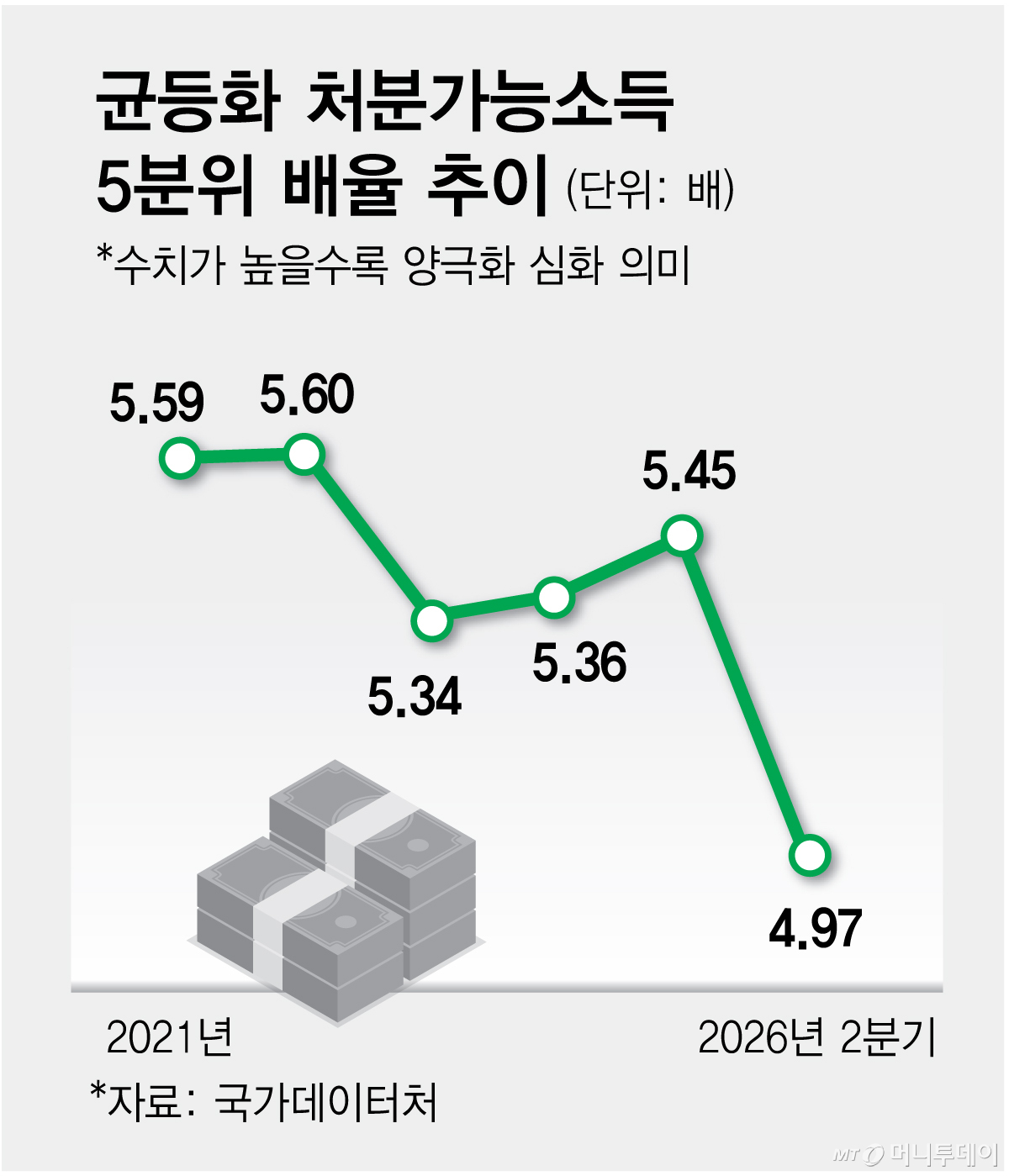
The decline in the 5th quintile ratio is largely attributed to the high-price impact support funds. The growth rate of transfer income, composed of public and private transfer income, reached 20.4%, the highest level since the second quarter of 2022 (44.9%), marking a 16-quarter gap. High-price impact support funds are recorded as public transfer income.
Park Soon-ok, chief of the Household Budget Trends Division at the Data Bureau, stated, "The second quarter has seasonal factors that are lower compared to other quarters," but added, "In this quarter, both income and expenditure increased, and a significant portion of the income increase was driven by growth in transfer income due to high-price impact support funds."
He also noted, "There was an upward shift in income for the 1st quintile through public transfer income," while adding, "Although the 5th quintile also increased, its income growth was relatively lower than other quintiles due to factors such as a decline in labor income."
The average monthly household income in the second quarter was 5.295 million won, a 4.5% increase from the same period last year. This marks the 12th consecutive quarter of growth since the third quarter of 2023. Labor income rose to 3.218 million won (0.8%), business income to 977,000 won (3.8%), and transfer income to 931,000 won (20.4%). Real income, reflecting the inflation rate, increased by 1.5%.
Household expenditure rose by 3.0% to 3.993 million won, marking 22 consecutive quarters of growth since the first quarter of 2021. Increases were seen in household goods and housekeeping services (17.9%), food and accommodation (3.5%), and entertainment and culture (7.6%), while decreases occurred in transportation and shipping (-0.5%) and alcohol and tobacco (-2.2%). Real consumption expenditure increased by 0.4%. Disposable income rose by 5.2% to 4.235 million won, and the surplus amount increased by 9.6% to 1.302 million won. The average propensity to consume fell by 1.2 percentage points to 69.2%.

 in ECONOMY
