

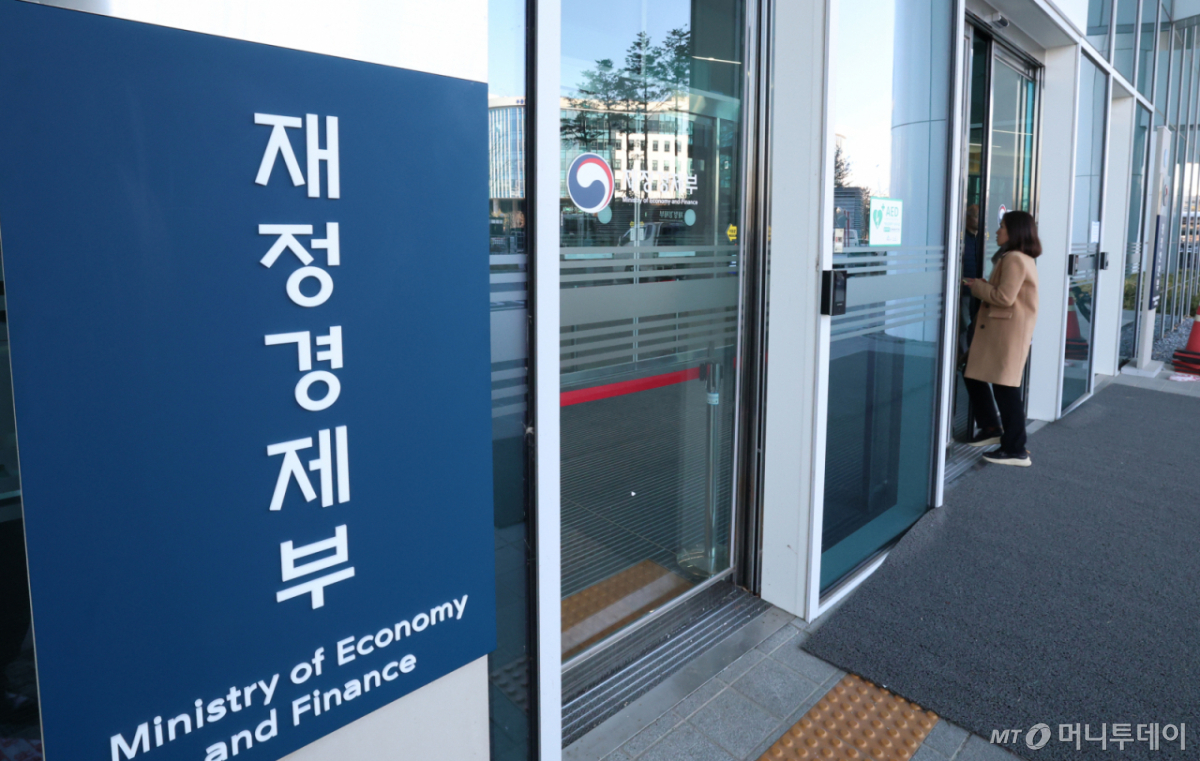
The government is accelerating the enactment of the "Basic Act on the Development of Service Industries" (Service Industry Act) to support the service sector, where high-value-added industries are concentrated, following its push for semiconductors. New industries that had been stifled by siloed regulations across ministries are expected to gain breathing room. With the direction set to exclude the health and medical fields, which had strongly opposed being classified under the service industry, the bill is now effectively awaiting passage by the National Assembly.
According to government ministries on the 21st, the Ministry of Economy and Finance is pushing for the enactment of the Service Industry Act within the year to foster the service sector as a driver of the Korean economy following semiconductors. The service industry refers to sectors other than those that produce goods, such as agriculture, forestry, fisheries, and manufacturing. It includes accommodation and food services, finance and insurance, public administration, education, health and medical care, arts, and sports.
Currently, there is no integrated government support system or legal basis for supporting the service industry. Most importantly, with the rapid development of AI (artificial intelligence) and its convergence with existing service industries giving rise to a flood of new industries, it has become difficult to define these emerging sectors within the existing framework. Every time new industries such as Tada, Lotte, and Samcheomsam emerged, they failed to enter the formal regulatory system and faced disputes.
The service industry has long been viewed as an auxiliary sector to manufacturing and consistently ranked low in priority. However, as AI combines with various service industries to generate economic value, there are many voices calling for proactive deregulation. In particular, the service industry accounts for 60% of Korea's added value and 70% of employment. Its job creation coefficient is 10.0, which is twice that of manufacturing.
Industry insiders unanimously state that there is no government support for the service sector, only regulations saying what "should not be done." Nam Seong-jun, CEO of Dajayo, stated at the "Service Industry Policy Communication Seminar" held at the Government Sejong Complex on the 19th, "No matter how good a technology is, it is useless if it does not emerge as a service," adding, "Procedures were established to achieve good results, but now it seems the procedures have become the purpose in themselves." He expressed that businesses are unable to operate at all due to being tied up in procedures such as permits and licenses.
Dajayo is a startup that remodels vacant houses in rural areas to broker lodging services. In its early stages, the company faced the brink of closure due to regulatory barriers. In 2019, it underwent police investigation on the grounds that the Rural Development Act provided no legal basis for operating vacant houses without residents as lodging facilities.
When a startup faces regulations after founding and operations are halted, sales deteriorate and securing investment becomes difficult. For another challenge to begin, there must be an enterprise that has proven its concept, but according to Nam (CEO), the "first penguin" effectively faces the brink of closure in the process of breaking through regulations. Dajayo also gained breathing room after being selected for the regulatory sandbox special exemption and the Ministry of Economy and Finance's (now Ministry of Economy and Finance) "One Step Model," but the damage caused by regulations remains a persistent issue.
This is precisely where the Service Industry Act is needed. Notably, the bill to enact the Service Industry Act, introduced by Democratic Party of Korea lawmaker Kim Young-hwan, explicitly states that the government should improve unreasonable regulations and practice proactive administration to activate the service industry. In particular, it stipulates that when laws are unclear, they should be interpreted in a direction that prioritizes industrial promotion. It also includes provisions for supporting research and development in the service industry and establishing an agency to mediate conflicts between new industries and existing businesses.
Most importantly, by excluding the "health and medical" field, the bill has moved away from the "privatization of healthcare" framework, which had been the biggest point of contention. Of the four bills pending in the 22nd National Assembly, two (the Kim Young-hwan and Choi Eun-seok (Rep.) bills) exclude the application of laws such as the Medical Service Act, Nursing Act, Pharmacy Act, National Health Insurance Act, and National Health Promotion Act.
The Service Industry Act has repeatedly failed to clear the hurdle of the National Assembly since it was stalled during the Lee Myung-bak administration in 2011 on grounds that it would undermine the public nature of healthcare. The government is also in a mood of expecting enactment within the year, as much of the main controversy has been resolved.
A Ministry of Economy and Finance official said, "In a situation where new convergent services combined with AI are emerging rapidly, it is not easy to systematically support the service industry under the current system," adding, "We will strive to ensure that the Service Industry Act is enacted within the year so that the service industry can become a second pillar of economic growth alongside manufacturing sectors such as semiconductors."

 in ECONOMY
