

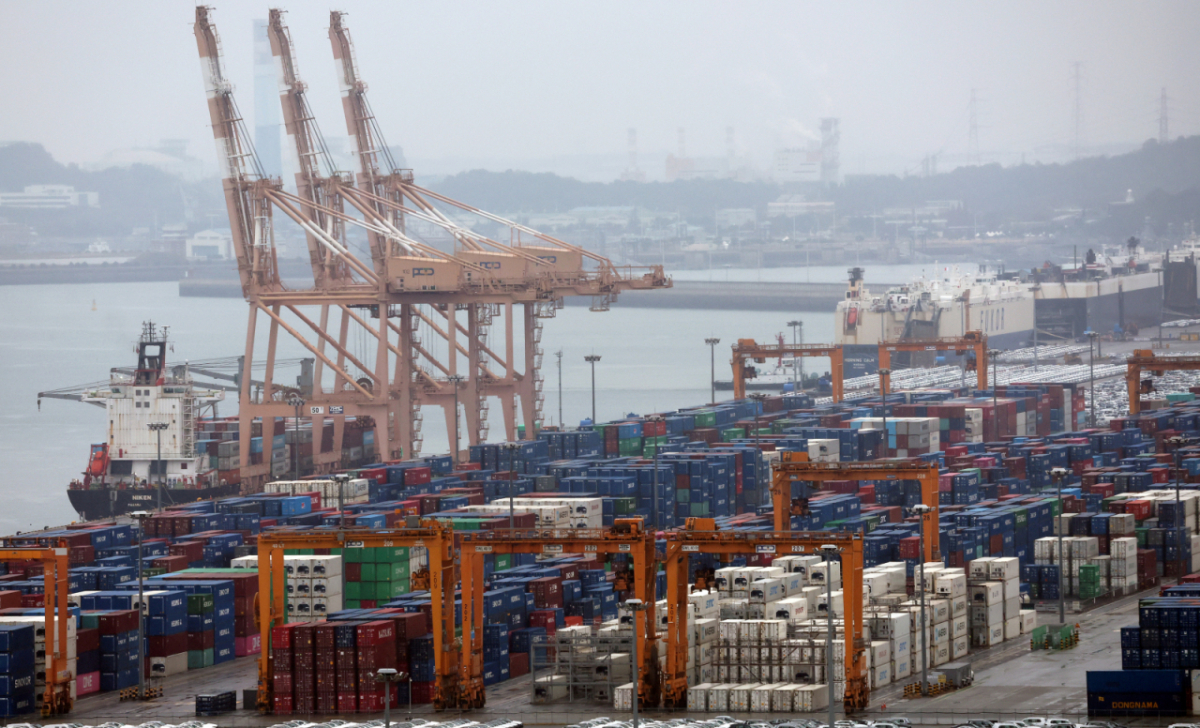
With cumulative exports through October this year surpassing a record high of USD 930 billion, analysts say a breakthrough to USD 1 trillion is highly likely within this month. South Korea is expected to join the "USD 1 Trillion Club" as the fourth country in the world, following the United States, China, and Germany. As the semiconductor boom continues, exports are projected to grow by more than 20% next year.
According to the "October 2026 Export and Import Trends" released on the 1st by the Ministry of Trade, Industry and Energy, last month's exports totaled USD 115.28 billion, a 93.7% increase from the same period last year. This follows September's record-high exports of USD 121.1 billion, marking the second consecutive month that exports exceeded USD 110 billion. It is also the highest export figure for any October on record.
Cumulative exports from January to October this year reached USD 930 billion, surpassing the USD 900 billion mark for the first time in history. This represents a 60.6% increase compared to the same period last year. Previously, last year's total export volume of USD 709.3 billion was considered the record high, but this year's cumulative exports had already surpassed last year's annual total by reaching USD 812.7 billion through September. Last month marked the first time in history that the USD 900 billion threshold was crossed.
Given this trend, a breakthrough to USD 1 trillion in exports is highly likely within this month. Export values typically tend to increase from the beginning of the month to the end. Calculating based on the daily average export value for the first 20 days of last month (USD 4.74 billion), there is a high probability that the USD 1 trillion mark will be reached between the 19th and 20th of this month.
If South Korea achieves USD 1 trillion in exports, it will become the fourth country in history to do so, following the United States, China, and Germany. Japan, a major export power, has never achieved USD 1 trillion in exports.
Securing a top-five position in global exports this year is certain, with the possibility of rising to fourth place depending on circumstances. According to World Trade Organization (WTO) data, the country-by-country export rankings for the first half of this year were: 1st China (USD 2,125.4 billion), 2nd United States (USD 1,238.8 billion), 3rd Germany (USD 952.4 billion), 4th Netherlands (USD 531.5 billion), and 5th Republic of Korea (USD 496.1 billion). Considering that South Korea's export growth has accelerated in the second half, there is ample possibility of overtaking the Netherlands to claim fourth place by year-end.
The core driving force behind the export boom is semiconductors. Last month's semiconductor exports totaled USD 56.44 billion, a 259.4% increase from the same period last year. This is the second-highest record in history, following September's USD 60.3 billion, and also the highest record for any October on record.
As global investment in AI (artificial intelligence) expands, semiconductor demand has surged while supply remains limited, causing semiconductor prices to continue rising. This year, DDR (Double Data Rate) 5 fixed prices based on 16Gb (gigabytes) have risen monthly: USD 40 in June, USD 45 in July, USD 46.5 in August, USD 48 in September, and USD 50 in October.
If this trend continues, annual exports could exceed USD 1 trillion this year, potentially reaching USD 1.1 trillion. Even with a simple calculation assuming exports of USD 100 billion each in November and December, this year's exports are projected to reach USD 1,130 billion.
Analysts predict that the export growth trend will continue next year as well, given the expected persistence of the semiconductor boom. Jung Sung-tae, a researcher at Samsung Securities, analyzed in a report on the 1st of last month, "Monthly exports are expected to remain around USD 120 billion in the fourth quarter, pushing this year's total above USD 1.1 trillion." He added, "Even if next year's exports maintain current levels, achieving 20% growth is secure, and there is a high possibility of upward revision considering price adjustments for HBM (High Bandwidth Memory)."
However, recent global trends in rising interest rates, the resulting deterioration in the financial soundness of big tech companies, and reduced AI investment are cited as variables. The fact that plans to build AI data centers in major regions such as the United States are facing disruptions due to resident opposition is also a burden.

 in ECONOMY
