

Norway designed a structure in the 1990s to accumulate oil revenues in a sovereign wealth fund and return the investment returns to society as a whole according to fiscal principles. It converted resource booms, rather than consuming them as temporary windfalls, into long-term social assets.
The Future Response Fund emerged from discussions on how best to utilize record-breaking excess tax revenue resulting from the semiconductor supercycle (super-boom). The one who first raised the issue was former Cheong Wa Dae Policy Office Director Kim Yong-beom. Although he attached the tentative name “National Dividend,” fueling controversy, the essence of his proposal was a question about how to institutionalize structural excess profits (excess tax revenue) for social benefit.
Former Director Kim cited the case of Norway’s sovereign wealth fund. In 1990, Norway launched the Government Pension Fund Global (GPFG) to preserve oil revenues as assets for future generations. It invested the proceeds from selling oil in overseas assets and set a limit on how much of that income could be injected into the government budget, thereby preventing an inflow of cash assets into the domestic economy. This was because a massive influx of money domestically could drive up prices and wages, potentially undermining the competitiveness of other export industries.
The government initially also considered allocating a significant portion of excess tax revenue to a “Korean-style sovereign wealth fund.” At the time, the government was preparing to launch such a fund. The concept was to increase national wealth and generate continuous returns through a sovereign wealth fund, rather than exhausting excess tax revenue as temporary fiscal support.
Ku Yun-cheol, then Deputy Prime Minister and Minister of the Ministry of Economy and Finance, stated in an appearance on the economics-focused YouTube channel “3PROTV” at the end of May last year, “We aim to create a virtuous cycle where excess tax revenue that appears when the economy is doing well serves as a resource for the sovereign wealth fund, which then invests it to earn more money.”
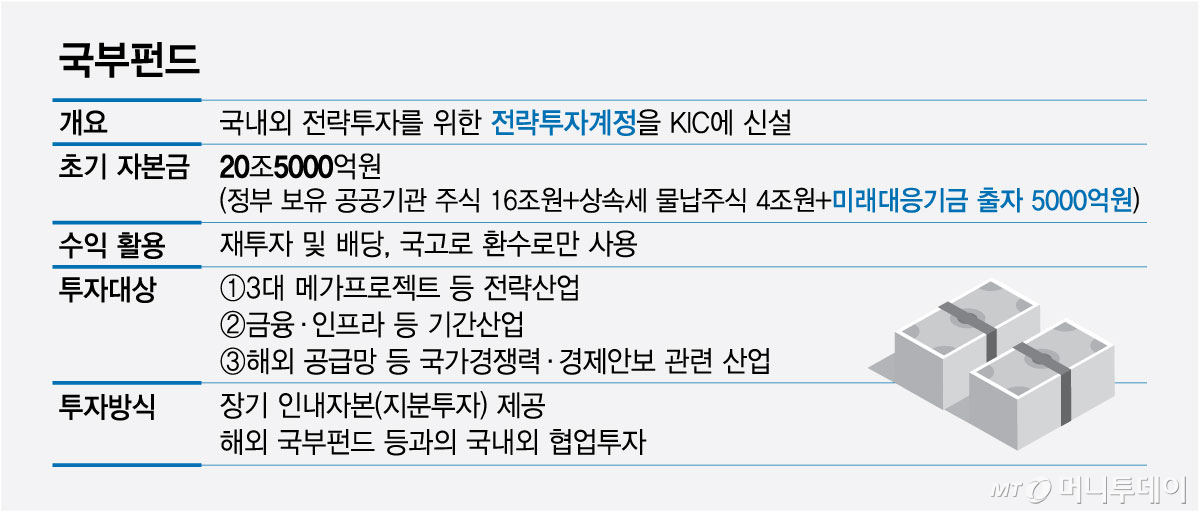
However, with the emergence of the Future Response Fund idea, the plan to allocate excess tax revenue to a Korean-style sovereign wealth fund lost momentum. In its economic policy direction for the second half of the year released in July last year, the government withdrew its plan to establish a Korean-style sovereign wealth fund and shifted course by creating a “Strategic Investment Account” within the existing sovereign wealth fund, the Korea Investment Corporation (KIC). In addition to the previously announced resources of 16 trillion won in public institution stocks and 4 trillion won in stock paid as tax, it decided to contribute only 500 billion won in cash from the Future Response Fund.
Instead, the Future Response Fund rose rapidly in prominence. Analysts suggest that, from the government’s perspective, the fund’s appeal lay in its character, similar to a “contingency reserve,” which allows for flexible execution. In fact, the government’s proposal allows the fund management plan to be changed without National Assembly approval within 30% of the expenditure amount for major items. Although the government drew a line, controversy arose when President Lee Jae-myung proposed using the Future Response Fund for holiday discount support budgets.
Among experts, concerns are emerging that a fund approach responding only to short-term demand carries a high risk of resources from temporary booms being dispersed and consumed as disposable budgets. On the other hand, it is pointed out that since a sovereign wealth fund preserves principal while structuring expenditures based on generated investment returns, the use of sovereign wealth funds should be expanded further to build sustainable future response capabilities.
The Ministry of Planning and Budget shows reluctance toward proposals to increase the Future Response Fund’s capital contribution to a sovereign wealth fund. Park Hong-geun, Minister of the Ministry of Planning and Budget, explained during a National Assembly audit that “the Future Response Fund has two aspects: one as a fiscal stabilization device and the other as strategic investment,” adding, “It is not a fund established with the concept of managing surplus funds to create national wealth.”
He added, “A sovereign wealth fund involves holding equity stakes to make long-term investments in advanced strategic industries using stocks held by public institutions or stock paid as tax by companies,” and concluded, “Ultimately, it is insufficient even from the perspective of a stabilization device that returns funds to the fiscal budget.”
Professor Song Heon-jae of the University of Seoul stated at a public hearing on the enactment of the Future Response Fund Act held in the National Assembly, “Norway’s sovereign wealth fund uses resources only within the range of expected real returns while preserving principal, and Chile’s Economic and Social Stabilization Fund has its criteria determined by an independent expert body under a structural fiscal balance rule.” He noted that this “shows that the success or failure of [the Future Response Fund] depends not on the size of the treasury, but on the rules for opening and closing it and the independence of those rules from government discretion.”

 in ECONOMY
