

Kristalina Georgieva, Managing Director of the International Monetary Fund (IMF), met with Deputy Prime Minister and Minister of Economy and Finance Lee Hyoung-il in Bangkok, Thailand, on the 17th of last month. While mentioning the Future Response Fund, she evaluated it as a "buffer device to prepare for future changes in economic conditions."
Stefano Scarpetta, Chief Economist of the Organisation for Economic Co-operation and Development (OECD), also met with Vice Minister of Planning and Budget Cho Yong-beom in Paris, France, on September 30, describing the Future Response Fund as a "wise policy choice."
These are assessments of the Future Response Fund issued by two major international organizations representing the global economy. This is the background behind President Lee Jae-myung's remark in his State of the Nation Address on the budget bill on the 2nd, stating that "international organizations and major credit rating agencies have also very positively evaluated the improvement in the fiscal balance and the role of the Future Response Fund."
In fact, there is not much dissent regarding the original intent behind introducing the Future Response Fund. This is because a consensus has been formed on the need for a mechanism to respond to tax revenue volatility amid recurring excess revenues and shortfalls, and to secure stable resources for future generations and growth drivers.
The issue lies less in the purpose of the Future Response Fund than in its operational method. In addition to issues primarily raised by the opposition party, such as infringement on the National Assembly's budget deliberation authority and national debt management, the asymmetry between revenue and spending is pointed out as a structural limitation of the Future Response Fund.
The main sources of funds for the Future Response Fund include excess tax revenue, additional tax revenue, and the balance of world surplus funds. Among these, additional tax revenue accounts for the majority.
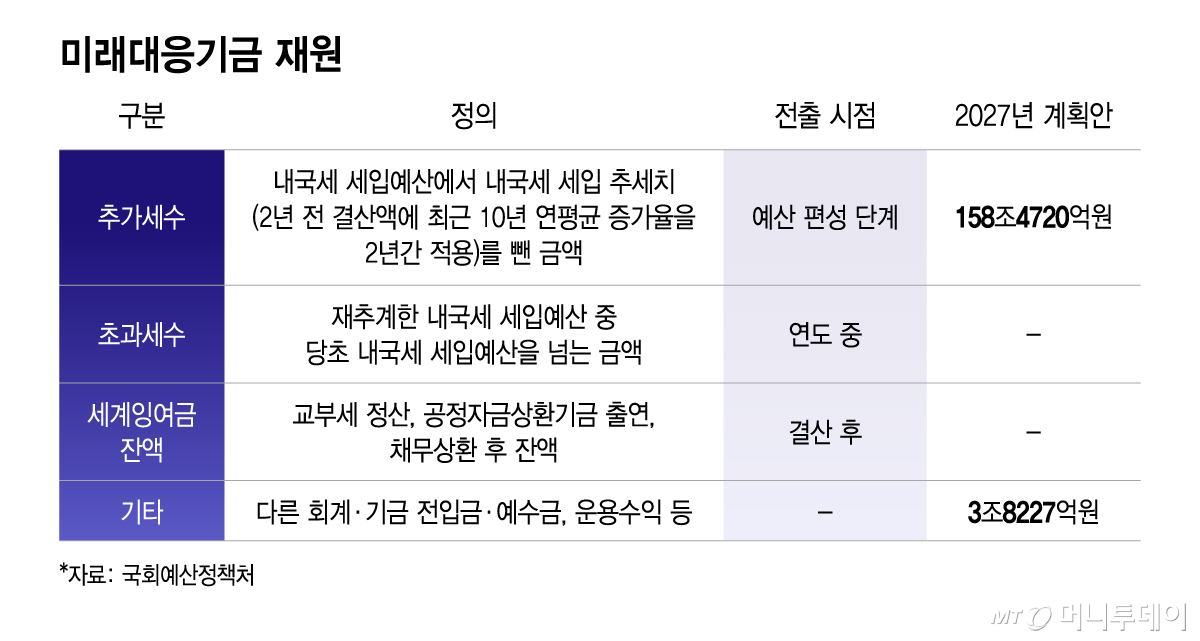
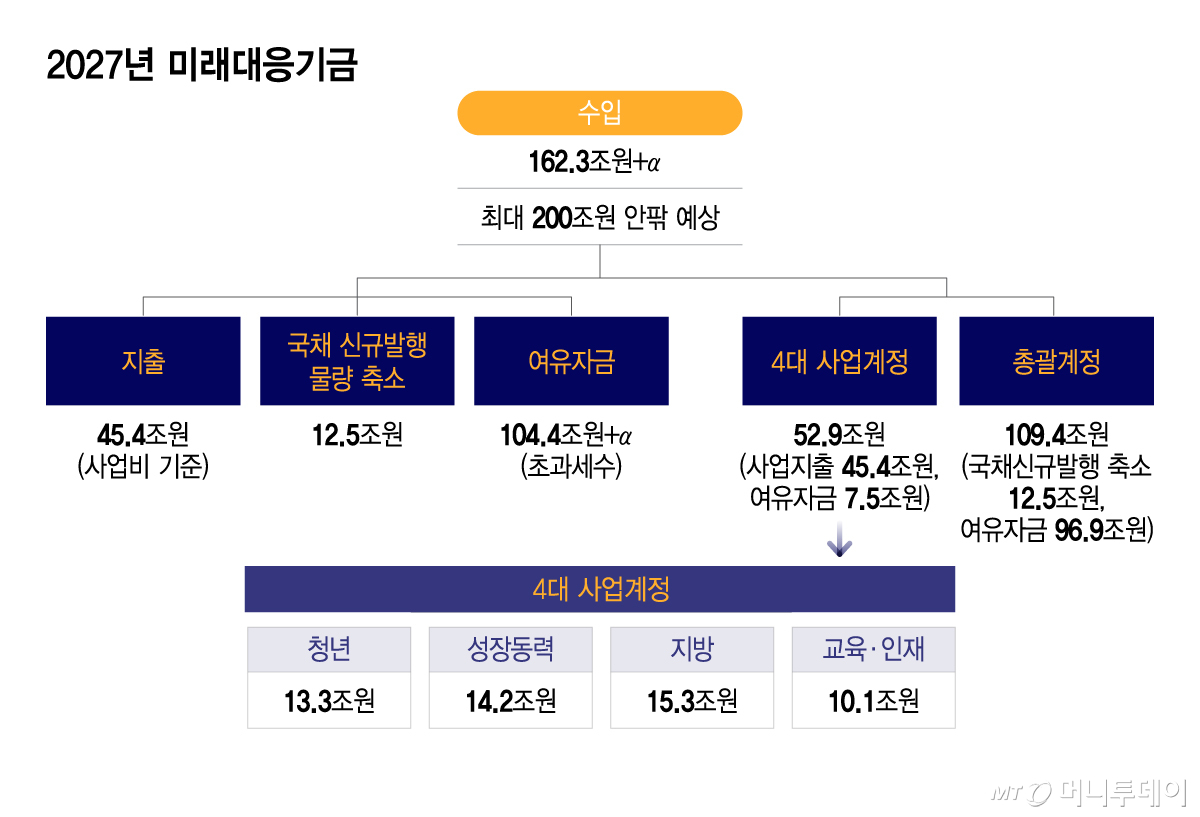
Additional tax revenue refers to the amount by which the domestic tax revenue budget in the next year's budget bill exceeds the trend value of domestic taxes. The additional tax revenue included in next year's budget bill is 158 trillion 472 billion won. Adding other sources of 3 trillion 822.7 billion won, the plan is to establish a Future Response Fund of 162 trillion 294.7 billion won.
Excess tax revenue, which refers to taxes collected beyond the budget bill, is also a source for the Future Response Fund. The Ministry of Economy and Finance projected in September through a tax revenue re-estimation that this year's excess tax revenue would reach 63 trillion 200 billion won. It has not yet been decided how much of the excess tax revenue will be transferred to the Future Response Fund.
Therefore, the final size of the Future Response Fund will be determined during the National Assembly's deliberation process. Since a significant portion of the excess tax revenue is expected to be transferred, the final size is projected to approach or exceed 200 trillion won.
Despite being a large-scale fund, many hold skeptical views on its sustainability. The Budget Policy Office of the National Assembly recently stated in its "Comprehensive Analysis of the Budget Bill" that it expects no additional tax revenue will be generated after 2029. This is because the trend value is expected to exceed domestic tax projections.
If the Budget Policy Office's forecast holds true, the Future Response Fund will need to worry about its sustainability after 2029. Spending may exceed revenue. The government plans to spend 45 trillion 400 billion won from the Future Response Fund next year alone.
The National Assembly Committee on Finance and Economy pointed out in a review report that "some projects, once introduced, may have the nature of continuous or repetitive spending that is difficult to reduce in the short term," adding that "a review of the medium- and long-term resource sustainability of the Future Response Fund is necessary."
Criticism surrounding the Future Response Fund has not ceased despite positive evaluations as a fiscal stabilization device, for these reasons. The debate over the priority between national debt repayment and future investment stems from differences in fiscal management philosophy, but the fund's sustainability is an issue that should be examined separately.
Song Heon-jae, Professor of Economics at the University of Seoul, pointed out at a public hearing on the Future Response Fund held by the National Assembly Committee on Finance and Economy on this day, stating, "The fund must preserve its principal, and resources must steadily flow into the fund," adding, "In a situation where excess and additional tax revenues cannot be predicted, ultimately, it is impossible to preserve the principal."
He continued, "If that is the case with the fund, the government should be able to answer the question of whether it would not be better to pay off debts first and issue government bonds when money is needed," stating, "I think the government has not yet provided a clear answer."

 in ECONOMY

