

It was found that the Future Response Fund’s projects include numerous cash-based support measures, as well as programs that contradict the very purpose of "future response." In particular, concerns have been raised that because the fund is structured so the government can draw on it at will while evading National Assembly oversight, it could encourage reckless fiscal management.
According to the Ministry of Economy and Finance and other sources on the 3rd, a total of 162.3 trillion won has been allocated to the Future Response Fund, comprising 52.9 trillion won for four major project accounts and 109.4 trillion won for an overarching account.
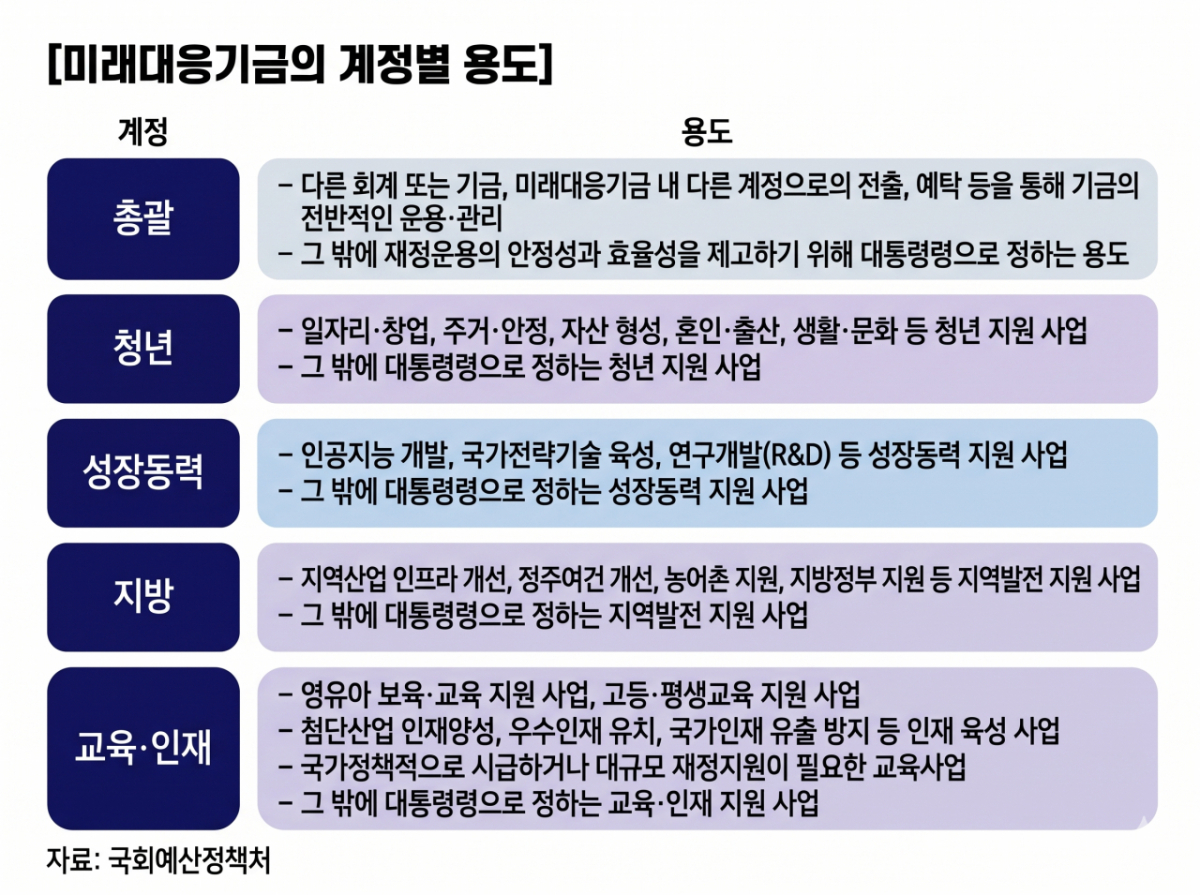
The four major accounts are Youth (13.3296 trillion won), Growth Drivers (14.1638 trillion won), Local Regions (15.2662 trillion won), and Education and Talent (10.1029 trillion won). The overarching account consists of 109.4 trillion won, including 12.5 trillion won to reduce new government bond issuance and 96.9 trillion won in surplus funds.
The intent behind the Future Response Fund is to serve as a strategic investment platform that accumulates tax revenues built up by an unexpected semiconductor boom for productive spending, and as a fiscal stabilization mechanism to reinforce fiscal capacity in a timely manner. Although the accumulated tax revenue is temporary, the idea is not to spend it all at once but to use it for the future.
The problem is that many of the projects supported by the Future Response Fund are cash-based budget items and have nothing to do with future preparedness.
A detailed breakdown of all 140 projects reveals a large number of cash-based initiatives, including △the Rural Basic Income Pilot Project, △Youth Future Savings, △Youth Culture and Arts Pass, △Youth Rent Support, △Child Basic Allowance, and △Our Independence Fund for Youth.
In particular, the Rural Basic Income Pilot Project has been allocated 1.1657 trillion won, a fivefold increase compared to this year’s regular budget. The Youth Culture and Arts Pass project, which provides 100,000 to 150,000 won in cultural viewing expenses to youth aged 19 to 34, has also been expanded by 22 times to 792.5 billion won. These are projects that are somewhat detached from the purpose of future response.
Critics also point out that these are not new projects but existing ones simply transferred over. According to the National Assembly Budget Office, among the 129th items (45.4 trillion won) in the four major project accounts, purely new projects number 55 (18.8666 trillion won, or 41.6%), consolidations and splits of other projects number 3 (4.0007 trillion won, or 8.8%), and transfers from other ministries number 71 (22.4912 trillion won, or 49.6%). The amount derived from existing projects totals 26.4959 trillion won, accounting for 58.4% of the project costs.
Moreover, the National Assembly Budget Office’s analysis indicates that even the 55th items described by the Ministry of Economy and Finance as purely new are either transfers of existing projects budgeted this year or splits from existing programs. Projects such as support for the Korea University of Science and Technology and AI Convergence Innovation Talent Development (R&D) were budgeted with only changes in accounting and fund structures.
In particular, the Ministry of Economy and Finance set a self-adjustment limit of 30% on the fund operation plan to prepare for unexpected spending needs. If the law passes as is, this means the government could unilaterally adjust a significant portion of the budget approved by the National Assembly.
President Lee Jae-myung mentioned in a Cabinet meeting last September a plan to increase the budget for holiday agricultural and seafood discount support by 1 trillion won using the Future Response Fund. In response, Minister of Economy and Finance Park Hong-geun dismissed the possibility, stating, "I understand that the President spoke in general terms without knowing the specific details of the future fund’s projects." However, concerns have grown that the Future Response Fund could become a "government piggy bank" due to the President’s remarks.

 in ECONOMY
