

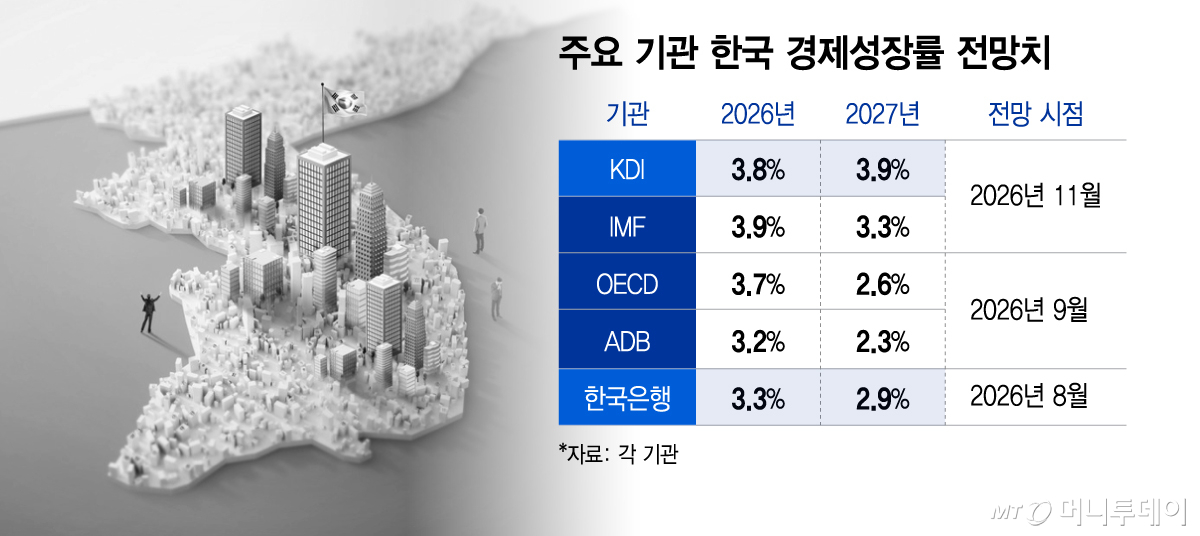
The Korea Development Institute (KDI), a state-funded research institution, further raised its forecast for Korea's economic growth rate this year to 3.8%. In particular, it projected that the high-growth trend will continue next year at an even higher rate of 3.9% than this year. This reflects strong exports and capital investment driven by the semiconductor supercycle (super-boom).
However, some point out that the warmth from semiconductors is skewed toward only certain sectors, resulting in growth without a tangible improvement in the economy as felt by consumers.
In its "Economic Outlook" released on the 18th, KDI presented this year's Korean economic growth rate forecast at 3.8%. This is 0.6 percentage points (p.p.) higher than the forecast of 3.2% announced in August.
The growth rate for next year is projected to be 3.9%, higher than this year. This figure represents a substantial upward revision of 1.7 p.p. compared to the previous forecast.
The semiconductor boom underpins KDI's upward revision of its growth rate forecasts. The analysis suggests that strong global semiconductor demand has rippled into exports and capital investment. In fact, semiconductors account for roughly half of KDI's growth rate forecast for this year. KDI officials explained that approximately two-thirds of the growth rate forecast for next year is also attributable to semiconductor-related growth.
In particular, the significant upward revision of next year's growth rate forecast is largely due to the GDP (gross domestic product) weight of the computer, electronics, and optical equipment sector—including semiconductors—being significantly larger than in a typical year. In simple terms, this means that the share of semiconductors in Korea's economy next year has expanded considerably compared to before.
Previously, major international forecasting agencies had also successively raised their growth rate expectations for Korea. The International Monetary Fund (IMF) newly presented its forecast for Korea's growth rate this year at 3.9% during a briefing on the results of its annual consultation held the previous day. This was an increase of 0.6 p.p. from the forecast made just one month ago. It also raised its growth rate forecast for next year to 3.3%.
Additionally, KDI viewed the potential growth rate, which it had previously seen declining to the mid-1% range, as having rebounded to around 2%. Kim Ji-yeon, head of forecasting at KDI's Economic Outlook Division, said, "It is still too early to determine whether the improvement in potential growth rate is temporary or has risen on a trend basis."
However, despite the high nominal growth, there are also points noting that the gap between the tangible economy and official figures remains. This is because exports are showing a steep upward trend, while domestic demand recovery, such as private consumption, is relatively sluggish.
In fact, retail sales in the third quarter decreased by 0.5% year-on-year. A quarterly decline in retail sales compared to the same period of the previous year has occurred for only five quarters.
Kim Mi-ru, head of the Macroeconomic and Financial Policy Research Department at KDI, said, "We predict that private consumption will grow by about 2.4% next year, but I think there will still be some gap between the tangible economy and the overall growth rate." She added, "In particular, for small business owners and self-employed individuals to feel (the economic improvement), the growth in the food and accommodation sector must be prominent, but the growth in sectors like food and accommodation remains relatively low."

 in ECONOMY
