

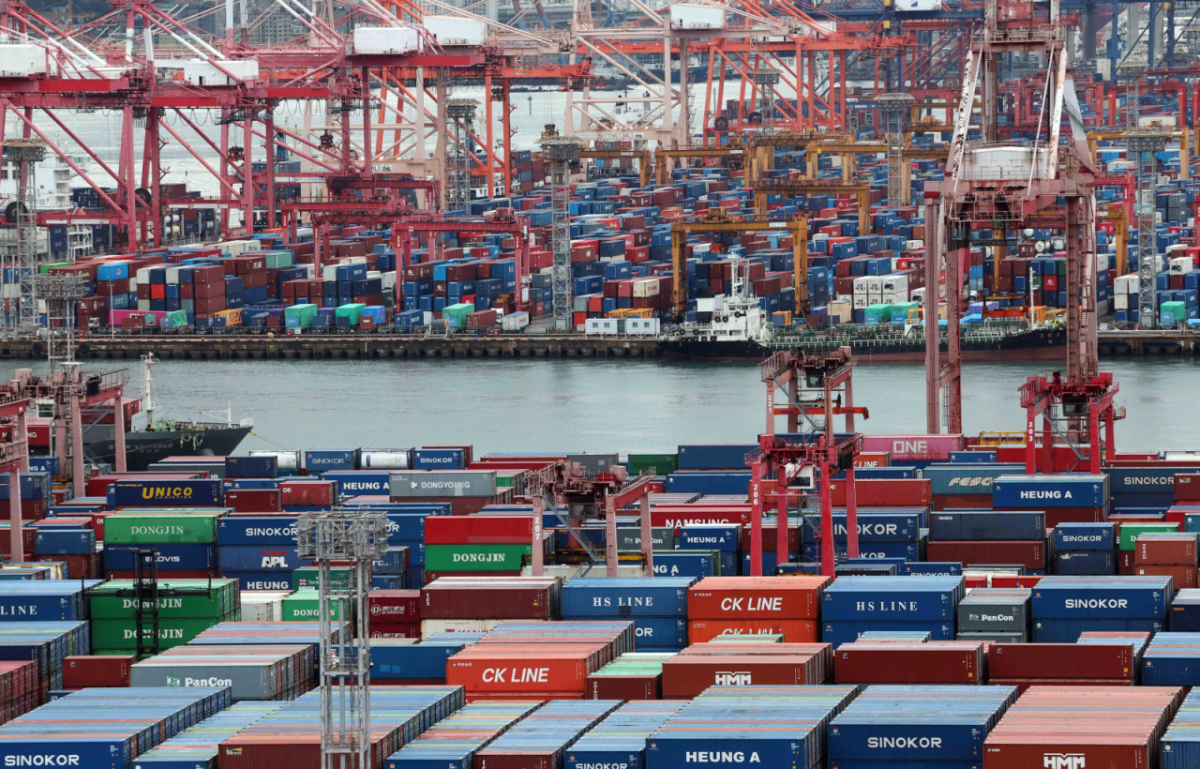
South Korea is expected to surpass $1 trillion in exports this week, becoming the fourth country in the world to reach the milestone after the United States, China and Germany.
The achievement marks a dramatic transformation for a country that once relied on exports of light industrial goods such as squid and wigs but has since emerged as a major exporting nation in semiconductors, automobiles and shipbuilding. It represents a milestone in South Korea's 80-year export history.
However, challenges remain, including export volatility stemming from an overreliance on certain products, particularly semiconductors, and escalating trade tensions with major economies, including the United States.
According to the Ministry of Trade, Industry and Energy and the Korea Customs Service on Nov. 15, cumulative exports reached $963.464 billion as of Nov. 10, up 62 percent from the same period last year.
The figure has already surpassed last year's record annual exports of $709.3 billion, leaving just $36.536 billion to reach the $1 trillion milestone.
Based on recent export trends, South Korea is highly likely to cross the $1 trillion threshold this week. At the average daily export pace of $4.46 billion recorded from Nov. 1 to 10, the milestone could be reached as early as Nov. 20. Given the tendency for exports to increase toward the end of each month, the target could be reached one to two days earlier.
If achieved, South Korea would become the fourth country to record $1 trillion in annual exports, following the United States, China and Germany. Even Japan, a major export powerhouse, has yet to reach the milestone.
It would mark the country's rise to the ranks of the world's four largest trading nations in roughly 80 years, dating back to 1948, when its first trade vessel, the Angdo, carried dried seafood and agar to Hong Kong and Macao.
South Korea is also on track to rank among the world's top five exporters this year. According to International Monetary Fund data, China ranked first with $2.5232 trillion in exports from January to July, followed by the United States with $1.4365 trillion, Germany with $1.1099 trillion and the Netherlands with $611.9 billion. South Korea ranked fifth with $595.3 billion.
In terms of trade balance, calculated by subtracting imports from exports, South Korea recorded a surplus of $167.8 billion during the same period, ranking second globally behind China, which posted a surplus of $719.2 billion.
This indicates that the country is not simply exporting large volumes but also generating substantial trade surpluses.
Semiconductors have been the driving force behind this year's record-breaking export performance. Semiconductor exports totaled $396.8 billion from January to October, up 193.1 percent from a year earlier.
Their share of total exports also climbed to 42.7 percent, driven by surging demand for memory chips amid a global boom in artificial intelligence investment.
The $1 trillion export milestone is particularly significant as it comes amid a global shift toward protectionism and mounting geopolitical risks, including the war in the Middle East. However, concerns remain.
South Korea's trade structure, which is still heavily concentrated in certain products and markets, leaves exports vulnerable to fluctuations. Its record trade surplus could also prompt trading partners running deficits to demand more balanced trade.
"South Korea needs to diversify its export markets, products and companies while fostering future industries such as advanced manufacturing and physical AI," said Park Min-jun, head of the Korea Trade-Investment Promotion Agency's Trade and Investment Research Center. "It also needs to actively address supply chain and trade risks from an economic security perspective."

 in ECONOMY
