

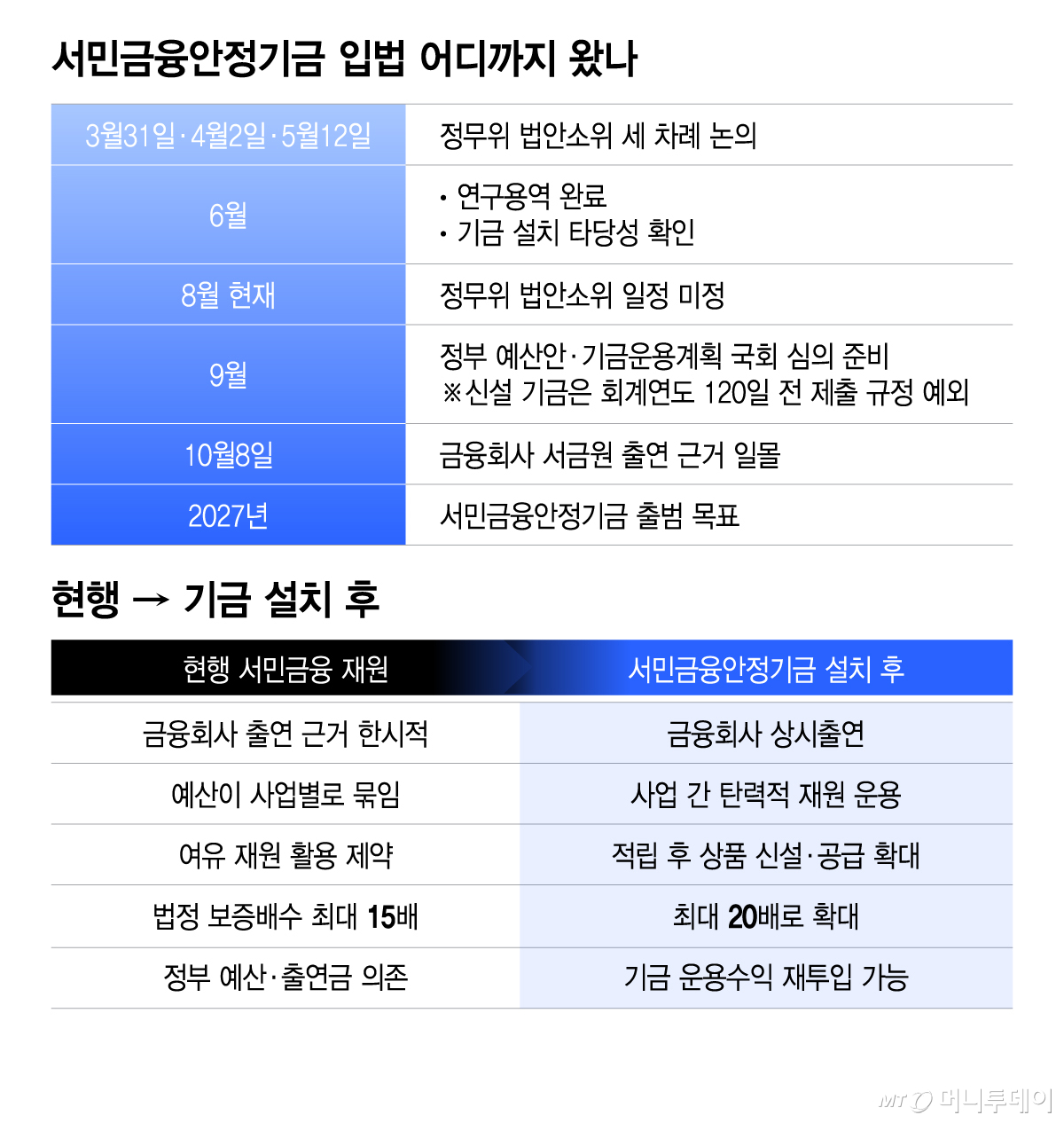
Conditions have been set for legislating the Low-Income Financial Stability Fund, which aims to stably secure funding for policy-based low-income financial services. The research report that had delayed bill processing in the first half concluded that the fund has "economic viability," and consultations with the Ministry of Planning and Budget were also completed, overcoming a major hurdle. However, since the schedule for the Political Affairs Committee's subcommittee meeting this month has not yet been finalized, urgent discussions are needed at the National Assembly to finalize legislation before October 8—the sunset date for the legal basis of financial institutions' contributions.
According to financial authorities and political circles on the 3rd, the amendment to the Low-Income Financial Services Act was discussed three times in the Political Affairs Committee's subcommittee during the first half but failed to pass. At that time, opinions were raised that the bill should be processed only after confirming the results of a consulting service covering the validity of establishing the fund and its funding management plan, leading to a decision to continue deliberations.
With the final report now released, most procedural issues raised during the first-half review have largely been resolved. In particular, the report concluded that the fund has economic viability when considering social benefits, including interest rate reductions for low-income households upon its establishment.
Consultations with fiscal authorities have also been completed. The Financial Services Commission had attempted to establish similar funds in 2016 and 2021 but failed to clear the threshold of consultation with fiscal authorities. This time, however, the proposal to establish a new fund has become a national governance task under the Lee Jae-myung administration, and consultations have been held with the Ministry of Planning and Budget, improving legislative conditions compared to the past.
The core of the amendment is converting the Low-Income Financial Guarantee Account and the Self-Sufficiency Support Account within the Low-Income Financial Promotion Institute into statutory funds. It removes the validity period of current regulations requiring financial institutions to contribute to the institute, thereby establishing a basis for continuous contributions, and raises the statutory guarantee multiplier cap from 15 times to 20 times. Remaining funds in the fund can be accumulated and used to launch new products or flexibly expand supply.
The immediate priority is to establish a legal basis for continuous contributions by financial institutions. The current legal basis expires on October 8. After that, there will be no grounds to impose contribution obligations on financial institutions. Even after the subcommittee meeting, procedures remain for plenary sessions of the Political Affairs Committee, the Legislation and Judiciary Committee, and the full National Assembly, so legislation must be finalized by next month at the latest.
Kwon Dae-young, Deputy Chairman of the Financial Services Commission, stated in the subcommittee meeting last May: "Since the sunset date for private contributions is October 8, I earnestly request prompt processing of the bill. The fiscal year budget must be submitted by September 3 this year, and before that, we must establish a fund operation plan to implement proper policy-based low-income financial services for the Republic of Korea."
The Financial Services Commission plans to persuade legislators by explaining the results of the consulting service, the consultation content with the Ministry of Planning and Budget, and concerns about funding gaps due to the sunset of the legal basis for financial institutions' contributions to newly formed members of the Political Affairs Committee. While preparing a contingency plan to utilize the existing general account if the bill fails to pass alongside the fund accounting based on the assumption that the bill will be approved, the Commission is also preparing for potential delays in policy-based low-income financial service supply due to legislative delays.

 in FINANCE
