

Starting next month, a so-called '8-week rule' will be implemented requiring patients with minor injuries from car accidents to submit additional medical certificates if they continue treatment beyond eight weeks. This is expected to put an end to long-term outpatient treatments and over-treatment that have persisted even in minor traffic accidents.
According to the insurance industry on the 3rd, the government plans to approve a revision to the Enforcement Decree of the Automobile Liability Guarantee Act at this week's State Council meeting to improve the medical treatment system for automobile insurance. The core of the revision is to mandate that patients with minor injuries (injury grades 12–14) from traffic accidents must submit a medical certificate confirming the necessity of additional treatment if they receive care beyond eight weeks after the accident. Currently, there are no special restrictions allowing long-term treatment, but in the future, treatment for more than eight weeks will be permitted only when medically necessary. If the revision passes as scheduled, it will take effect on the 10th of next month.
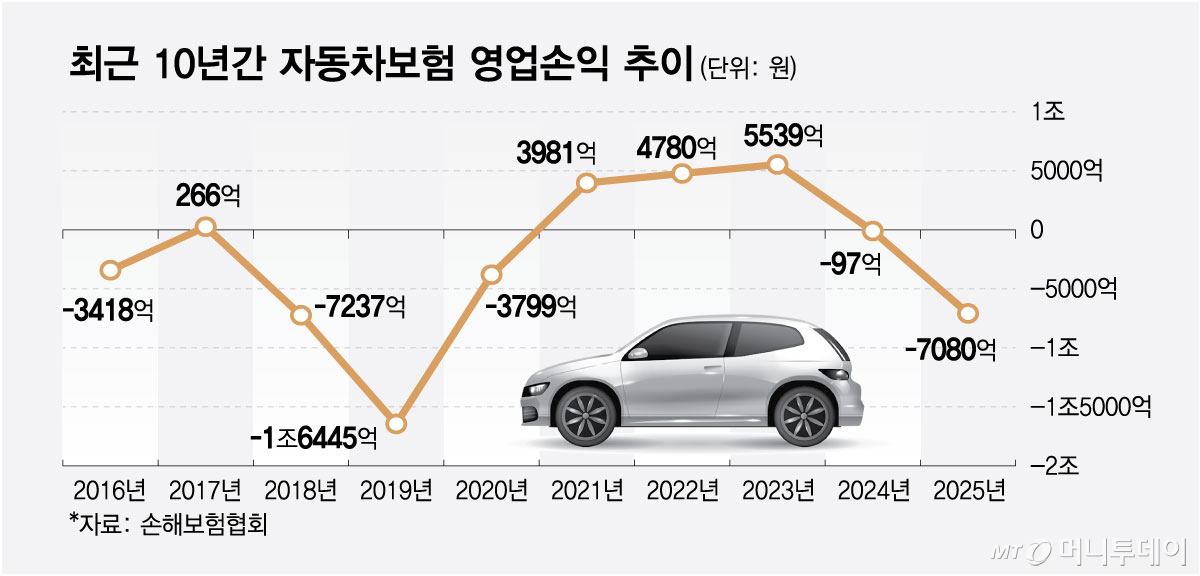
Financial authorities and the property and casualty insurance industry have been pushing for institutional improvements, viewing cases where patients receive long-term outpatient treatment for neck or back pain following minor contact accidents as a major cause of rising automobile insurance payouts. The scale of losses in the automobile insurance sector is once again expanding as vehicle usage normalizes after the pandemic. Last year's automobile insurance loss amount reached 708 billion won.
In fact, as of last year, patients with minor injuries accounted for 95.7% of all traffic accident patients. The property and casualty insurance industry considers over-treatment of minor injury patients occurring on the ground to be a serious issue. For instance, in March last year, a man in his 40s sitting in the passenger seat was diagnosed with lumbar strain after a so-called 'door knock' accident where he opened his driver's side door and made contact with the passenger-side door of an adjacent vehicle, resulting in an insurance payout of approximately 1.7 million won. In August of the same year, a man in his 50s received a diagnosis of cervical strain and other conditions from an accident involving contact between side mirrors, securing an insurance payout of 6.6 million won.
The property and casualty insurance industry expects that the implementation of this system will reduce over-treatment and insurance fund leakage, leading to improvements in the automobile insurance loss ratio. Recently, rising automobile insurance loss ratios due to increased repair labor costs and medical expenses have been pressuring the profitability of insurance companies. The industry believes that if treatment periods are managed reasonably, not only will the deficit in automobile insurance shrink, but some factors driving premium increases will also be alleviated. Financial authorities plan to reflect the insurance premiums saved through the introduction of the '8-week rule' in next year's premium calculations.
However, significant opposition from the traditional medicine industry is expected following the introduction of the 8th-week rule. This is because the proportion of treatment costs covered by traditional medicine for minor injury patients is higher than that of Western medicine. Last year, the average treatment cost per patient with a minor injury was approximately 1.088 million won for traditional medicine, exceeding three times the 355,000 won for Western medicine treatment.
A property and casualty insurance industry official stated, "Since the current rate of long-term treatment for minor injury patients is too high, the introduction of the 8th-week rule appears to be helpful," but added, "However, it is unclear exactly how much the loss ratio will improve with the implementation of the 8th-week rule."

 in FINANCE
