

The five major regional hub banks aggressively expanded lending in the first half of this year to grow their scale, but profitability did not improve as expected. Instead, even after clearing nearly 1 trillion won in non-performing loans (NPLs), delinquency rates rose. Analysts suggest that as interest rates climb, the financial soundness burden on local banks with high exposure to regional corporate loans is increasing.
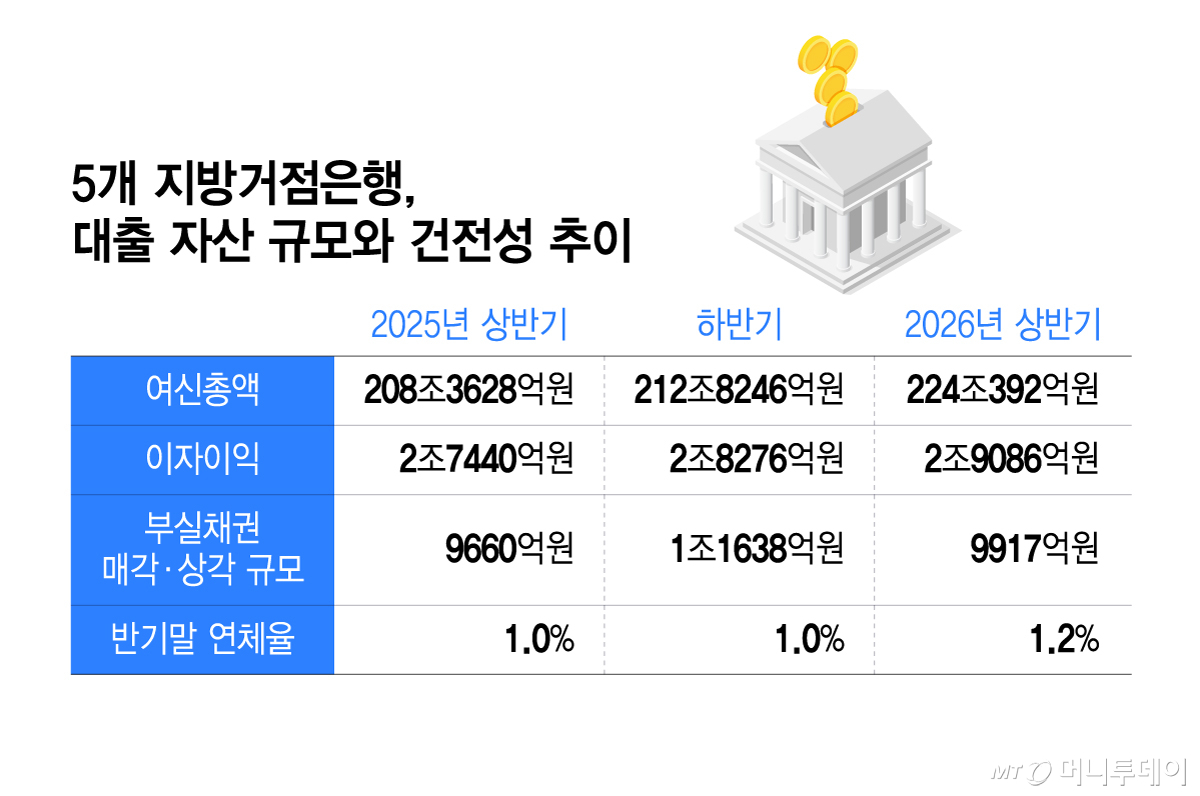
According to the financial sector on the 3rd, total lending by the five major regional hub banks—BNK Busan Bank, BNK Gyeongnam Bank, iM Bank, Gwangju Bank, and Jeonbuk Bank—reached 224 trillion 39.2 billion won as of late June this year. This represents a 5.3% increase from the end of last year (212 trillion 824.6 billion won).
Compared to last year, the pace of loan growth was steeper. In the first half of last year, lending rose by 1.7%, from 204 trillion 945.3 billion won to 208 trillion 362.8 billion won, and in the second half, it increased by only 2.1%, reaching 212 trillion 824.6 billion won.
This reflects the regional hub banks' active expansion of loans to corporations and households despite a sluggish local economy in the first half of this year, thereby increasing their assets. In particular, these banks absorbed household loan demand that major banks had not met in the first quarter, further boosting their lending growth.
However, while loans increased significantly, profitability did not improve accordingly. Interest income for the five regional hub banks totaled 2 trillion 908.6 billion won in the first half of this year, a mere 2.9% increase from the second half of last year (2 trillion 827.6 billion won). This growth rate was lower than the 3.1% increase recorded in the second half of last year compared to the first half of that same year (2 trillion 744.0 billion won).
While loan growth increased by 2.5 times, the interest income growth rate declined by 0.2 percentage points (P). Despite expanding loans at nearly double the previous pace, profits failed to keep up. Rising funding costs, such as deposit rates, led to higher interest expenses, largely offsetting the benefits of loan expansion.
As lending grew, financial soundness deteriorated. The five regional hub banks sold or wrote off 991.7 billion won in non-performing loans (NPLs) during the first half of this year. Although the scale of bad debt cleanup increased compared to the same period last year (966.0 billion won), the simple average delinquency rate rose from 1.0% in both the first and second halves of last year to 1.2% in the first half of this year. The fact that delinquency rates rose even after actively clearing NPLs indicates that new bad debts are emerging faster than existing ones are being resolved.
Analysts attribute this trend to regional banks being more significantly affected by economic slowdown and high interest rates compared to major commercial banks. Regional banks' loan portfolios consist of approximately 60% corporate loans and 40% household loans. In contrast, the five major commercial banks maintain a roughly 50-50 split, with a relatively higher share of household loans. Notably, regional banks hold more loans for local manufacturing firms and SMEs (small and medium-sized enterprises), making them directly vulnerable to economic fluctuations. With growing expectations of further interest rate hikes in the second half, this trend is expected to become even more pronounced.
A local bank official stated, "Regional banks have a higher proportion of corporate loans than major commercial banks, so they are inevitably more exposed to interest rates and economic conditions." However, the official added, "We expect profitability to rise in the second half as the impact of the loan assets expanded in the first half begins to fully materialize."

 in FINANCE
