

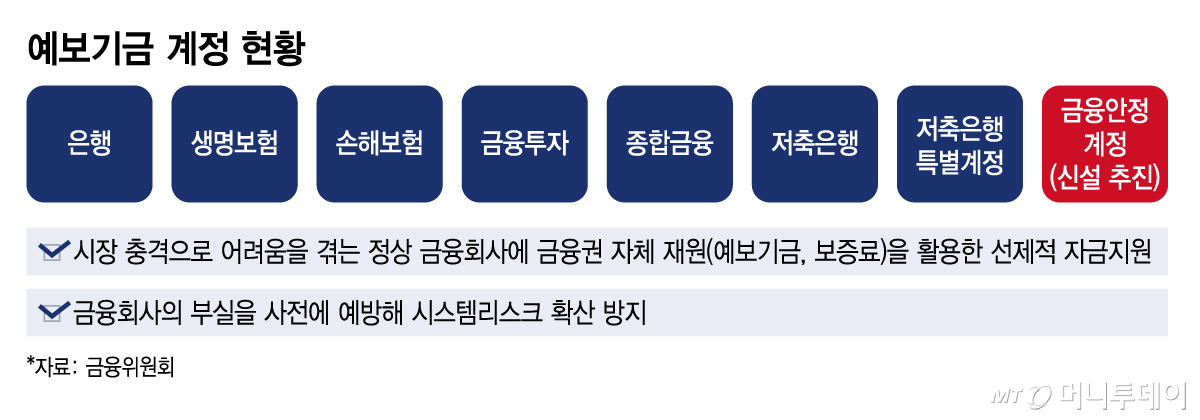
The financial authorities plan to relaunch the introduction of a 'Financial Stability Account' in the second half of the year, which would allow for proactive responses to shocks in the financial market by utilizing deposit insurance funds accumulated by financial institutions. The initiative aims to establish a permanent account within the deposit insurance fund to provide support to sound financial institutions before they develop non-performing assets. With both ruling and opposition parties having introduced bills in the 22nd National Assembly, discussions are expected to gain momentum once bill review resumes at the Political Affairs Committee.
According to financial authorities on the 11th, the Financial Services Commission is advancing amendments to the Deposit Insurance Act as a key legislative priority for the second half of the year to introduce the Financial Stability Account. This system enables the Korea Deposit Insurance Corporation to supply funds through methods such as loans, debt guarantees, and capital injections by utilizing the Financial Stability Account when the financial market undergoes rapid changes that lead to liquidity constraints or capital adequacy needs across multiple financial institutions.
The introduction of the Financial Stability Account was formally discussed in 2022 when the LegoLand crisis froze the short-term funding market. Subsequently, following the collapse of Silicon Valley Bank (SVB) in the United States in 2023 and concerns over a bank run triggered by rumors of a crisis at Saemaeul Credit Cooperatives, the need for mechanisms to respond before financial institutions become insolvent became increasingly prominent.
While the United States, Japan, and the European Union established systems to preemptively block systemic risks following the 2008 global financial crisis, the Korean authorities judge that domestic financial stability measures have been overly focused on post-crisis responses such as injecting contingency funds or creating public capital after insolvency occurs.
Accordingly, the plan is to complement the limitations of the past Financial Stability Fund by institutionalizing a support system within the deposit insurance fund. Although the government established the Financial Stability Fund in 2009 following the global financial crisis, actual support amounted to zero due to stringent conditions such as 1:1 matching capital increases by controlling shareholders, and the fund was terminated at the end of 2014.
Financial Stability Account failed under the 21st National Assembly... Relaunch underway in the 22nd National Assembly
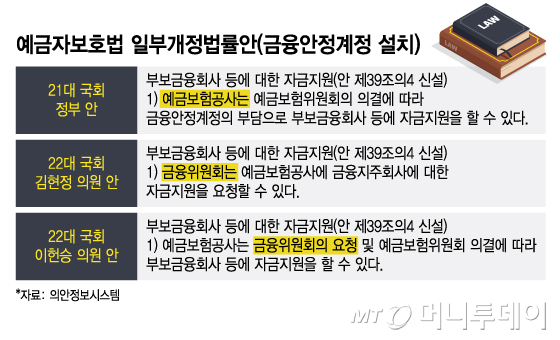
The government introduced a bill to amend the Deposit Insurance Act, which included provisions for establishing the Financial Stability Account, at the National Assembly. However, it was discarded upon expiration of the term without being processed in the 21st National Assembly.
In the 22nd National Assembly, Democratic Party of Korea lawmaker Kim Hyun-jeong and People Power Party lawmaker Lee Heon-seung each introduced bills to amend the Deposit Insurance Act for the establishment of a Financial Stability Account. Both bills follow a structure where funds are provided to financial institutions after approval by the Financial Services Commission and the Deposit Insurance Committee, followed by monitoring of repayment plan implementation.
During the National Assembly review process, opinions were raised that it is necessary to more broadly gather views from relevant institutional investors when activating the Financial Stability Account. The Financial Services Commission and the Deposit Insurance Corporation are currently reviewing measures to actively reflect the opinions of relevant institutional investors such as the Ministry of Economy and Finance and the Bank of Korea during actual system operations.
A Financial Services Commission official stated, "The purpose is to prepare in advance a tool that allows the financial sector to resolve temporary crises on its own by utilizing deposit insurance funds accumulated by financial institutions rather than using fiscal resources."
Although the revised bill was included as an agenda item for the Political Affairs Committee's subcommittee three times this year, no substantive review has yet taken place. Given that the authorities are again advancing it as a legislative priority for the second half of the year, discussions are expected to resume in the newly constituted Political Affairs Committee.

 in FINANCE

