

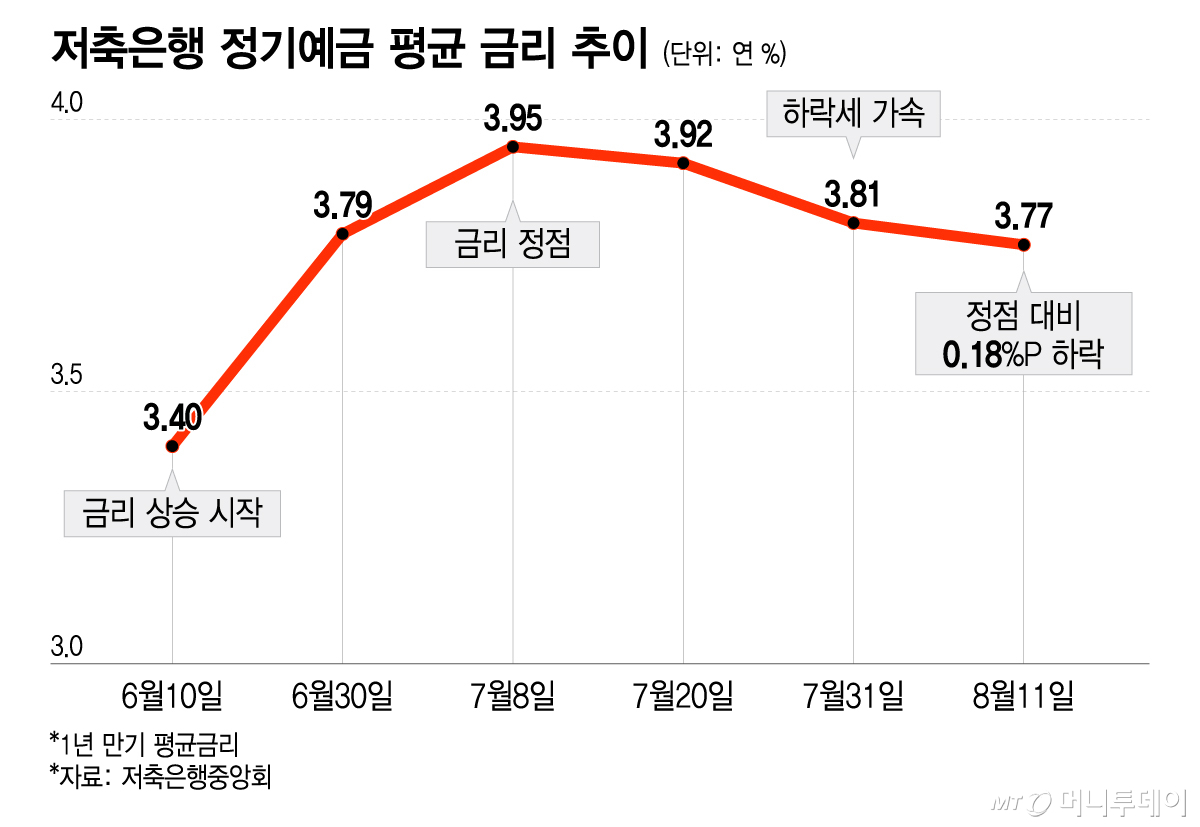
As the stock market falls, interest rates on savings bank fixed deposits are also declining. While some savings banks once offered high-interest fixed deposits at 4.6% annually, it has now become difficult to find products exceeding 4.0%. Analysts predict that deposit rates at savings banks will shift depending on future stock market conditions.
According to the Korea Savings Bank Association on the 11th, the average interest rate for one-year fixed deposits at savings banks stood at 3.77% annually as of that day. This marks a 0.18 percentage point drop from the peak of 3.95% reached on the 8th last month within just one month.
Interest rates on savings bank fixed deposits began rising in June. As funds rapidly fled to the stock market, banks competitively raised rates to defend their deposit base. Especially large savings banks absorbed high costs to attract deposits while complying with the 100th% loan-to-deposit ratio regulation.
At that time, many savings banks raised one-year fixed deposit rates above 4.0% annually. Some even offered rates as high as 4.60%.
However, high-interest fixed deposit products are now hard to find. At current levels, the highest available rates hover in the early 4.0% range. About a month ago, there were 166 such products offering rates in the 4.0% bracket; as of this day, only 56 remain—reduced to one-third. Currently, only NH Savings Bank offers a special 4.5% fixed deposit product.
Savings bank deposit rates began falling alongside the sharp decline in KOSPI. As stock market volatility increased, funds waiting on the sidelines started returning to safe fixed deposits. It is analyzed that savings banks are lowering rates and curbing further inflows after determining that deposit instability has been resolved.
Additionally, many savings banks had already met their deposit targets through high-interest fixed deposits earlier. With loan operations struggling and deposit goals already achieved, there was no incentive to raise rates further to attract more funds.
This relief allows savings banks to reduce interest cost burdens. Since deposits are the core funding source for these institutions, lower new and renewed deposit rates directly reduce overall funding costs. Assuming a 10 trillion won funding base, the 0.18 percentage point drop from peak rates translates to annual savings of 18 billion won in funding expenses.
However, it is premature to assume that competition for deposits among savings banks has completely disappeared. A strong rebound in the stock market could trigger another 'money move' phenomenon, where funds shift back into equities.
A savings bank official stated, "Over the past month, the stock market failed to deliver expected returns, resulting in less capital outflow than anticipated." The official added, "Deposit rates will likely follow short-term stock market trends. If Samsung Electronics and SK Hynix stocks surge sharply, liquidity managers may face renewed concerns."

 in FINANCE
