

Although insurance companies are successively raising the threshold for household loans, demand for borrowing from insurers remains stubbornly high. While some insurers have halted mortgage-backed loans and credit loans or reduced their limits, funding needs are shifting toward policy loans (contract-based loans), which are easier to access. From the insurers’ perspective, raising the bar even for policy loans could lead policyholders in need of emergency funds to surrender their contracts, creating deep concern.
According to the insurance industry on the 11th, as of late June, the outstanding balance of insurance contract loans at five major life insurers—Samsung Life, Hanwha Life, Kyobo Life, Shinhan Life, and NH Nonghyup Life—stood at approximately 42 trillion won. This represents an increase of nearly 2 trillion won over five months from 40 trillion won at the end of January.
Insurance contract loans allow borrowers to secure funds without separate credit checks by using the surrender value of their insurance contracts as collateral, meaning demand can grow as loan thresholds rise elsewhere. For borrowers who find it difficult to obtain mortgage-backed or credit loans, these contracts offer a way to maintain coverage while securing necessary funds. Typically, loans can reach 50% to 95% of the surrender value. Interest rates are also relatively low. According to major life insurers, the lowest interest rate for policy loans ranges from 3.15% to 3.25% annually, though most actual loans are reportedly made at around 5% annually.
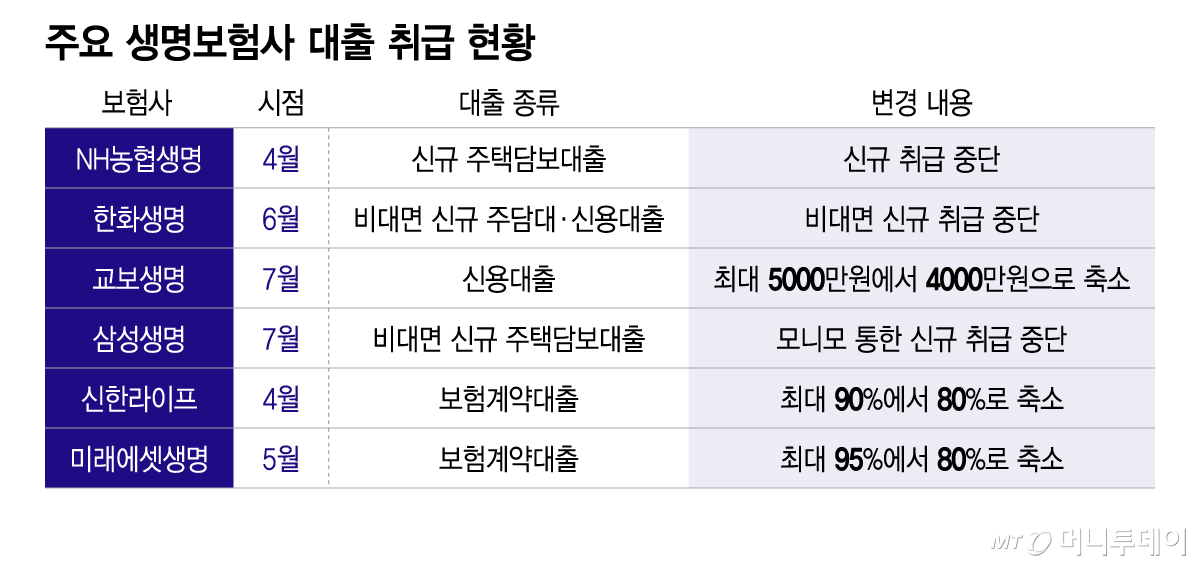
As financial authorities strengthen oversight of household loans, insurance companies are also reducing non-face-to-face new mortgage-backed and credit loans. NH Nonghyup Life halted new mortgage-backed loan processing starting in April, while Hanwha Life stopped both non-face-to-face new mortgage-backed loans and credit loans from June onward. Kyobo Life reduced its credit loan limit from 50 million won to 40 million won last month. Samsung Life has also suspended non-face-to-face new mortgage-backed loans via Monimo since last month, citing system maintenance and other reasons.
Insurers that have halted mortgage-backed or credit loans generally continue offering policy loans, reflecting sustained demand from borrowers. However, there is a trend of gradually reducing policy loan limits. Shinhan Life lowered its limit from 90% to 80% of the surrender value starting in April, and Mirae Asset Life reduced its maximum limit from 95% to 80% beginning in May. For example, if a policyholder’s surrender value is 40 million won and the previous limit was 95%, they could have borrowed up to 38 million won; with the limit now at 80%, their borrowing capacity drops to 32 million won—a reduction of about 6 million won.
Recently, financial authorities have raised concerns regarding policy loans, and the insurance industry is reportedly considering further reductions in loan limits. The issue lies in the fact that while lowering policy loan limits can reduce outstanding loan balances, it may also increase the likelihood that policyholders needing funds will surrender their contracts instead of borrowing, thereby receiving their surrender values directly.
An industry insider stated, “Although insurance companies are adjusting loan volumes, given the overall tightening of credit access across the financial sector, demand for policy loans is likely to continue rising.” The insider added, “Some insurers have already received warnings from financial authorities regarding policy loans, but they cannot arbitrarily restrict this customer right, leaving them in a difficult position.”

 in FINANCE
