

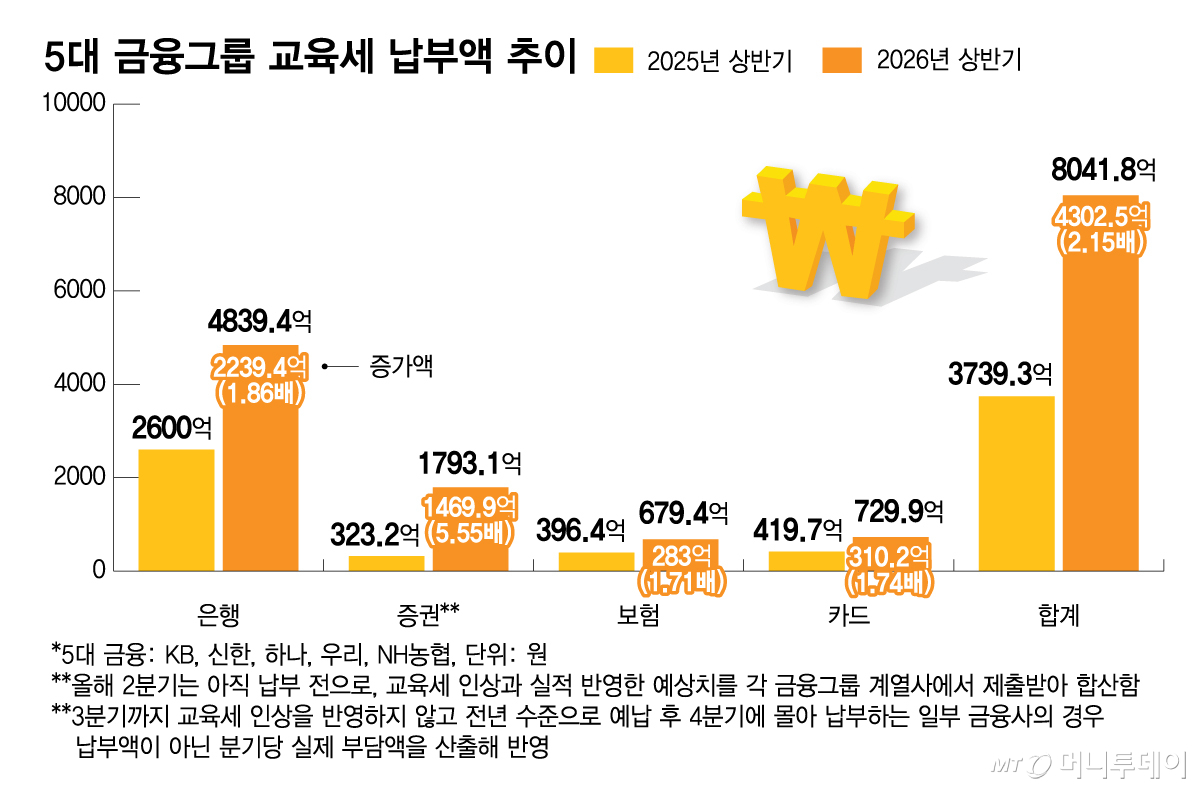
It was confirmed that the education tax burden for the top five financial groups (KB Kookmin, Shinhan, Hana, Woori, and NH Agricultural Cooperative) will exceed 800 billion won in the first half of this year. Due to the government's increase in the maximum education tax rate, banks alone paid an additional 223.9 billion won in education taxes compared to the same period last year, and insurance companies paid an additional 28.3 billion won, resulting in a total education tax payment amount increasing by more than 400 billion won year-on-year. In particular, for securities firms, some financial groups saw their education tax burden surge dramatically, reaching 7.57 times the previous year's level.
According to an investigation by Money Today into the quarterly education tax payments of major subsidiaries of the top five financial groups—including banks, securities companies, insurance companies, and card companies—the education tax burden jumped from 373.9 billion won in the first half of last year to 804.2 billion won in the first half of this year, a 2.15-fold increase. The amount is expected to be even larger when including savings banks and capital companies. For this year's education tax, which has not yet been finalized, estimates were calculated based on revenue reflecting the tax rate increase for comparison purposes.
Previously, through last year's tax reform plan, the government raised the maximum education tax rate for financial institutions with annual revenues exceeding 1 trillion won from 0.5% to 1%, effective this year.
Among banks, securities firms, insurance companies, and card businesses within the top five financial groups, the securities sector experienced the steepest increase, with its first-half education tax burden reaching a total of 179.3 billion won. This represents a 5.55-fold surge in tax burden within just one year, up from 32.3 billion won the previous year.
There were also significant differences in growth rates among securities firms. The burden amount increased by between a minimum of 3.94 times and a maximum of 7.57 times compared to last year, indicating that the higher the revenue scale, the steeper the rise in education tax.

 in FINANCE
