

'Financial consumers are the top priority.'
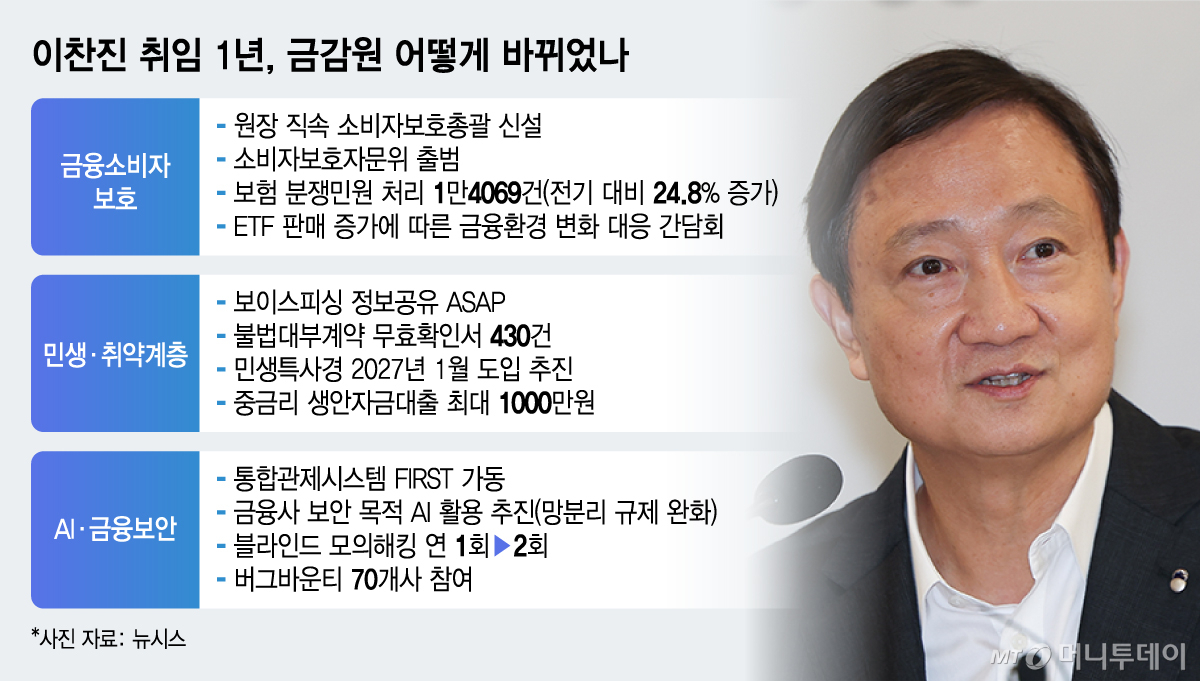
This is the principle that Lee Chan-jin, head of the Financial Supervisory Service (FSS), has most strongly instilled in the FSS during his first year in office. Moving away from the existing supervisory approach that emphasized the soundness management of financial companies and post-incident sanctions, he established a financial supervision system focused on preventing consumer harm before it occurs and actively remedying damages once they have happened.
The director marked his one-year anniversary on the 14th. Over the past year, the role of the FSS has expanded significantly from that of an 'institutional investor' that holds parties accountable after problems arise to one that prevents problems before they occur and steps in directly when consumers face difficulties.
This change began with organizational restructuring. In January this year, a consumer protection oversight division was placed under the direct supervision of the director, grouping supervisory, inspection, and dispute resolution functions within the same sector. The FSS restructured its own operational framework to ensure that issues identified in complaints and disputes do not end as simple complaint handling but are immediately linked to inspections and regulatory improvements. In March, the director launched the Financial Consumer Protection Advisory Committee, which has discussed 32 agenda items up to last month.
The status of consumer protection has also risen within financial companies. The number of financial firms reporting their consumer protection management strategies to their boards of directors increased from 55 to 69, and the number of companies establishing sub-committees for consumer protection within their boards rose from two to 15. Additionally, 64 companies have granted their Chief Consumer Officer (CCO) for financial consumer protection the right to prior agreement on key matters and the right to demand improvements. This is evaluated as elevating consumer protection from a frontline department's task to a management priority that must be overseen by top executives and boards of directors.

After inspecting bank ETF fees, a task force is formed to revise KPIs and sales procedures
In the second half of this year, efforts will accelerate to directly examine sales practices of financial products that are disadvantageous to consumers. A representative target is bank trust ETFs. Sales of ETF trusts by six major banks reached 64 trillion won from January last year through May this year, and fee income during this period grew to 586.4 billion won. Fee income for just May this year alone was 103.6 billion won, reaching 10.2 times the level of December last year.
The FSS issued consumer alerts and requested banks to improve KPIs and strengthen guidance on comparing front-end and back-end fees to determine whether consumers properly understood the fee structure during the surge in sales. This month, the FSS will inspect banks selling ETF trusts to closely monitor compliance with obligations to explain trust fees.
The inspection is not the end of the matter. Starting in September, a task force (TF) comprising industry players and associations will be formed to discuss improvements to the trust fee system, bank performance evaluations (KPIs), and sales procedures. The aim is not merely to detect individual cases of incomplete sales but to overhaul the very structure that creates sales incentives disadvantageous to consumers.
Focused investigation on insurance fraud hospitals... 'strict measures' against illegal debt collection
Efforts to eradicate livelihood financial crimes will also intensify. In the second half of this year, the FSS will conduct focused investigations on hospitals suspected of insurance fraud and plans to take strict action if predatory financial activities targeting low-income and vulnerable groups, such as illegal debt collection, are uncovered.
Over the past year, the FSS has also taken the lead in remedying damages from illegal private lending. If a contract is deemed socially harmful, the FSS operates a system that issues invalidity confirmation certificates under the director's name and supports lawsuits to invalidate such contracts. Between March and July, 430 such certificates were issued. The 'Dead Phone Zero' initiative, which blocks calls made using disposable phones used for illegal private lending, has also been activated.
The amount of damage from voice phishing decreased from 124.8 billion won in December last year to 50.1 billion won in May this year. Damage from new types of phishing, such as romance scams and no-show frauds, also fell from 129.9 billion won to 68.7 billion won during the same period. Amid continued government-wide crackdowns and public awareness campaigns, the FSS has contributed to preemptively blocking criminal damage by upgrading its Financial Institution Transaction Detection System (FDS) and building the 'ASAP' platform, which enables financial institutions, telecommunications companies, and law enforcement authorities to share suspicious information.
The FSS is also pushing for the introduction of special judicial police officers with the authority to conduct investigations directly. Aiming for implementation in January next year, it is promoting legislative amendments to include violations of the Loan Business Act and the Debt Collection Act within the scope of duties for these special investigators. The plan is to create a structure where criminal information obtained during the blocking of illegal financial advertisements is used as leads for investigations, and materials gathered during investigations are then utilized to aid victim remediation.

 in FINANCE

