

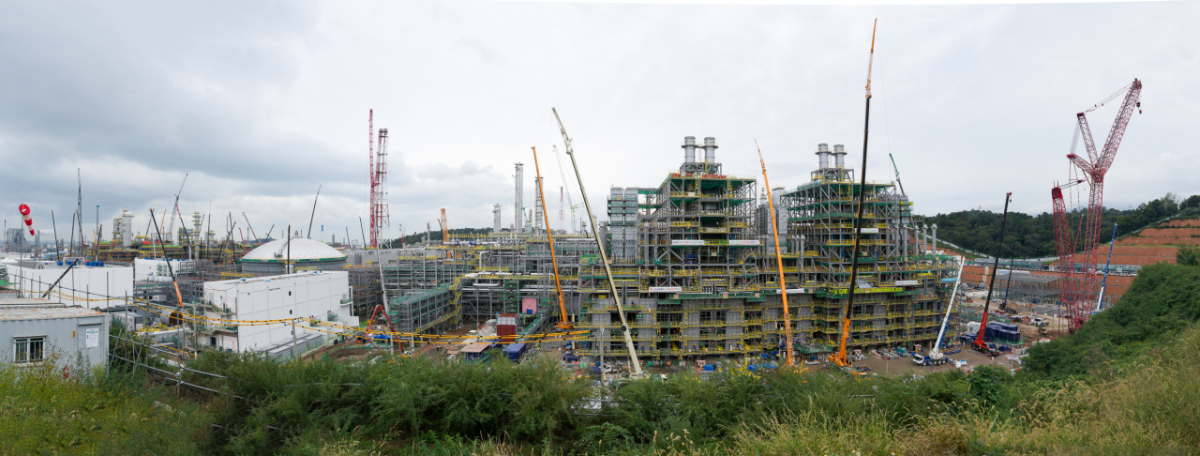
S-OIL held an event at the Shilla Hotel in Seoul to jointly commemorate its 50th anniversary and the completion of the Shaheen Project on Wednesday.
At the event, S-OIL reflected on its achievements over the past 50 years, during which it has secured global competitiveness based on its refining, petrochemical, and lubricant base oil businesses.
The company also announced plans to secure new growth drivers and realize its medium- to long-term business vision, using the Shaheen Project—the largest investment project in Korea’s petrochemical industry, completed this year—as a springboard.
The Shaheen Project is a large-scale petrochemical venture being carried out with a total investment of 9.258 trillion won at the Ulsan Onsan National Industrial Complex. Its core involves building the world’s largest steam cracker, TC2C (integrated refining and petrochemical facilities), and polymer production facilities.
In particular, TC2C is a technology jointly developed by Saudi Arabia’s Aramco and Lummus Technology, which will be commercialized for the first time in the world through the project.
It is a technology that directly converts crude oil into basic petrochemical feedstocks such as olefins and aromatics without passing through existing refining processes like atmospheric and vacuum distillation towers. The company explained that this enhances efficiency in producing petrochemical products from crude oil and secures cost competitiveness.
Once the Shaheen Project is fully operational, S-OIL will secure an additional annual production capacity of approximately 3.2 million tons of petrochemical products.
As a result, the production share of the petrochemical sector in its overall business is expected to more than double from the existing 12% to 25%. S-OIL plans to begin commercial operations by mid-2027 after stable trial runs.
The main products are basic olefins produced by steam crackers, such as ethylene, propylene, and butadiene. Among these, a portion of the ethylene will be converted into high-value-added polymer products, such as polyethylene (PE), at the polymer plant and supplied to domestic and international markets.
Domestically, basic olefins will be supplied via pipeline to petrochemical downstream companies in the Ulsan region. To this end, S-OIL has also built an integrated pipeline network connecting major monomer demand sites in the Ulsan area.
The company aims to contribute to strengthening the industrial ecosystem through cooperation with the regional petrochemical industry based on a stable feedstock supply system.
Economic ripple effects are also expected. S-OIL projected that the Shaheen Project will generate an annual import substitution effect of approximately $770 million.
This is expected to reduce Korea’s import dependence on petrochemical feedstocks and contribute to improving the trade balance. The project is also seen as creating an economic value of approximately $87 million annually in the Ulsan region, boosting regional economic vitality.
S-OIL’s history dates back to 1976. Its origin lies in the establishment of Han-Iran Petroleum (Korea-Iran Petroleum Co., Ltd.), with Ssangyong Cement and the Iranian National Oil Company each contributing 50% as affiliates of the Ssangyong Group at the time.
Subsequently, it strengthened its growth foundation through Saudi Arabia’s Aramco equity investment in 1991 and continued proactive investments, including the expansion of second and third atmospheric distillation facilities in the 1990s and the construction of large-scale bulk crude cracking (BCC) units. It established the current S-OIL structure after separating from the Ssangyong Group in 2000.
Anwar Al-Hijazi, CEO of S-OIL, stated at the ceremony, “Going forward, we will strengthen synergies among our refining, petrochemical, and lubricant base oil businesses, enhance global competitiveness through continuous innovation and investment, and drive growth for the next 50 years.”
Separately, a pre-event was held on the 24th at S-OIL’s Ulsan Onsan Plant with the attendance of key domestic and international figures. Attendees included Kim Sang-wook, Mayor of Ulsan; Son Ju-seok, President of the Korea National Oil Corporation (KNOC); and Mohamed Y. Al-Khatani, President of Aramco’s Downstream Division. The event proceeded in the order of a welcome address by S-OIL’s CEO, congratulatory remarks from key attendees, an unveiling ceremony for a commemorative sculpture, and a tree-planting ceremony. Attendees toured the project’s core facilities, including TC2C, steam crackers, and storage tanks, to review the project’s key achievements and advanced technologies.

 in INDUSTRY
