

As the Financial Services Commission and the Financial Supervisory Service are being discussed as potential targets for a second wave of public institutional investor relocations, concerns are rising within the financial sector that a 'forced' relocation could cause significant turmoil for financial companies and the financial market. The primary duties of the financial authorities involve inspecting and licensing financial institutions; however, over 90% of financial companies are concentrated in Seoul and the metropolitan area. Critics argue that forcibly pushing ahead with relocations would only lead to inefficiency and unnecessary costs being incurred in Yangsan.
707 inspections conducted this year alone—can business trips from Sejong to Seoul be feasible? Per-person 150,000 won business trip expenses could also 'snowball.'
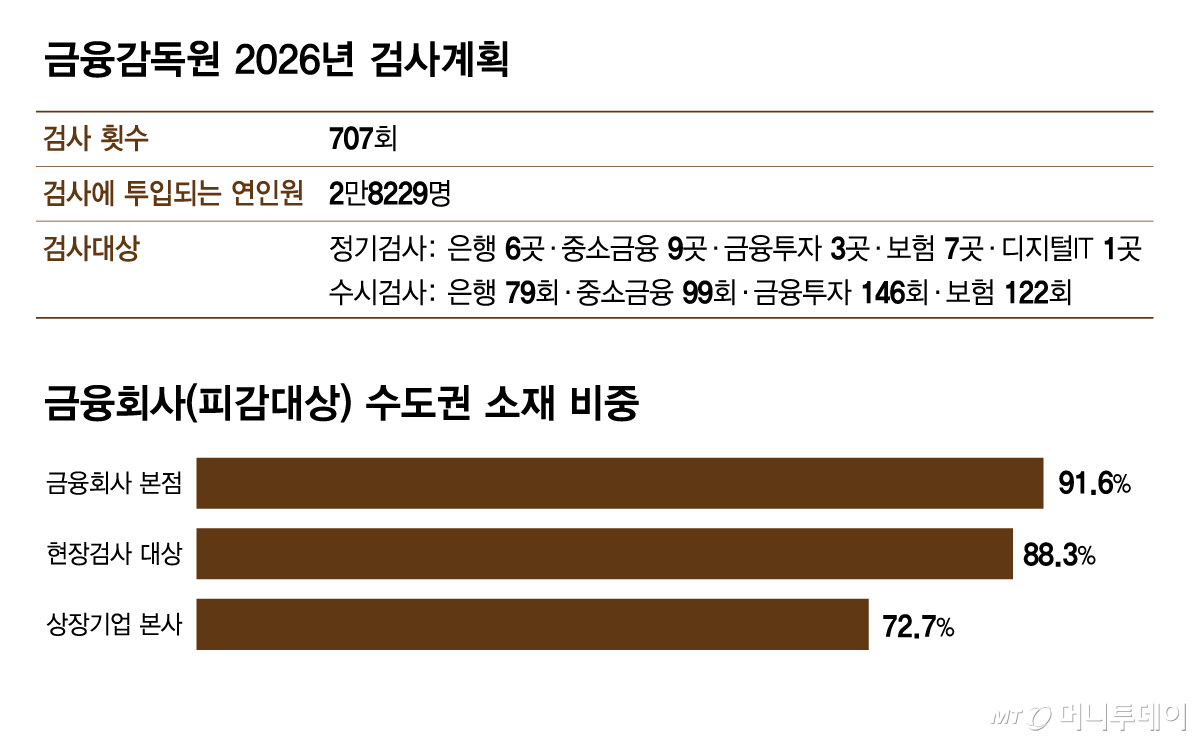
According to the financial sector on the 18th, if the Financial Supervisory Service, headquartered in Seoul Yeouido, relocates to local areas such as Sejong City, practical concerns are being raised that it will be difficult to properly carry out its core duties of inspecting and supervising financial companies. The Financial Supervisory Service plans to conduct a total of 707 inspections this year. Regular and unscheduled inspections are conducted targeting banks, securities firms, insurance companies, credit card issuers, mutual financial institutions, and savings banks, with the number of Financial Supervisory Service personnel involved reaching 28,229 (calculated as person-days).
If the Financial Supervisory Service relocates to Sejong, inspection personnel nearing 30,000 annually would need to make 'reverse business trips' to Seoul or the metropolitan area. This is because 91.6% of financial company headquarters are located in the metropolitan area, and 88.3% of financial companies subject to on-site inspections by the Financial Supervisory Service are also in the metropolitan area. Narrowing the scope to the capital market, 72.7% of listed company headquarters are distributed in the metropolitan area.
Financial Supervisory Service employees must go on field assignments to the respective financial institutions for up to a month or longer when conducting regular inspections. In some cases, more than 20 personnel are deployed at once based on bank standards. If the Financial Supervisory Service relocates to Sejong, dozens of personnel would need to undertake long-term business trips to Seoul for over a month per single regular inspection.
Business trip expenses could also become 'unrealistic' and balloon. According to the Financial Supervisory Service's internal regulations, daily allowances for inspection business trips, excluding transportation costs, are around 150,000 won. Of this, accommodation costs range from 80,000 to 100,000 won depending on the region. This amount is, of course, based on the premise of local area business trips. If the destination is Seoul rather than a local area, accommodation and stay expenses would need to be increased further. Assuming 30,000 personnel make business trips to Seoul annually, an additional cost of 30 thousand won to 4 billion won would be incurred. Over a 10-year period, this could amount to hundreds of billions of won.
Relocation costs could also be higher than for general institutional investors. This is because their main business involves the sensitive and complex financial sector. Looking at the case of the Ministry of Oceans and Fisheries, which completed its headquarters relocation from Sejong City to Busan last year, direct moving costs were reported to be approximately 118.9 billion won. The number of Ministry of Oceans and Fisheries headquarters staff was around 600 to 700 people. In contrast, the Financial Supervisory Service has about 2,200 employees, roughly three times that number. While direct comparison is difficult, the financial sector analyzes that relocation costs would require around 300 billion won, with additional costs for IT facility relocation potentially reaching hundreds of billions of won.
Relocation costs in the trillions of won fall on financial companies; concerns over 'blind spots' in financial consumer protection
The relocation of financial authorities places a heavy burden primarily on financial companies. The Financial Services Commission and the Financial Supervisory Service are responsible for licensing and permitting financial institutions. Financial companies would need to frequently travel to local areas to obtain licenses, inevitably leading to severely reduced operational efficiency. Moreover, costs amounting to hundreds of billions of won due to relocation will ultimately have to be shouldered by financial companies. The Financial Supervisory Service operates as a non-capital special corporation (other public institutional investor), and the supervisory contribution fees paid annually by financial companies, totaling about 350 billion won, account for 70% of its budget.
It also runs counter to financial consumer protection. 81.4% of financial complaints are concentrated in the metropolitan area. Financially vulnerable groups, including the elderly, have historically filed complaints by visiting the Yeouido Financial Supervisory Service complaint center; however, relocation to local areas raises concerns that 'blind spots' could emerge from a consumer protection perspective.
The government plans to finalize and announce plans for the relocation of public institutional investors as early as this month or at the latest within the year. However, it is reported that when selecting targets for relocation, the functional efficiency of each institutional investor following relocation will be an important consideration. Financial Supervisory Service Chairman Lee Chan-jin mentioned in a press conference last March: "It is the reality of finance that everything is concentrated in the Seoul metropolitan area," and added, "It is difficult to imagine leaving the field and going anywhere else."

 in FINANCE
