

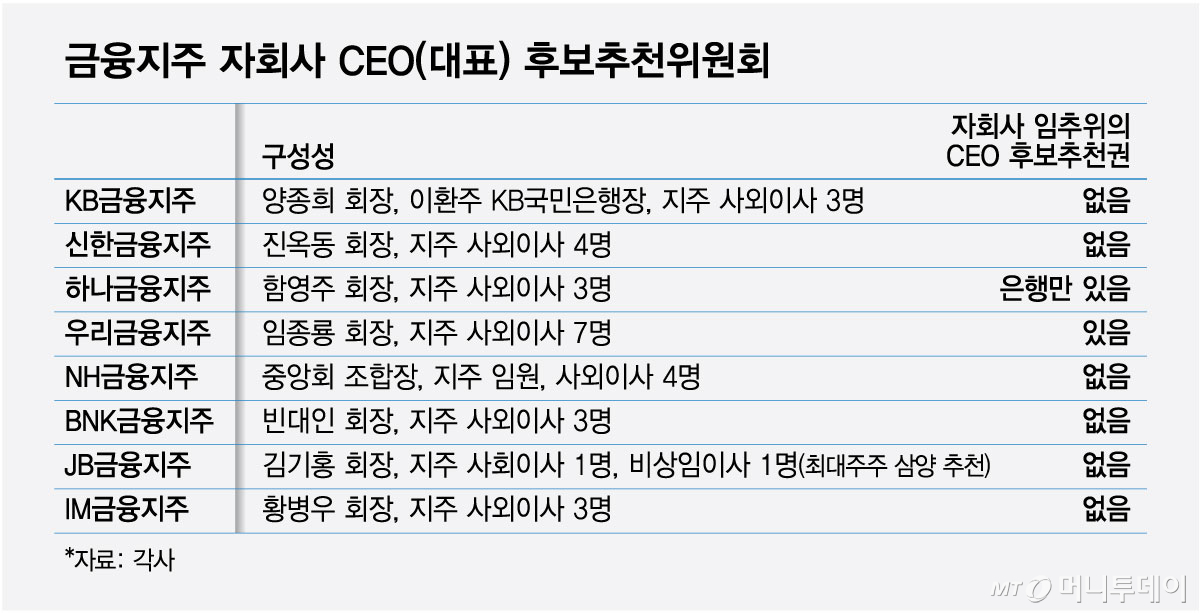
Financial holding companies are considering a plan to grant the right to recommend CEO candidates to the executive nomination committees (nomination committees) of their subsidiaries, such as banks. This comes just one day after Lee Chan-jin, head of the Financial Supervisory Service, publicly criticized the inadequate succession procedures for CEOs of financial holding company subsidiaries. The move aims to actively reflect the opinions of independent directors at banks during the appointment process of bank presidents and could serve as a check on Ji Ju (Chairman)'s personnel authority. It is expected to influence the appointment procedures for presidents of the five major commercial banks, which will begin this month.
One day after pointing out "inadequate management succession procedures," KB, BNK, and Shinhan Financial Holdings review granting CEO candidate recommendation rights to subsidiary nomination committees
According to the financial sector on the 16th, KB Financial Holdings, Shinhan Financial Holdings, and BNK Financial Holdings are considering a plan to allow their subsidiaries' nomination committees, composed of independent directors, to directly recommend CEO candidates when appointing CEOs. For example, when selecting a bank president, the bank's independent directors would directly recommend the candidate for the position.
This is interpreted as a response to Lee, head of Lee Chan-jin (Director), who criticized the inadequate management succession procedures for CEOs of financial holding company subsidiaries and publicly warned against personnel decisions based on "close personal relationships" or "factions" with the chairman. It is reported that President Lee will hold a meeting with financial holding company chairmen on the 23rd to convey directives for improving corporate governance.
Currently, in most financial holding companies, management succession procedures proceed in a manner where Ji Ju (Chairman)'s intentions are strongly reflected when appointing subsidiary CEOs. The subsidiary representative director candidate nomination committee (sub-committee), composed of some or all independent directors from the chairman and shareholders, unilaterally recommends the subsidiary CEO candidate. The subsidiary's executive nomination committee then assesses suitability before the board of directors and shareholders' meeting make the final appointment.
KB Financial Holdings recommends group company CEO candidates through its sub-committee, consisting of Yang Jong-hui (Chairman), Lee Hwan-ju, president of KB Kookmin Bank, and three independent directors from the holding company. Shinhan Financial Holdings also has five members, including Jin Ok-dong (Chairman) and four independent directors from the holding company, decide on subsidiary CEO candidates. Although financial authorities established best practices for corporate governance in 2023 and called for strengthening the role of subsidiary executive nomination committees, most recommendations were not implemented.
Among financial holding companies, only Woori Financial Holdings has granted candidate recommendation rights to its subsidiary executive nomination committee. However, even at Woori Financial, the subsidiary's nomination committee has not exercised this right. Hana Financial Holdings began granting candidate recommendation rights to its subsidiary executive nomination committees for banks only starting in 2024. NH NongHyup Financial and iM Financial Holdings do not grant candidate recommendation rights but instead have bank presidents from Lee Sa-hoe (Chairman) attend the sub-committee meetings.
Impact on appointment procedures for presidents of five major commercial banks beginning this month.. "Who would listen to a chairman without personnel authority?"
Following President Lee's warning, KB Financial, Shinhan Financial, and BNK Financial are highly likely to shift in the future toward having their subsidiary executive nomination committees recommend candidates. In fact, it has been confirmed that some holding companies are already considering plans to significantly transfer personnel authority for appointing subsidiary CEOs to their subsidiary boards of directors.
The terms of office for presidents of the five major banks—KB Kookmin Bank, Shinhan Bank, Hana Bank, Woori Bank, and NH NongHyup Bank—are set to expire simultaneously by the end of this year. Accordingly, financial holding companies will begin appointment procedures to select next-generation bank presidents from mid-month. If subsidiary CEO candidate recommendation rights are introduced in this process, changes are expected in future succession patterns for bank presidents.
However, there is also no small resistance to granting candidate recommendation rights to subsidiary executive nomination committees. The argument is that excessive intervention in the subsidiary CEO personnel authority, which is an inherent right of Ji Ju (Chairman), could constitute overstepping one's bounds.
A financial sector official stated, "It is perhaps natural for a chairman to appoint someone they have worked with and coordinated closely with." However, they added, "But is it really the right approach to suddenly ask independent directors from outside to recommend candidates without properly understanding the candidate pool?" Another official pointed out, "Chairmen must retain personnel authority so that subsidiary CEOs can operate according to the chairman's management policies. If a chairman lacks personnel authority, who would listen to them? It could become difficult to pursue consistent group-wide policies."
Counterarguments also emerge that subsidiary executive nomination committees cannot function effectively as checks on Chu Cheon-gwon-i (Chairman)'s personnel authority. The claim is that there is no practical effect. Currently, most banks are 100% subsidiaries of financial holding companies. Since bank boards of directors are formed through shareholders' meetings, it is difficult to guarantee the independence of subsidiary executive nomination committees.

 in FINANCE
