

Financial holding companies are considering granting their bank subsidiary Executive Recommendation Committees (hereinafter referred to as "Executive Committees") the right to nominate CEO candidates. This comes just one day after Lee Chan-jin, Chief of the Financial Supervisory Service, publicly criticized the inadequate succession procedures for CEOs of financial holding company subsidiaries. The move is expected to influence the appointment process for presidents of the five major commercial banks starting this month.
According to the financial sector on the 16th, KB Financial Group, Shinhan Financial Group, and BNK Financial Group are reviewing plans to allow their subsidiary Executive Committees—composed of independent directors of the subsidiaries—to directly nominate CEO candidates when appointing a subsidiary CEO. This would mirror the current practice where independent directors of banks directly recommend bank president candidates during the selection process.
This is believed to be in response to yesterday (the 15th), when Lee, Chief of the Financial Supervisory Service, criticized the inadequate succession procedures for CEOs of financial holding company subsidiaries and publicly warned against personnel decisions influenced by "personal relationships" or "factions" with the chairperson. It is reported that Lee will hold a meeting with chairpersons of financial holding companies on the 23rd to convey key points for improving corporate governance.
Financial Supervisory Service Chief Warns of "Inadequate Succession Procedures" for Subsidiaries; Review Conducted Within a Day
Currently Applied to Woori and Hana Banks… Also Noted Excessive Chairperson Intervention
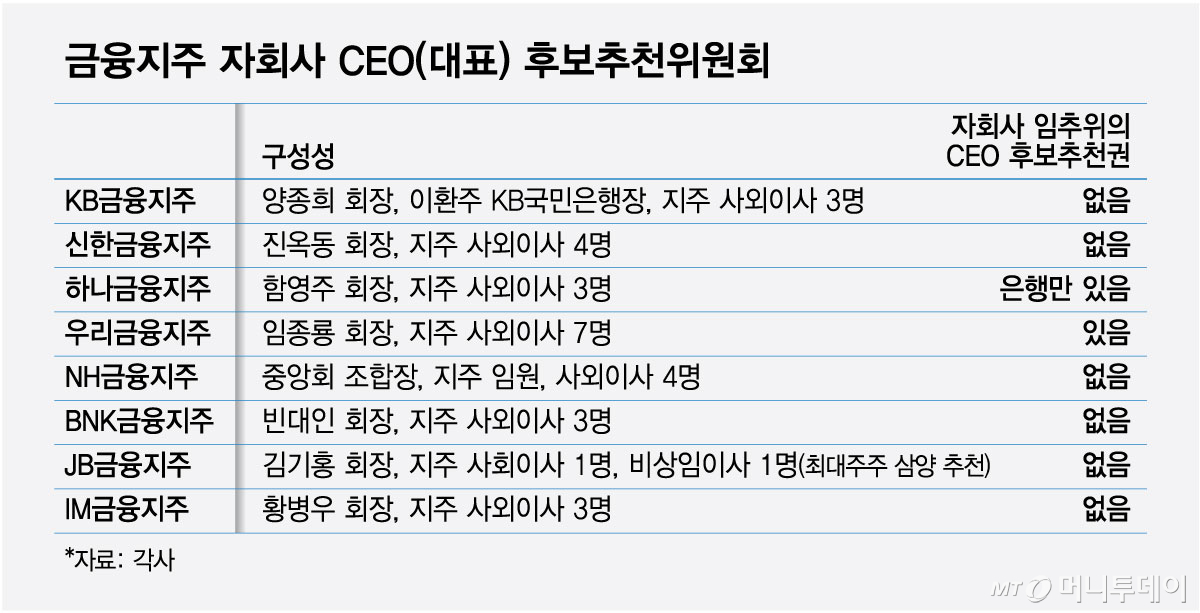
Currently, in most financial holding companies, the preferences of Ji Ju (Chairman) are strongly reflected when appointing a subsidiary CEO. The Subsidiary Representative Director Candidate Recommendation Committee (hereinafter "Subsidiary Committee"), composed of independent directors from both the chairperson and shareholders, nominates the subsidiary CEO candidate alone. The subsidiary Executive Committee then evaluates whether the nominee is suitable before the board of directors and shareholders' meeting make the final appointment.
KB Financial Group recommends group company CEO candidates through its Subsidiary Committee, which consists of Yang Jong-hui (Chairman), Lee Hwan-ju, President of KB Kookmin Bank, and three independent directors from the holding company—totaling five members. Shinhan Financial Group also determines subsidiary CEO candidates through a committee comprising Jin Ok-dong (Chairman) and four independent directors from the holding company. Although financial authorities established exemplary corporate governance practices in 2023 calling for strengthened roles of subsidiary Executive Committees, most recommendations were not implemented.
Among financial holding companies, only Woori Financial Group has granted nomination rights to its subsidiary Executive Committee. However, even Woori Financial Group has not utilized this right. Hana Financial Group began granting nomination rights to the Executive Committee only for its bank subsidiaries starting in 2024. NH Agricultural Cooperative Financial Group and iM Financial Group do not grant nomination rights but instead have the bank Lee Sa-hoe (Chairman) attend the Subsidiary Committee meetings.
In light of Lee's warning, it is highly likely that KB Financial Group, Shinhan Financial Group, and BNK Financial Group will shift toward having their subsidiary Executive Committees recommend candidates in the future. In fact, some holding companies have already been confirmed to be reviewing plans to significantly transfer personnel authority for appointing subsidiary CEOs to the subsidiary boards of directors.
However, there is also no small resistance to granting nomination rights to subsidiary Executive Committees. The argument is that this constitutes excessive interference in the chairperson's inherent authority over subsidiary CEO personnel decisions.
A financial sector official stated, "It is arguably natural for a chairperson to appoint individuals they have worked with and who have coordinated well together." They added, "Is it truly the right approach to ask independent directors from outside to recommend candidates without properly understanding them?" Another official pointed out, "If the chairperson holds personnel authority, subsidiary CEOs will operate according to the chairperson's management policies. Without personnel authority, who would listen to the chairperson? It could become difficult to pursue consistent group-wide policies."
Counterarguments also emerge that the subsidiary Executive Committee cannot function effectively as a check on Chu Cheon-gwon-i (Chairman)'s personnel authority. The claim is that it lacks practical effectiveness. Currently, most banks are 100% subsidiaries of financial holding companies. Since bank boards of directors are formed through shareholders' meetings, ensuring the independence of subsidiary Executive Committees is considered difficult.

 in FINANCE
