

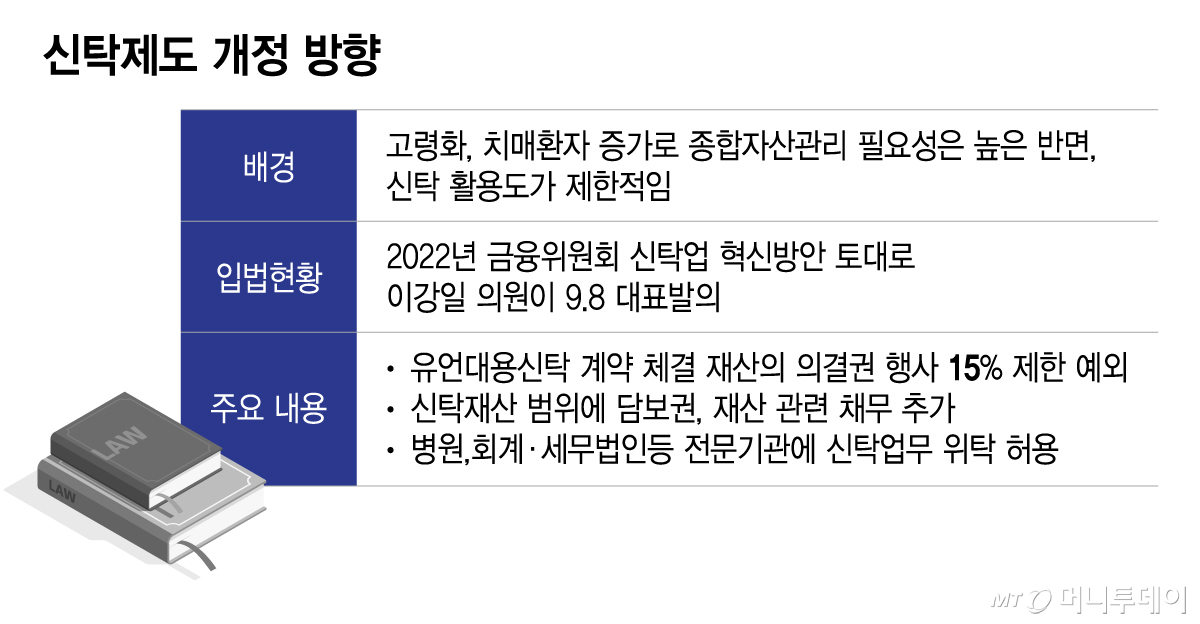
The restriction on exercising voting rights that has hindered family business succession trusts is expected to be lifted. While trust assets have been limited to exercising only 15% of voting rights, a legislative amendment creating an exception for testamentary substitutes is being pushed forward by the ruling party.
However, financial sector officials point out that the status of trust assets regarding inheritance tax exemptions remains unclear, necessitating concurrent amendments to tax laws.
According to financial industry sources on Sunday, Rep. Lee Kang-il of the Democratic Party of Korea, a member of the National Assembly's Political Affairs Committee, proposed an amendment to the Capital Markets Act to support business succession at small and midsize companies.
The bill would exempt shares placed in a trust used in place of a will from the current 15 percent voting rights limit when the votes are exercised according to the instructions of the settlor or beneficiary.
This content was included in the Financial Services Commission's trust law innovation plan released in 2022. Although People Power Party member Kim Sang-hoon proposed it as a lead sponsor in 2024, no progress was made.
This time, legislation is being pushed forward centered on ruling party members of the ruling party. Recently, the Financial Supervisory Service has begun collecting data on voting rights exercise status from financial institutions, and legislative momentum is expected to increase following the national audit.
A testamentary substitute is a product where account holders entrust their accumulated assets to a bank in advance, delegating fund management through posthumous inheritance.
If heirs are minors or face immediate difficulties in inheriting business control, they can designate individuals to exercise voting rights on behalf of the company by placing corporate shares in trust. With growing necessity for generational succession among SMEs (small and medium-sized enterprises), more people are turning to testamentary substitutes.
The problem is that even if 100% of corporate shares owned by a bank are placed in trust, full exercise of voting rights remains impossible. This is because current laws restrict voting rights acquired through trusts to 15% to prevent indirect share acquisitions.
In particular, since ordinary resolutions typically require 25% of total issued shares (one-fourth), voting rights restrictions are considered a major obstacle for succession trusts. For example, if a company has a largest shareholder holding 60% and a second-largest shareholder holding 40%, and the largest shareholder places their 60% stake in trust, the settlor can only exercise 15% of voting rights. This effectively changes the largest shareholder status.
Consequently, trust utilization rates have been low, with trusts often limited to only the 15th% of shares that can be exercised. Therefore, if this amendment passes, it is expected that voting rights restrictions during business succession will be lifted, significantly increasing the utility of testamentary substitutes.
A mid-sized bank official stated, "While inheritance-related disputes have increased, the utilization rate of family business succession trusts remains low." They added, "Especially if voting rights restrictions are lifted, major constraints in unlisted company succession trusts will be resolved."
Additionally, the amendment includes provisions to expand the scope of trust assets to cover collateral and debts, enabling various trust products. It also permits professional institutional investors such as hospitals, tax law firms, and patent law firms to delegate core trust business operations to trust operators.
However, some critics warn this could become a "half-hearted" reform. Currently, if an heir holds 40% of corporate shares (20% for listed companies) and manages the business for over 10 years, they can receive up to 6 billion won in tax deductions upon inheritance. The issue lies in whether the period during which assets are entrusted to a trust will be recognized as holding period.
To maintain consistency under tax law, it is argued that even when assets are placed in trust, they should still be considered owned by the settlor. Currently, both property tax and comprehensive real estate tax impose tax obligations on the settlor.
Ultimately, critics emphasize that concurrent amendments must address uncertainties regarding direct asset-linked tax deductions. A financial sector official remarked, "Even companies eligible for inheritance tax exemptions frequently receive consultations about placing businesses in trusts, but many ultimately avoid doing so due to fears of losing tax benefits." They added, "Significant concerns exist that entrusting assets under uncertain conditions could nullify hundreds of billions of won in tax savings."

 in FINANCE
