

The three internet-specialized banks are successively expanding into new lending markets amid total household loan regulations. Toss Bank has entered the final stages of work to launch home loans within this year, while KakaoBank has launched down payment installment loans for pre-sale apartments, entering the collective lending market. K bank plans to expand its corporate finance services, which currently focus on individual entrepreneurs, to include small and medium-sized corporations.
According to the financial industry on the 26th, Toss Bank began a closed beta test (CBT) related to home loans for its employees starting from the 16th, reviewing the entire process from loan application to collateral evaluation, approval, and disbursement. This marks the final stage of product development with the goal of launching home loans within this year.
The test targets not only apartments but also villas, including duplexes and multi-family homes. Unlike apartments, villas lack standardized market price information, making it relatively difficult to handle non-face-to-face collateral loans. Toss Bank is verifying a system that uses an Automated Valuation Model (AVM) to assess the collateral value of villas and calculate loan limits. However, the official launch date and actual eligible properties will be finalized based on test results and other factors.
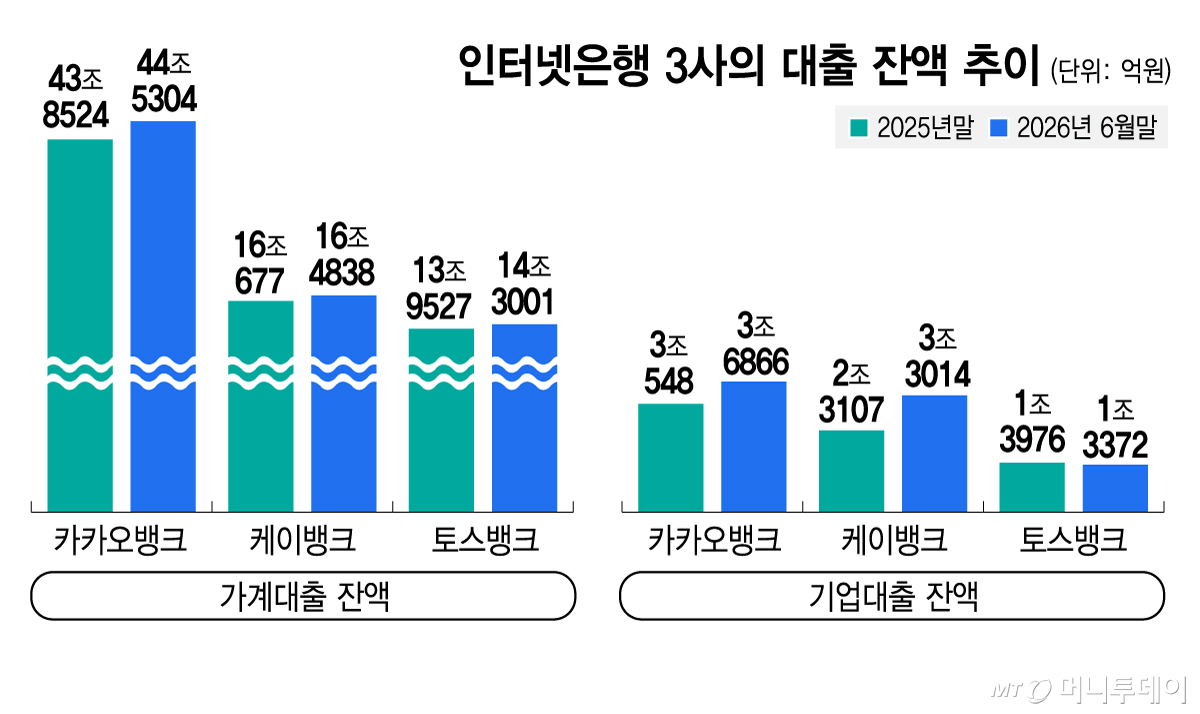
Toss Bank currently provides credit without general home loans, focusing primarily on personal loans and rental deposit loans. In particular, as of the end of June, the balance of rental deposit loans reached 4.5064 trillion won, a 47% increase from one year prior. Meanwhile, total lending grew only 3.3% to 15.6373 trillion won during the same period. With the launch of home loans, it is expected that Toss Bank will diversify its lending structure, which has been concentrated on personal and rental deposit loans, into long-term collateral-backed loans.
KakaoBank, which already holds general home loan products, is expanding its household loan portfolio by launching down payment installment loans. Launched on the 16th as the first internet bank to do so, the target of these pre-sale apartment down payment loans includes 20 new apartment complexes—11 in the Seoul metropolitan area and 9 outside it—covering a total of 12,806 households under general sales standards.
This product launch is expected to provide KakaoBank, which has faced constraints on home loan growth due to household loan total regulations, with a new channel for expanding its lending portfolio. In particular, financial authorities decided last month on the 13th to manage collective loans, including down payment installment loans, separately from each bank’s household loan total targets, creating conditions for entering this new market.
K bank is focusing on expanding its corporate finance business. To broaden its scope from individual entrepreneur loans to include small and medium-sized corporation loans, it is building a non-face-to-face lending system and preparing with the goal of launching the service in 2027.
In fact, among the three internet banks, K bank shows the steepest growth in corporate loan balances. K bank’s corporate loan balance increased by approximately 991.4 billion won (42.9%), rising from 2.31 trillion won at the end of last year to 3.3014 trillion won as of the end of June this year. During the same period, KakaoBank’s corporate loan balance grew only 631.8 billion won (20.6%), from 3.0548 trillion won to 3.06866 trillion won, while Toss Bank saw a decrease of 60.4 billion won (4.3%), falling from 1.3976 trillion won to 1.3372 trillion won.
An official at an internet bank stated, “All three internet banks still have high dependence on household loans, so the performance of new products will determine the future direction of their lending portfolios.” He added, “Competition to secure new growth drivers amid household loan total regulations is expected to intensify further.”

 in FINANCE
