

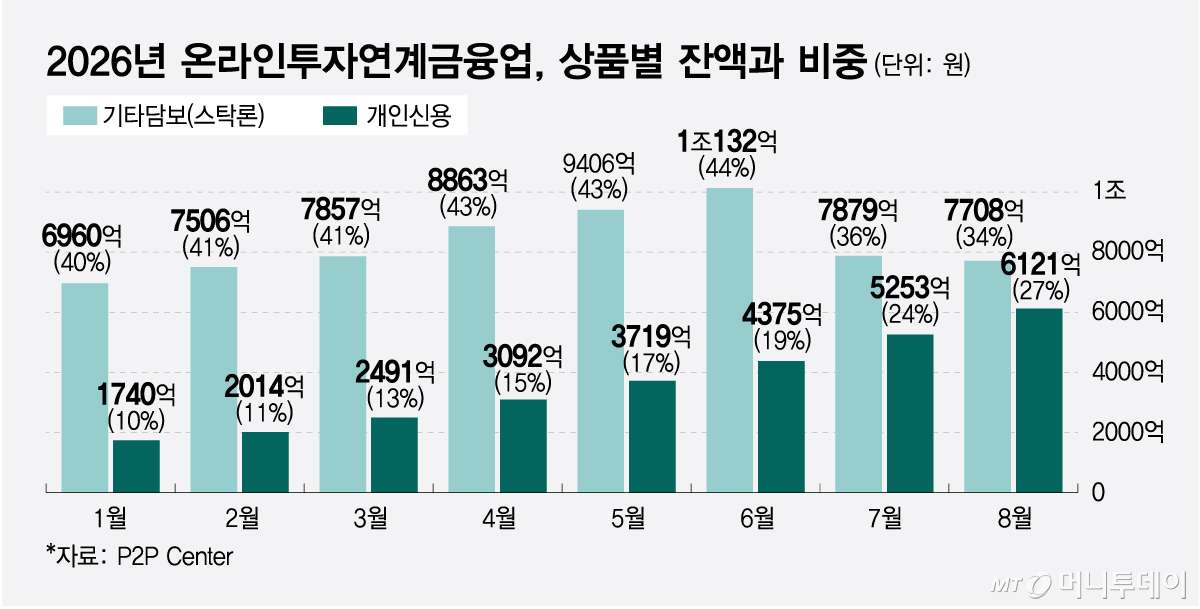
The OnLINE investment-linked finance (OnTU) industry is recovering its original purpose of providing mid-rate credit loans. Stock loan balances in the OnTU sector, which once exceeded 1 trillion won amid a stock market frenzy, have dropped by more than 230 billion won in just two months. Meanwhile, personal credit loan balances, which had drawn criticism from financial authorities for accounting for only 10% of the portfolio, are on the verge of surpassing 30%.
According to the financial sector on the 27th, as of last month, total outstanding loans from 46 OnTU companies amounted to 2.2672 trillion won, an increase of 527.1 billion won compared to January this year.
By product composition, 'other collateral' accounted for the largest share at 34%, or approximately 770.8 billion won. Other collateral is predominantly composed of 'stock loans,' which use stocks and cash held in securities accounts as collateral. The surge in stock investment enthusiasm during the first half of this year significantly increased the proportion of stock loans within the OnTU sector, and its impact continues to be felt.
However, outstanding loan balances under 'other collateral,' including stock loans, have decreased by more than 230 billion won over the past two months. As of June, other collateral (stock loan) balances reached 1.0132 trillion won, surpassing the 1st trillion won mark and accounting for 44% of the total. In July alone, the KOSPI index fell by 22.2%, leading to a sharp decline in stock loan balances across the OnTU sector alongside the steep drop in stock prices.
The financial authorities' strengthened regulation on stock loans also played a role. The Financial Services Commission (FSC) announced risk management measures last July, limiting new stock loan disbursements to within 30% of total linked loans and capping individual borrower limits at 1.01 trillion won.
The decline in stock loans has affected the ranking of OnTU companies. OnTU firm 'High Funding' had maintained its position as the industry leader based on outstanding loan balances since June last year, despite having a product portfolio consisting solely of stock loans. However, as stock loan balances plummeted, it lost the top spot to PFCT last month.
The reduced stock loan balances were offset by credit loans. The share of credit loans in OnTU products rose from 10% in January this year to 27% as of last month. Over the same period, credit loan balances increased from 174 billion won to 612.1 billion won. While other collateral loan balances fell by more than 230 billion won over the past two months, credit loans grew by 174.6 billion won.
This indicates that the OnTU industry is regaining its original purpose of providing mid-rate loans to individuals with medium-to-low credit ratings. Previously, the Financial Services Commission had criticized the sector for expanding primarily in collateral-based lending, such as real estate-backed loans, rather than credit loans, diverging from its founding mission.
The financial authorities aim to encourage the expansion of loans to medium-and-low credit individuals within the OnTU industry. To this end, the FSC recently announced institutional improvements, including the introduction of a 'Qualified OnTU Firm' system that will ease the burden of raising investment funds for designated firms. Additionally, linked investment finance will be expanded to include mutual financial institutions, and the scope of products will be broadened to cover credit loans for individual business owners.
An OnTU industry representative stated, "Personal credit loans have been steadily increasing since before, which is significant as it shows the industry is moving away from collateral-focused lending and finding a path toward growth through credit loans." They added, "The recent measures by the Financial Services Commission will also help promote the mid-rate lending that OnTU firms originally intended to offer."

 in FINANCE
