

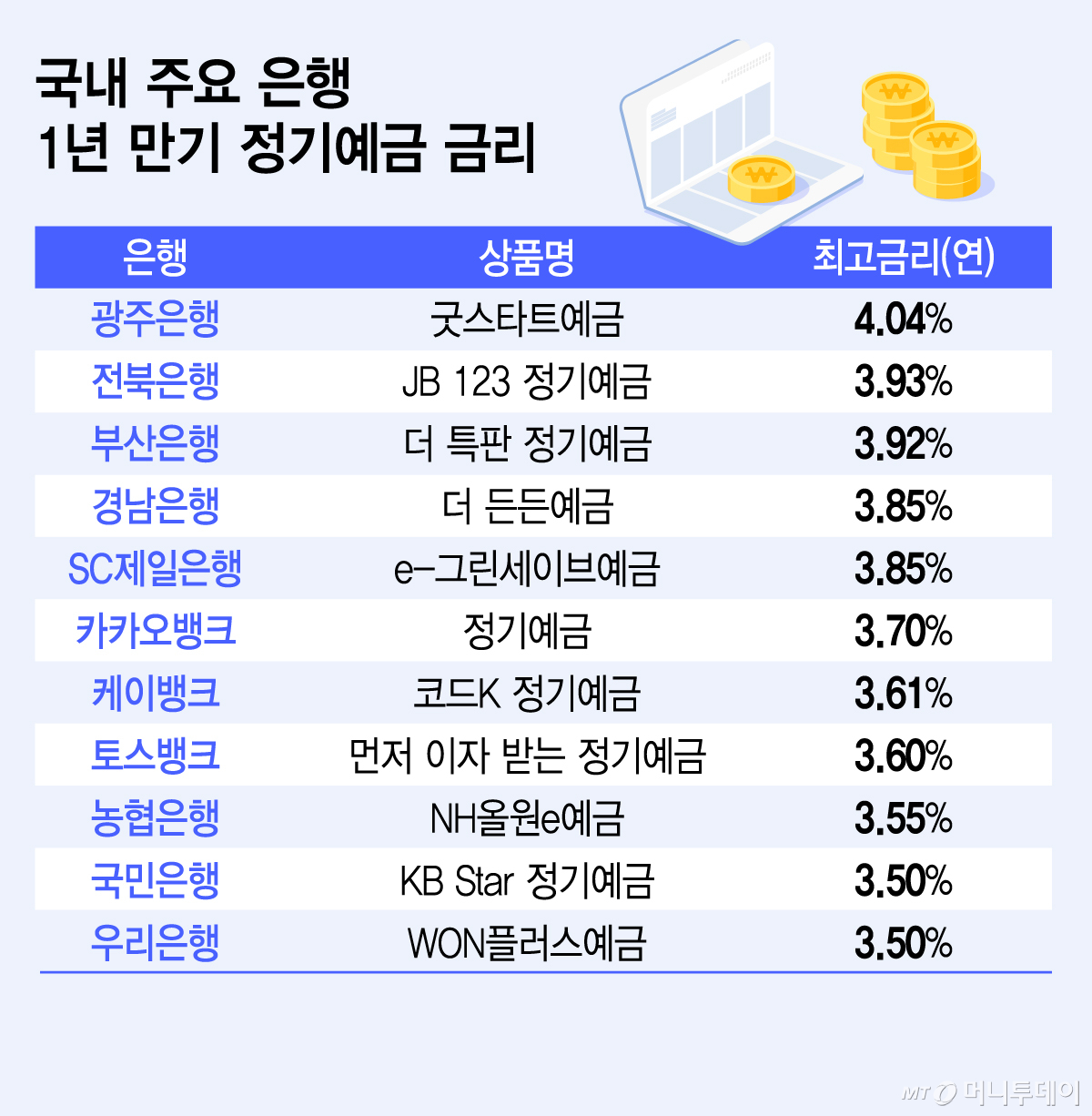
The reason banks are successively raising fixed deposit interest rates is that their need to secure funding from individual customers is growing. As volatile corporate funds have been withdrawn in large numbers, partly due to corporate tax payments, banks are raising deposit rates to secure relatively stable retail investor funds. The rise in deposit rates increases banks' funding costs and is expected to further push up loan rates in the future.
According to financial industry sources on the 29th, the balance of money market deposit accounts (MMDA) at the five major banks—KB Kookmin, Shinhan, Hana, Woori, and NH Nonghyup—stood at 121.3166 trillion won as of the 28th. The balance dropped from 133.0922 trillion won at the end of June to 118.3040 trillion won at the end of July, a decrease of approximately 14.8 trillion won in one month, and further fell to 117.3407 trillion won by the end of August. Although there has been some recovery this month, the balance remains about 12 trillion won lower than at the end of June.
MMDA is a representative low-cost deposit where companies park their short-term surplus funds. Typically, during corporate tax payment periods, companies withdraw funds from MMDA to pay taxes. In fact, it is known that trillions of won in corporate low-cost deposits left banks individually during July and August last month.
A senior official in the banking sector said, "Trillions of won in corporate low-cost deposits were withdrawn in line with the corporate tax payment period," adding, "To fill the gap left by these outflows and gather relatively stable retail investor deposits, banks have successively raised deposit rates."
While the balance of fixed deposits at the five major banks recently surpassed 1000 trillion won, and total bank deposit balances are increasing sharply, a significant portion of this increase is known to come from corporate funds. Consequently, it is explained that banks are raising deposit rates to attract retail investor funds, which have a higher tendency to be held until maturity.
The rapid rise in market interest rates is also influencing the increase in deposit rates. Following the impact of rising U.S. Treasury yields, the one-year bank bond yield rose by 0.411 percentage points (P) from a month earlier to 4.174% annually on the 28th. Not only are rising market interest rates being reflected in deposit rates, but from the banks' perspective, even if they raise the deposit rate by about 0.6%p based on a 3.5% annual fixed deposit, it remains a better funding source than bank bonds.
Furthermore, some banks are showing moves to proactively secure deposits in preparation for second-half funding demand. As the market highly anticipates an additional 0.25%P hike in the Bank of Korea's base rate in the second half, the intention is to raise funds before that to lower costs.
As deposit rates rise, it is known that inflows of retail investor funds into fixed deposits are also increasing. The balance of fixed deposits at the five major banks stood at 1009.4141 trillion won as of the 28th, an increase of 4.1822 trillion won from the end of August.
A rise in loan rates is inevitable due to the increase in deposit rates. The Cost of Funds Index (COFIX), which reflects the funding costs for bank deposits and savings, halted its upward trend in August, but there is a high possibility it will rise again once the successive increases in deposit rates by banks in September are reflected. If COFIX rises, the interest rates on floating-rate products for mortgage loans and jeonse (lump-sum rental) loans, which use it as a benchmark rate, will also follow suit.
Loan rates are already showing an upward trend. As of the 29th, the floating-rate mortgage loan rates at the five major banks were 4.46% to 6.29% annually, with the lower bound rising by 0.37%P compared to 4.09% to 6.38% two months ago. The decrease in the upper bound is due to NH Nonghyup Bank separately lowering its mortgage loan rates; for the remaining four major banks, both the upper and lower bounds of interest rates rose during the same period. Jeonse loan rates also jumped from 3.33% to 6.03% annually to 3.87% to 6.57% during the same period, with both the upper and lower bounds rising by 0.54%p.

 in FINANCE
