

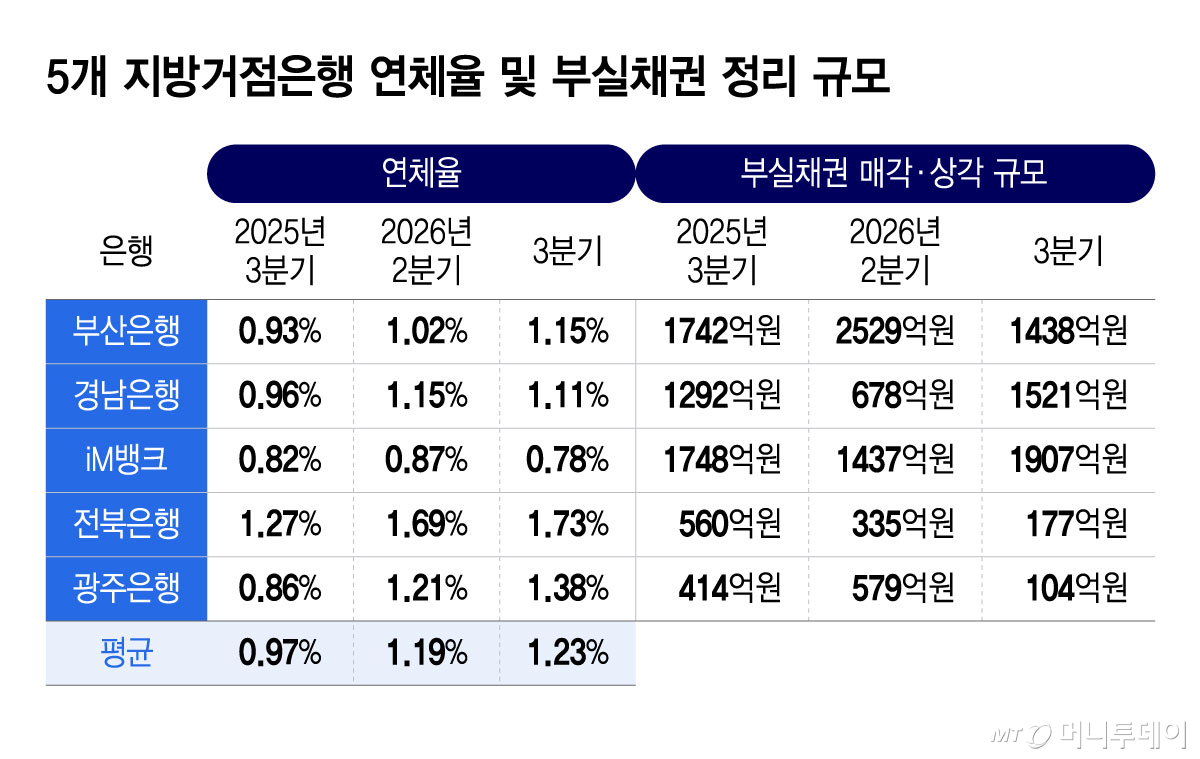
As the average delinquency rate of five regional banks soared to the 1.2% range, increased loan delinquencies among small and medium-sized enterprises (SMEs) and households in local areas are cited as the background. By bank, the direction of improvement in delinquency rates diverged. Banks that expanded the sale and write-off of non-performing loans (NPLs) managed to defend against a decline in soundness indicators, while banks with slower cleanup speeds saw their soundness deteriorate relatively.
According to financial industry sources on the 30th, the total delinquent assets of the five major regional hub banks—Busan Bank, Gyeongnam Bank, iM Bank, Jeonbuk Bank, and Gwangju Bank—reached 2.5404 trillion won in the third quarter, an increase of 117.1 billion won from the previous quarter. The average delinquency rate rose by 0.04 percentage points (P) to 1.23% compared to the previous period. It shows an upward trend from 0.97% a year ago.
By sector, the impact of increased delinquencies in household and small and medium-sized enterprise (SME) loan segments was significant. The average household delinquency rate recorded 1.44%, up 0.38 percentage points. Over the same period, the average SME delinquency rate was tallied at 1.48%, up 0.37 percentage points. Delinquent assets increased by 93.9 billion won in the household sector and 32.3 billion won in the SME sector compared to the previous quarter. Among corporate loan delinquent assets generated at these banks, 90% were concentrated in small and medium-sized enterprises (SMEs).
However, by bank, soundness indicators show differences. Busan Bank's delinquency rate rose by 0.13 percentage points to 1.15% from the previous quarter. Gwangju Bank rose by 0.17 percentage points to 1.38%, and Jeonbuk Bank increased by 0.04 percentage points to 1.73%.
On the other hand, delinquency rates improved at Gyeongnam Bank and iM Bank. Gyeongnam Bank was tallied at 1.11%, down 0.04 percentage points from the previous quarter. iM Bank recorded 0.78%, down 0.09 percentage points, falling below the 1st% line.
The NPL coverage ratio, which measures the provision reserve ratio against non-performing loans (NPLs), also showed a similar trend. Busan Bank's indicator retreated by 9.58 percentage points, while Jeonbuk Bank and Gwangju Bank fell by 1.51 percentage points and 10.54 percentage points, respectively. Meanwhile, iM Bank returned to 100% at 105.20%, the only one among the five banks to do so. Gyeongnam Bank was at 81.88%, still below 100%, but improved by 7.49 percentage points from the previous quarter.
The scale of non-performing loan cleanup determined the fate of soundness indicators. iM Bank sold or wrote off nearly 200 billion won worth of NPLs in the third quarter alone. This amount increased by 47 billion won compared to the previous period. The cumulative total was tallied at 504.4 billion won, surpassing last year's annual write-off and sale scale (499.1 billion won). Gyeongnam Bank's third-quarter write-off and sale scale was 127.9 billion won, an increase of 84.3 billion won from the previous quarter.
On the other hand, the cleanup speed slowed at the remaining banks. Busan Bank decreased by 109.1 billion won to 143.8 billion won compared to the previous quarter. Jeonbuk Bank and Gwangju Bank decreased by 15.8 billion won and 47.5 billion won, respectively.
As high interest rates persist, the scale of NPL sales and write-offs in the banking sector is expected to gradually increase going forward. However, regional banks are placed in relatively unfavorable conditions. While real estate collateral claims located in the metropolitan area are relatively easy to sell or recover, collateral claims related to local small and medium-sized enterprises (SMEs) may face difficulties in sale and recovery depending on the regional economy and real estate market conditions. According to an analysis of the NPL sale market by Samjong KPMG, the share of regional banks fell from 11.6% last year to 8.9% in the first half of this year. In contrast, the share of commercial banks increased from 52.2% to 54.1%.
A financial industry official said, "While there may be strategic differences by bank, due to the characteristics of regional banks, they hold many assets located in non-metropolitan areas, making recovery difficult, so a considerable amount must be processed through write-offs and sales," adding, "It is time for portfolio adjustment along with asset rebalancing by region, such as securing more metropolitan area assets."

 in FINANCE
