

Following its move into the capital goods sector, KakaoBank is also considering medium- to long-term mergers and acquisitions (M&A) in the credit card and securities industries. The bank aims to expand its non-banking businesses to achieve a return on equity (ROE) target of 15% by 2030.
However, the issue of major shareholder eligibility, intertwined with the ongoing trial of Kim Beom-soo, Kakao’s founder and largest shareholder, remains a variable in its business expansion plans.
Kwon Tae-hoon, chief financial officer (CFO) of KakaoBank, said during the Q3 earnings announcement conference call on Wednesday, “In addition to capital goods, we will approach M&A in the credit card and securities sectors from a medium- to long-term perspective. As the major shareholder eligibility issue has not been fully resolved, we will monitor the outcome of the upcoming trial while seeking possible opportunities.”
In particular, major shareholder qualification requirements pose an obstacle to entering the card industry. The Specialized Credit Finance Business Act requires major shareholders applying for a credit card business license to demonstrate sufficient capital contribution capacity, sound financial condition, and social creditworthiness.
Founder Kim was acquitted in the first instance of the trial over suspicions of market manipulation involving SM Entertainment, but an appeal is currently underway. As of the end of June, Founder Kim holds approximately 13.3% of Kakao’s shares as its largest shareholder, while Kakao holds approximately 27.2% of KakaoBank’s shares as its largest shareholder.
KakaoBank has already begun expanding into non-banking businesses through the acquisition of Maston Capital. In June, the bank signed a share purchase agreement to acquire 100% of Maston Capital and is currently awaiting approval from financial regulators. It plans to contribute approximately 150 billion won, launch new services such as used car installment financing in the first half of next year, and aim for an annual profit turnaround.
CFO Kwon said, “We will raise the ROE of the capital company to contribute to an overall increase in the bank’s ROE.” He added, “We will strive to achieve 10% in 2028, 12% in 2029, and 15% by 2030.” KakaoBank’s ROE for Q3 this year was 9.40%.
Expanding corporate loans and non-interest income was also presented as a pillar for achieving the ROE target.
Kwon said, “We will expand the share of corporate loans within our loan portfolio to 18% by 2030. We will raise the share of non-interest income in operating revenue to 40%.” As of Q3, the share of corporate loans and non-interest income stood at approximately 8% and 35%, respectively.
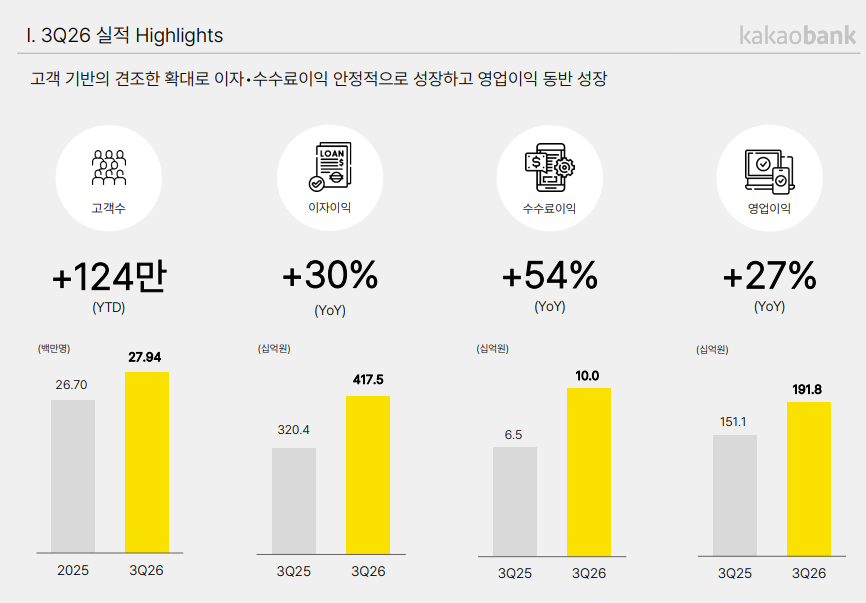
Performance this year continued its growth trend. Cumulative net profit for Q3 reached 469.8 billion won, a 25.2% increase from the same period last year.
This accounts for approximately 98% of the record annual net profit of 480.3 billion won achieved last year. Standalone net profit for Q3 was 141.7 billion won, up 27.2% from the same period last year and slightly higher than the previous quarter.
This was driven by cumulative interest income of 1.6409 trillion won, a 10.0% increase from the same period last year, and non-interest income of 888.3 billion won, up 6.4%. The net interest margin (NIM) rose by 2 basis points (1BP = 0.01 percentage point) to 2.15% in Q3 compared to the previous quarter.
Kwon noted, “In Q4, NIM is expected to slow slightly due to seasonal concentration of inflows into retirement pensions,” while adding, “The annual NIM is expected to rise by more than 10 basis points year-on-year, achieving our initial guidance.”
To defend its NIM, KakaoBank plans to maintain the share of low-cost deposits at over 50%. The share stood at 54.1% at the end of Q3, down from 56.7% in the previous quarter, but remained 17.2 percentage points higher than the banking industry average of 36.9%.
The bank is also broadening its customer base from domestic individuals to foreign nationals and corporations. “We launched services for long-term resident foreigners in October, and corporate banking is being prepared for launch targeting the first half of 2028,” Kwon said.
Based on improved performance, KakaoBank will also expand shareholder returns. The bank plans to raise its shareholder return ratio from 45.6% last year to 50% this year.

 in FINANCE
