

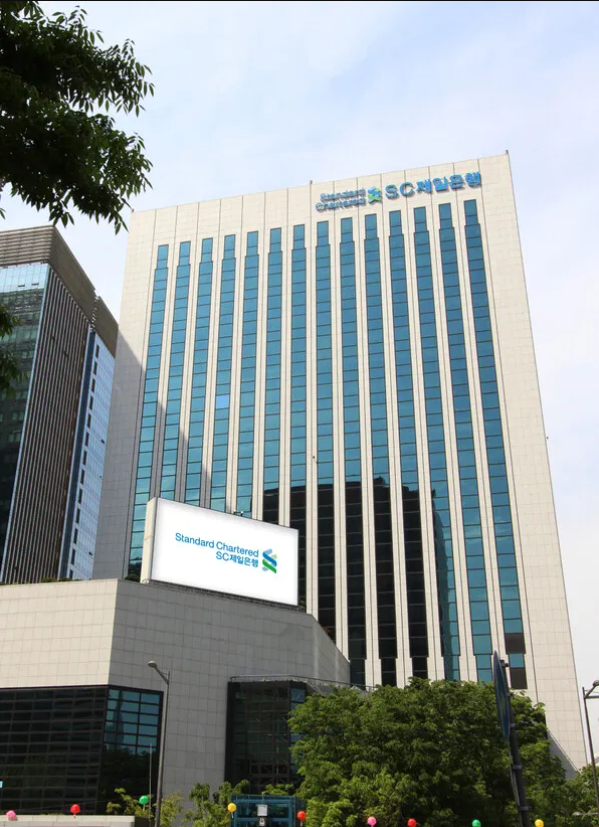
Standard Chartered Bank Korea posted a net profit exceeding 500 billion won through the third quarter of this year, resuming its interim dividend for the first time in three years. Strong performance in the wealth management (WM) and foreign exchange derivatives segments drove the results. While loans increased, centered on corporate banking, the delinquency rate and non-performing loan ratio rose.
Standard Chartered Bank Korea announced on the 13th that its cumulative consolidated net profit for the third quarter of this year reached 506.2 billion won, a 66.5% increase from the same period last year (304 billion won).
Non-interest income led the results, rising 54.2% to 418.5 billion won from 271.4 billion won in the same period last year. This was influenced by strong performance in the wealth management segment due to an increase in high-net-worth clients and a booming stock market, as well as expanded earnings in the foreign exchange derivatives segment.
Cumulative interest income for the third quarter was 942.4 billion won, up 3.7% from 908.9 billion won in the same period last year. Although the cumulative net interest margin (NIM) fell by 0.27 percentage points (p) from 1.44% to 1.17%, the increase in loan volume supported interest income.
Total loans as of the end of September were 44 trillion 405.3 billion won, a 1.4% increase from the same period last year (43 trillion 774.3 billion won). This was due to increased funding demand from corporate banking clients. Consolidated total assets also rose 24% to 117 trillion 469 billion won from 94 trillion 715.8 billion won in the same period last year.
However, standalone net profit for the third quarter decreased by 14.3% to 81.8 billion won from 95.4 billion won in the same period last year. This is interpreted as being due to non-interest income falling 19.2% from 65.5 billion won to 52.9 billion won, and corporate tax expenses rising 29.3% from 31.7 billion won to 41 billion won.
Asset quality indicators also deteriorated. As of the end of September, the delinquency rate rose by 0.19%p to 0.64% from 0.45% in the same period last year. The non-performing loan ratio also increased by 0.20%p from 0.54% to 0.74%. The scale of non-performing loans grew by 40.1% from 234.3 billion won to 328.2 billion won. The allowance for credit losses coverage ratio against non-performing loans fell by 29.35%p from 151.88% to 122.53%.
Profitability indicators improved. Return on assets (ROA) was 0.58%, and return on equity (ROE) was 12.06%, up by 0.14%p and 4.74%p, respectively, from the same period last year.
Total expected credit losses and other provisions were 101.4 billion won, an 11.1% increase from 91.3 billion won in the same period last year. This reflected additional accruals for expected credit loss provisions to prepare for risks related to conflicts in the Middle East region. Selling, general, and administrative expenses increased by 2.7% to 732.9 billion won due to rising operating costs from wage and price inflation.
Standard Chartered Bank Korea resumed its interim dividend amid improved performance. The board of directors resolved on the 12th to pay an interim dividend of 150 billion won. This is the first time since November 2023, when a 200 billion won dividend was paid. The dividend per share is 571 won, with the record date set for the 26th and the payment date scheduled for the 10th of next month. Following the dividend, the BIS total capital adequacy ratio (CAR) and Common Equity Tier 1 (CET1) ratio recorded 20.28% and 17.83%, respectively.
An official from Standard Chartered Bank Korea stated, "Based on stable financial performance, we plan to enhance shareholder value and strengthen the social role of finance," adding, "We will continuously seek financial support measures that align with the spirit of inclusive and productive finance, contributing to the sustainable growth of customers and businesses."

 in FINANCE
