

[For more diverse corporate information on the startups mentioned in this article, please visit the Unicorn Factory Big Data Platform 'Data Lab'.]
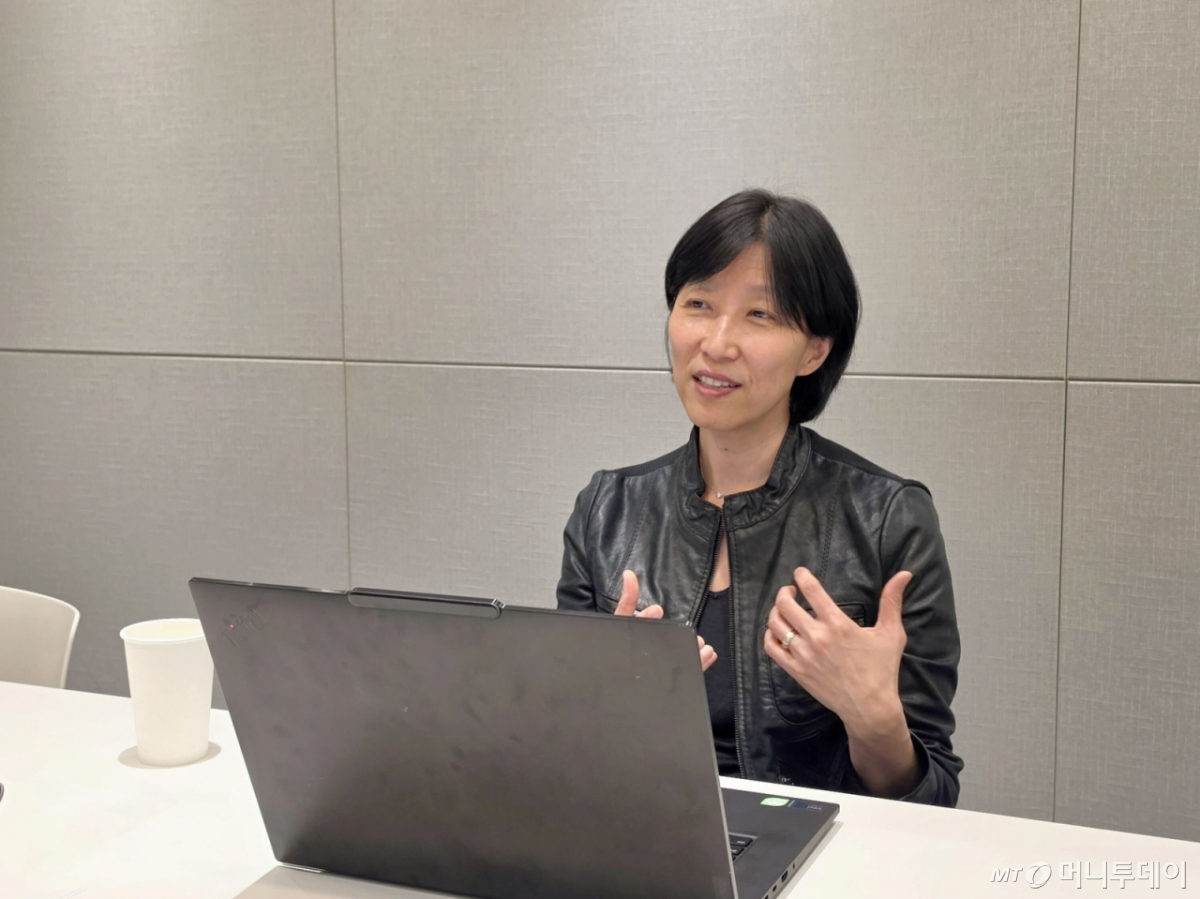
"When AI learns from data it generates itself, a phenomenon known as 'model collapse' occurs, where the quality of outputs rapidly deteriorates. Ultimately, only when 'Primary Data' obtained directly from real people is incorporated to calibrate for reality can AI technology deliver true value."
Hwang Hee-young, CEO of OpenSurvey, explained as follows regarding why data obtained from people is important in the AI era. As AI becomes more advanced, paradoxically, the value of unique data obtained directly from people grows even greater, according to Hwang (CEO).
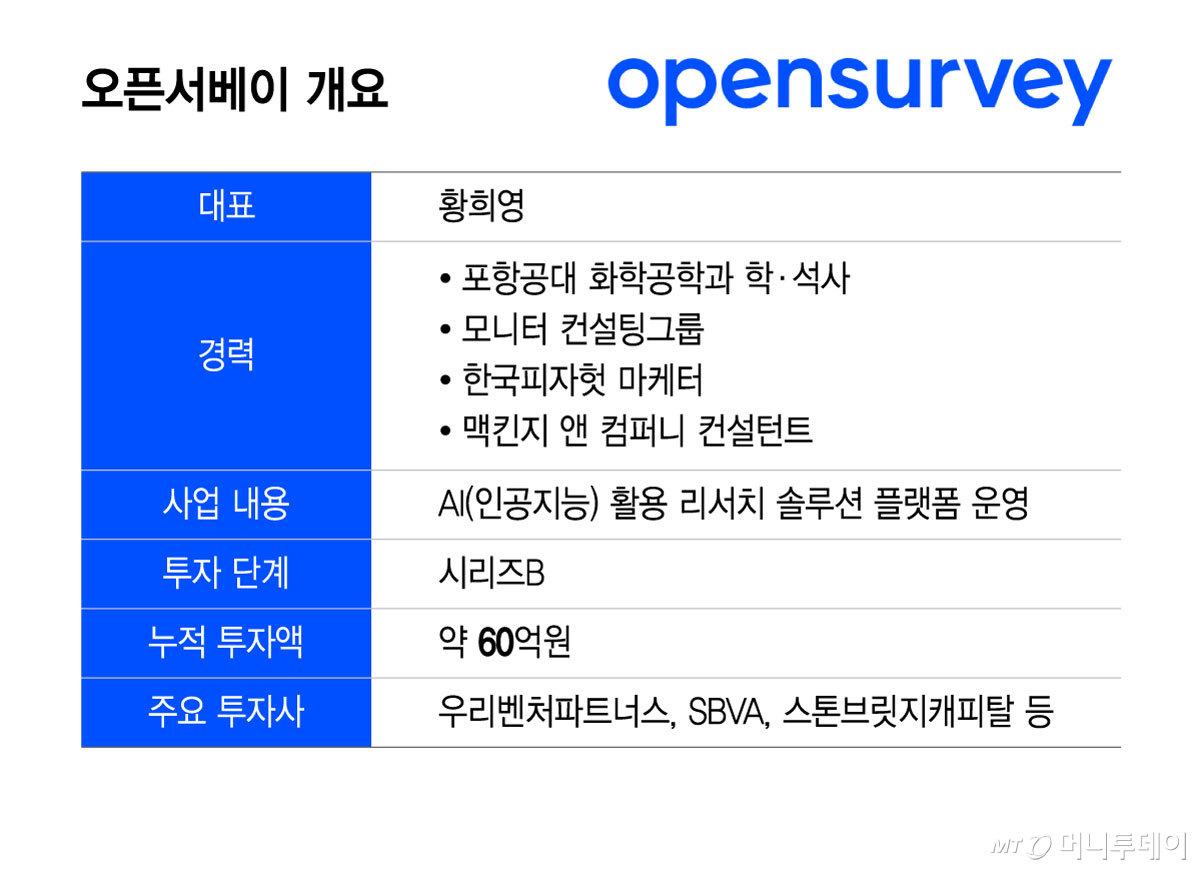
Hwang (CEO) stated, "Collecting data to understand what consumers want and what inconveniences they face to improve products and services has not changed significantly from the past. However, thanks to advancements in AI technology, we have entered an era where data can be interpreted more objectively and intuitively." OpenSurvey is a B2B (business-to-business) solution company that helps companies easily collect, analyze, and utilize survey data gathered via mobile and online channels.
Partnering as 'Data Assets' to Internalize Corporate Research
Hwang (CEO) is the 'second founder' of OpenSurvey, which started as ID Incubator in 2011. ID Incubator was established by Kim Dong-ho (CEO), who also re-founded Korea Credit Data. Hwang (CEO) joined as CPO (Chief Product Officer) in 2015 and was promoted to CEO in 2016 following discussions with Kim (CEO). Subsequently, through a management buyout (MBO), he acquired shares over six years to become the largest shareholder.
He changed ID Incubator's name to OpenSurvey and led its 'second founding.' A marketing expert from McKinsey, he spearheaded the pivot to a subscription-based B2B data platform and advanced the process of data analysis and insight generation—previously performed by humans—to an AI-driven level. Through AI trained on over a decade of accumulated research cases and expert feedback, the company also implemented technology that automatically generates questionnaires at an expert level when users simply input their objectives.
OpenSurvey highlights the 'internalization of corporate research' as its core value. Hwang (CEO) explained, "Even large clients conducting over 120 surveys annually are now designing and executing their own surveys within the platform without separate outsourcing, allowing them to quickly grasp results." He added, "As internalization of research spreads, recurring revenue based on subscriptions is also being maintained stably."
This subscription-based research internalization is leading to tangible business results for companies that have adopted it. Yuhan Kimberly applied the solution to its own brand mall 'MomQ,' expanding the frequency and scale of customer data collection by up to five times, which enabled it to successfully improve its flagship product, Huggies diapers.
Socar supplemented offline customer experiences, which were difficult to grasp through app logs alone, with surveys and integrated them with its internal CRM. It then executed customized message strategies for each customer segment, resulting in a 117% increase in reservation conversion rates.
Overcoming AI Limitations with Primary Data
Regarding the current hot topic in the research industry, AI-based 'virtual panels,' Hwang (CEO) pointed out clear limitations and defined their proper usage. He stated, "Utilizing AI panels offers significant advantages in R&D (research and development) efficiency, particularly regarding costs." However, he noted, "Since responses from virtual consumers generated by assigning specific personas to AI eventually converge toward a mathematical average, this represents a limitation as it underrepresents the complex diversity of the real world."
The limitation of virtual panels is that during the alignment process to ensure AI technology does not harm humans, they exhibit a strong 'good respondent bias,' tending to provide only socially desirable answers. Hwang (CEO) said, "Only when data from actual human responses is included for calibration can results be utilized without disconnecting from reality."
To address the shortcomings of 'virtual panels' that apply fabricated personas, OpenSurvey is advancing its 'synthetic panel' function, which predicts based on past response data. He remarked, "Creating a universal virtual panel capable of answering all questions is currently unrealistic in terms of technical reliability." He added, "OpenSurvey plans to provide customized synthetic panels with minimal distortion by combining the data it has accumulated with its statistical interpretation capabilities."
OpenSurvey also plans to introduce a feature where an AI engine directly interprets data based on natural language and provides answers. Furthermore, building on product advancements, it aims to accelerate global expansion, focusing primarily on the Asia-Pacific (APAC) market.
[MoneyToday startup media platform Unicorn Factory]

 in FUTURE

